Pip Value Calculator for All Forex Pairs (Formula + Free Tool)
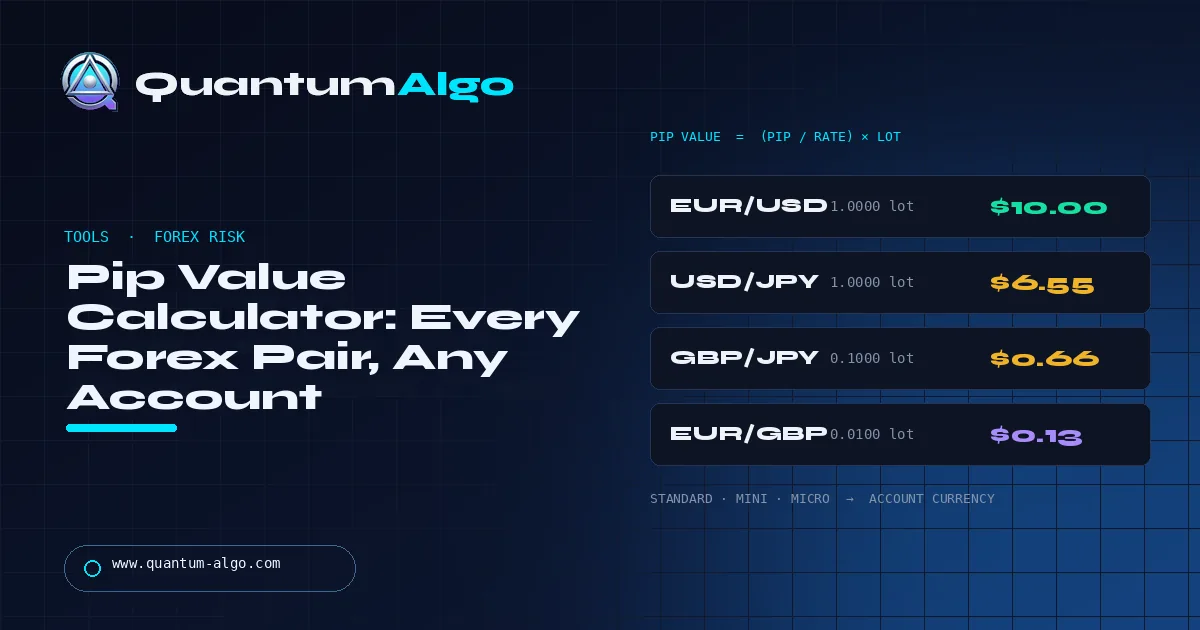
Pip value = units traded × pip size, then converted into your account currency. On a USD account, one standard lot of EUR/USD is $10 per pip, but USD/JPY at 156.00 is about $6.41 and a cross like GBP/JPY needs a second conversion. Use the calculator below to get the exact figure before you size a stop.
Every position-size mistake I have reviewed in a trader’s journal started with a wrong pip value — usually the “$10 per lot” shortcut applied to a JPY pair or a cross. This guide gives you the formula, the conversion rules that trip people up, worked examples for USD, EUR and CHF accounts, and a calculator that turns the number into stop risk and maximum units. Pip value is the bridge between a chart level and a cash loss; Quantum Algo’s free indicators help you find the level, and this page makes sure the cash side is right.
Indicators that prove themselves in public.
One engine, four precision tools — the Gold (XAU) Scalper, the institutional Gravity Zone, the Zeno momentum Oscillator, and Zeno Stocks for equities.
Why is pip value not always $10 per lot?
The familiar rule “one standard lot equals about $10 per pip” is only true for many USD-quoted major pairs when the position is 100,000 base-currency units and the account is denominated in USD. It is not universal. Pip value changes with position size, quote currency, exchange rate, contract specification, and account currency.
A reliable pip value calculator must answer four questions:
- What is the pair’s pip size?
- How many base-currency units are being traded?
- What is the pip value in the pair’s quote currency?
- How should that amount be converted into the account currency?
OANDA describes a pip as a standardized price increment and notes that the exact quote precision can vary. Most non-JPY pairs use 0.0001 as one pip; many JPY pairs use 0.01. Some brokers quote fractional pips, called pipettes, at one-tenth of a standard pip. Confirm the broker’s specification before using a result for a live order.
What is the pip value formula?
Let:
U= base-currency units traded;PIP= pip size, normally 0.0001 or 0.01;Q= current price, quoted as quote currency per one base unit;R= conversion rate between the pip-value currency and the account currency.
For a pair quoted directly in the account currency, pip value is:
pip value = U × PIP
Example: 100,000 EUR/USD units × 0.0001 = 10 USD per pip.
For a pair whose quote currency is not the account currency:
pip value in account currency = U × PIP × conversion rate
The conversion rate depends on whether you multiply or divide. If the pip value is in GBP and the account is USD, multiply by GBP/USD. If the available quote is USD/GBP, divide by USD/GBP. The calculator below makes that direction explicit rather than silently guessing.
For JPY-quoted pairs, the pip size is usually 0.01. Example: 100,000 USD/JPY units × 0.01 = 1,000 JPY per pip. If the account is USD, divide by USD/JPY or use the equivalent JPY/USD conversion.
How do lots and units change pip value?
“Lot” is a broker convention, not a universal law. Common forex sizing is:
| Label | Base units | Approximate pip value on a USD-quoted non-JPY pair |
|---|---|---|
| Standard lot | 100,000 | $10 per pip |
| Mini lot | 10,000 | $1 per pip |
| Micro lot | 1,000 | $0.10 per pip |
| Nano lot | 100 | $0.01 per pip |
The approximation assumes a quote currency of USD and a pip size of 0.0001. A broker may permit different contract sizes, CFDs may use a point value instead of a forex lot, and metals or indices may not follow forex conventions at all.
What is the difference between a pip and a pipette?
A five-digit EUR/USD quote such as 1.08427 displays a pipette in the fifth decimal place. One standard pip is 0.00010, so a move from 1.08420 to 1.08430 is one pip even though the platform displays ten fractional increments. A three-digit USD/JPY quote such as 156.327 usually displays a pipette in the third decimal place; one standard pip is 0.010.
Confusing points with pips can understate risk by a factor of ten. In a risk calculator, label the input clearly as pips, then convert to price distance using the pair’s pip size.
Worked examples: EUR/USD, USD/JPY, GBP/JPY and EUR/GBP
EUR/USD account in USD
Position: 0.50 standard lots = 50,000 EUR. Pip size: 0.0001.
Pip value: 50,000 × 0.0001 = $5 per pip.
If the stop is 24 pips, the gross stop risk is 24 × $5 = $120 before spread and commission.
USD/JPY account in USD
Position: 100,000 USD. Pip size: 0.01.
Pip value in JPY: 100,000 × 0.01 = 1,000 JPY.
At USD/JPY 156.00, the USD value is approximately 1,000 ÷ 156 = $6.41 per pip.
GBP/JPY account in EUR
Position: 20,000 GBP. Pip size: 0.01.
Pip value in JPY: 20,000 × 0.01 = 200 JPY.
Convert JPY to EUR using the current EUR/JPY quote: 200 ÷ EURJPY.
EUR/GBP account in USD
Position: 10,000 EUR. Pip size: 0.0001.
Pip value in GBP: 10,000 × 0.0001 = 1 GBP.
Convert GBP to USD by multiplying by GBP/USD: 1 × GBPUSD.
How do you turn pip value into position size?
Pip value becomes useful when it is connected to a stop. The position-size formula is:
units = maximum cash risk ÷ (stop pips × pip value per unit + costs per unit)
If the account is $5,000 and the risk limit is 1%, maximum cash risk is $50. With a 25-pip stop and a pip value of $0.10 per micro lot, estimated gross risk on one micro lot is $2.50. The theoretical maximum is 20 micro lots before costs; a prudent plan subtracts spread, commission, and slippage and may impose a smaller exposure cap.
For a cross pair, calculate the pip value in the account currency first. Do not size using the quote-currency value and hope the conversion is close enough when the account is small or the pair is volatile.
How do you calculate profit and loss from pips?
For a long trade:
gross P&L = (exit price − entry price) × units
For a short trade:
gross P&L = (entry price − exit price) × units
If you prefer pips:
gross P&L = pips moved × pip value
Then subtract commissions, spread paid at entry and exit, swaps/financing, and any conversion charges. A calculator that reports gross P&L without costs can look precise while overstating the amount available to the trader.
Why can pip value change during the trade?
For pairs where the quote currency differs from the account currency, the pip value changes as the conversion rate changes. This is why a position can have a slightly different cash-per-pip at entry and exit. Brokers may also calculate realized P&L using bid/ask prices and then convert the result at a specific rate. A retail calculator should show an estimate and identify the assumed conversion quote.
How do spread, commission and swap change the result?
The spread is paid through the difference between bid and ask. If EUR/USD has a 0.8-pip spread, a position is initially down roughly 0.8 pip times its pip value before price movement. Commission may be charged per side or per round turn. Swap or financing is applied according to the broker’s policy and can be material for positions held over rollover.
For a realistic trade plan, add:
- entry spread;
- exit spread or slippage;
- commission per unit or lot;
- overnight financing;
- conversion fee if the broker changes the settlement currency.
What about exotic pairs?
Exotic pairs may have wider spreads, less liquidity, and more volatile conversion rates. The mathematical formula still works, but the result is less stable and execution uncertainty is larger. A calculator should allow the user to enter the broker’s exact pip size and contract size rather than assuming all pairs are standard.
Which pip-value errors cost traders the most?
Using $10 for every standard lot. It fails on JPY and cross pairs.
Using the wrong direction for conversion. USD/GBP is not GBP/USD.
Confusing pips and points. Fractional quotes often show one extra digit.
Ignoring bid/ask. The chart’s last price is not always an executable price.
Assuming lot size. Verify the broker’s contract specification.
Ignoring account currency. A EUR account needs conversion even on USD-quoted pairs.
Treating leverage as a risk reducer. Leverage changes margin, not the cash loss per pip.
How does cross-currency conversion work?
The most dependable design starts with the pip value in the quote currency and then finds a conversion path to the account currency. If the quote currency equals the account currency, stop. If the market directly quotes quote-currency/account-currency, multiply. If it quotes account-currency/quote-currency, divide. If neither quote exists, use a two-leg path through a liquid intermediary such as USD or EUR and show the two rates to the user. Never hide a missing rate by returning zero.
For example, an AUD/NZD position in a GBP account produces pip value in NZD. If NZD/GBP is available, multiply by NZDGBP. If only GBP/NZD is available, divide by GBPNZD. If neither is available but NZD/USD and GBP/USD exist, convert NZD to USD and then USD to GBP. The rate timestamp should be shown because a delayed or stale conversion can make a small-account risk estimate materially wrong.
More examples: AUD, CHF and CAD accounts
AUD/USD in an AUD account
Trade 25,000 AUD/USD units. One pip is 0.0001, so the pip value is 2.50 USD. If AUD/USD is 0.6600, convert USD to AUD by dividing: 2.50 ÷ 0.6600 = 3.79 AUD per pip. The value is larger in AUD when the Australian dollar is worth less than one US dollar.
EUR/CHF in a CHF account
Trade 10,000 EUR. One pip is 0.0001, giving 1 CHF per pip because CHF is the quote currency. No additional conversion is required for a CHF account. A 32-pip stop is approximately 32 CHF before costs.
CAD/JPY in a USD account
Trade 50,000 CAD. One pip is 0.01, giving 500 JPY per pip. If USD/JPY is 156.00, the USD pip value is 500 ÷ 156 = 3.21 USD. If the broker uses a different contract multiplier or settles in another currency, use that specification instead.
Worked risk-budget example
Suppose a trader has a $12,000 account and permits 0.75% risk. The budget is $90. EUR/GBP is quoted at 0.8550 and the account is USD. A 15,000-unit position has a quote-currency pip value of 1.50 GBP. If GBP/USD is 1.2700, the account-currency pip value is $1.905. A 30-pip stop costs about $57.15 before costs, leaving room below the $90 limit. A 50,000-unit position would produce roughly $190.50 risk at the same stop and would exceed the plan.
The example shows why lot labels can be misleading. Two traders both saying “half a lot” may be using different contract sizes or account currencies. Units and conversion rates make the risk visible.
Why is margin not the same as risk?
Leverage and margin answer how much collateral the broker requires; pip value answers how much the position gains or loses as price moves. A high-leverage account can open a position with little margin while still carrying a large pip risk. A good calculator should show margin only if the broker’s leverage and contract rules are known, and it should keep margin visually separate from stop-loss risk.
When should you use a point-value calculator instead?
Indices, metals, energies, and many crypto CFDs may use points, ticks, contracts, or coin units rather than forex pips. A unified tool can support them, but the label should change. Ask for tick size and tick value, contract size, or coin quantity. Do not apply the 0.0001 or 0.01 pip convention to XAU/USD or an index unless the broker explicitly defines it that way.
What happens when the stop is widened?
Assume a $10,000 account, 0.5% maximum risk, and a 40-pip stop. The cash budget is $50. A 10,000-unit EUR/USD position at roughly $1 per pip risks about $40 before costs, so it fits with a small buffer. A 10,000-unit USD/JPY position may be near $0.64 per pip after conversion, risking about $25.60. The same “0.10 lot” label therefore creates different cash risk. Compare units, pip value, and stop distance—not lot labels alone.
If the stop is widened to 80 pips, the first position now risks roughly $80 and violates the budget. The correct response is to reduce quantity or skip the trade, not to hope that the stop will not be reached. This is why a pip calculator belongs beside a risk rule.
Pip value is units × pip size in the quote currency, converted to your account currency. The $10-per-lot shortcut only holds for USD-quoted, USD-account, non-JPY pairs. Get the value right first, then stop pips × pip value = cash risk, and risk budget ÷ risk per unit = maximum size — that order never changes.
◆ Interactive check
Do you know what one pip is worth?
Questions traders ask about pip value
On a 1,000-unit micro position in a USD-quoted non-JPY pair, one pip is approximately $0.10. For other quote or account currencies, convert the result.
Only in simple cases where the quote currency is the account currency. Otherwise it changes with the conversion rate.
No. Leverage changes the margin required to open a position. Pip value is driven by units, pip size, price, and currency conversion.
Not safely by default. Gold, indices, and CFDs use instrument-specific point values and contract sizes. Add a separate contract-specification mode rather than labeling everything a pip.
Multiply units by 0.01 to get yen per pip, then convert yen into your account currency: divide by USD/JPY for a USD account, or by EUR/JPY for a EUR account. Twenty thousand GBP/JPY units = 200 JPY per pip ≈ $1.28 at 156.00.
Most brokers quote gold to two decimals, so one “pip” (0.01) on one lot of 100 oz is $1, and a $1.00 move is 100 pips or $100. Check your broker’s contract size — see our dedicated XAUUSD pips guide for the full breakdown.
Yes whenever the quote currency differs from the account currency. A EUR account trading EUR/USD earns dollars per pip and must convert them at EUR/USD, so the pip value moves with the rate during the trade.
No. Pip value is what one pip is worth in cash; spread cost is the pips you pay to enter and exit multiplied by that value. A 0.8-pip spread on a $10-per-pip position costs about $8 round trip.
Zeno draws the stop and take-profit levels on the chart and applies built-in risk management to the signal; the pip-value maths here converts that stop distance into cash so your lot size respects your risk budget. QuantumBot sizes and executes automatically for subscribers.
References & Related Guides
Read next
- Best Forex Pairs to Trade: By Session, Spread, Volatility and Style
- Best Forex Brokers: How to Choose One That Protects Your Money (US, UK/EU/AU and Everywhere Else)
- Lot Size Calculator for Forex and Gold: Size the Trade from the Stop, Not the Ticket
- What Is Notional Value in Trading? (Notional vs Margin vs Risk + Calculator)
- How to Calculate Pips in XAUUSD (Gold)
- Position Sizing: The Complete Guide
- Trading Calculator: Position Size & Risk
- Risk Reward Ratio Calculator
- Pips, Lots & Leverage Explained
- Leverage Trading: Complete Guide
- Best Forex Indicator
- What Is Slippage in Trading?
Authoritative sources
- OANDA: what is a pip
- Investopedia: pip definition and calculation
- CME Group: understanding FX quotes
- BIS Triennial Survey: FX market turnover
- TradingView: what is a pip