Center of Gravity Indicator: The Complete Low-Lag Oscillator Guide
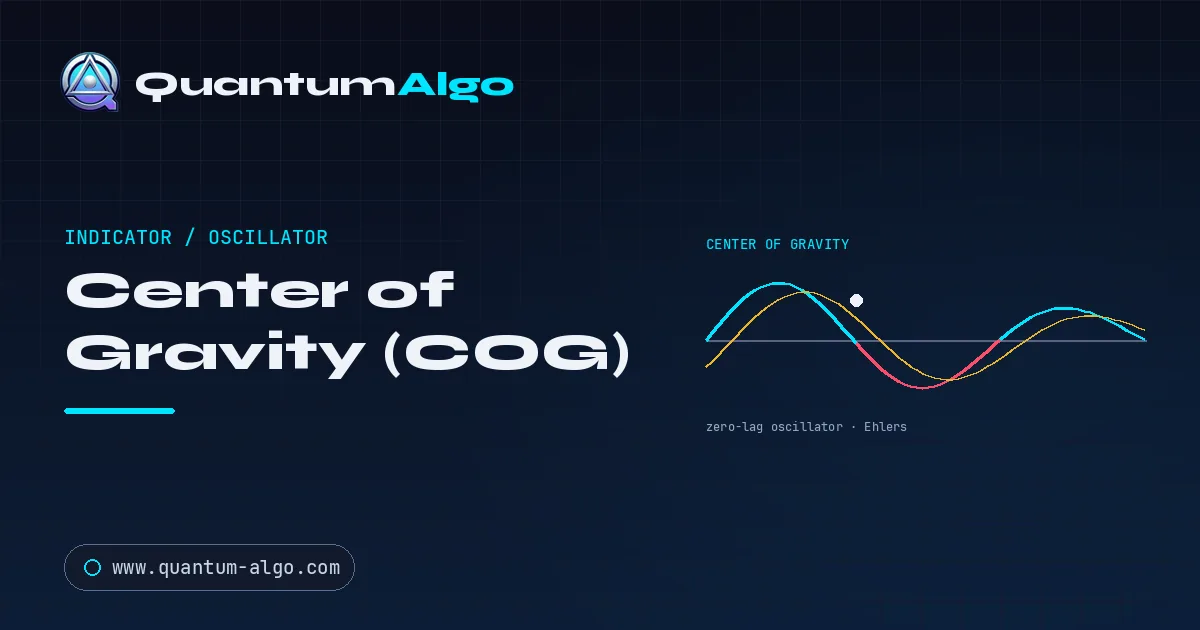
The Center of Gravity indicator is an oscillator designed by John Ehlers that plots the balance point of recent prices, treating each price in a lookback window as a weight on a beam. Because that balance point shifts the instant the price distribution changes, its line turns almost exactly at pivots with near-zero lag. It works best in cyclical markets.
The Center of Gravity (COG) indicator is an oscillator designed by John Ehlers to do something most oscillators cannot: identify turning points with almost no lag. Where a traditional moving average or momentum tool reacts after price has already turned, the Center of Gravity uses a weighting scheme borrowed from physics — the centre of mass of recent prices — to produce a smooth line that pivots close to the actual highs and lows. For traders who care about timing reversals in ranging or cyclical markets, that near-zero lag is the whole appeal.
This guide explains what the Center of Gravity indicator is, the physics idea behind it, how to read its line and signal crossovers, where it works and where it fails, and how to use it without over-trading. It is a practical breakdown of a genuinely clever tool that is often misunderstood as just another oscillator.

Automate your trades. Let Quantum Algo trade for you.
Every signal executed on your own account — 24/7, hands-off.
What does the Center of Gravity indicator plot?
The Center of Gravity is a smoothed oscillator that plots the "balance point" of price over a lookback window. The name is literal: Ehlers took the physics formula for a centre of mass — where you would place a single support to balance a set of weights — and applied it to a window of recent prices. Each price in the window is treated as a weight, and the indicator computes where their collective balance point sits. As new prices arrive and old ones leave the window, that balance point moves, and its motion is plotted as the COG line, usually oscillating around a zero or centre line with a signal line for crossovers.
The reason this matters is lag. Almost every smoothing tool trades responsiveness for smoothness — the smoother the line, the later it turns. Ehlers designed the Center of Gravity specifically to break that trade-off in cyclical markets, producing a line that is both smooth and nearly coincident with price pivots. In a market that is oscillating within a range, the COG can flag the turn at the top or bottom of the range with far less delay than a standard oscillator, which is exactly where its value lies.
Price as weights on a beam
The Center of Gravity is the balance point of recent prices — it shifts the moment the distribution changes.
What is the physics idea behind the Center of Gravity?
You do not need the mathematics to use the indicator, but the intuition helps you trust it. Picture the last ten prices laid out as weights on a seesaw, positioned by how recent they are. The centre of gravity is the single point where the seesaw balances. If recent prices are clustered high, the balance point sits high; as price rolls over and recent bars come in lower, the balance point slides down — and it starts sliding the moment the distribution shifts, not several bars later once an average has caught up.
This is why the Center of Gravity is described as a near-zero-lag oscillator. It is not predicting the future; it is reacting to a change in the shape of recent price the instant that change begins, because the balance point is sensitive to the newest weights. That sensitivity is a double-edged sword — it is what gives the low lag, and also what makes the tool noisy in the wrong conditions, as we will see.
Which Center of Gravity signals should you act on?
In practice the indicator gives you a few readable signals, and combining them is more reliable than trading any one alone.
Turn as warning, crossover as confirmation
The raw line-turn flags a possible reversal early; the signal-line cross confirms it has momentum.
Line turns at extremes
When the COG line reaches a high extreme and rolls over, it flags a possible top; a low extreme turning up flags a possible bottom. This is its signature low-lag reversal read.
Signal-line crossovers
Most versions plot a trigger line. The COG crossing above its signal is a bullish cue and below it a bearish one — a cleaner, slightly later confirmation than the raw turn.
Zero-line context
Whether the oscillator sits above or below its centre line gives directional context, helping you favour long or short signals in line with the broader lean.
Divergence
When price makes a new extreme but the COG does not, that divergence — a concept shared with RSI can warn that the move is losing conviction ahead of a turn.
Where it works and where it fails
The Center of Gravity is a cycle tool, and its performance depends entirely on whether the market is behaving cyclically — the domain of mean reversion. This is the single most important thing to understand about it, because using it in the wrong regime is the main reason traders give up on it.
Filter by regime before trusting a turn
Only act on reversal signals when a regime check says the market is ranging.
Ranging (its home) versus trending (its weakness)
In a range the COG catches every swing; in a strong trend it fights the move and whipsaws.
In a ranging or cyclical market, the Center of Gravity is close to ideal: price oscillates between bounds, and the COG catches each swing near its turn with minimal lag, giving genuinely useful reversal signals. In a strong trend, it is a liability. A trending market keeps making new extremes, and the COG keeps flagging "overbought, reversal coming" at every push — signals that fail one after another as the trend continues. The tool is not broken; it is simply being used against its design. This is why the Center of Gravity is almost always paired with a trend or regime filter that switches it off, or fades its signals, when a strong trend is in force.
How should you tune the Center of Gravity length?
The Center of Gravity's main parameter is its lookback length — the size of the window whose balance point it computes. A shorter length makes it faster and more sensitive, catching turns earlier but generating more noise; a longer length makes it smoother and steadier but a little later. The right choice depends on the cycle length of the market you trade and your timeframe: faster instruments and lower timeframes generally want a shorter length, slower instruments and higher timeframes a longer one.
Because the tool is a cycle indicator, the ideal is to match its length roughly to the dominant cycle you are trading. Some advanced implementations even measure the market's cycle and adapt the length automatically. Whatever you choose, the discipline is the same as any indicator: pick a sensible value, test it on your specific market and timeframe, and adjust only with evidence rather than chasing a perfect setting that does not exist.
How does the Center of Gravity compare with RSI, MACD and Stochastic?
It helps to place the Center of Gravity next to the oscillators you already know, because its low-lag reversal focus makes it behave differently from the classics.
| Oscillator | Primary use | Lag at turns | Best regime |
|---|---|---|---|
| Center of Gravity | Reversal timing | Near-zero | Ranging / cyclical |
| RSI | Overbought / oversold, divergence | Moderate | Ranging (with trend caveats) |
| MACD | Momentum & trend shifts | Higher (lagging) | Trending |
| Stochastic | Overbought / oversold swings | Low-moderate | Ranging |
The pattern is clear: the Center of Gravity trades away some stability for exceptional turn-timing, which is precisely why it excels in ranges and struggles in trends. Momentum tools like MACD sit at the opposite end — more lag, but better suited to confirming trends. Many traders use a COG for timing and a slower momentum tool for context, letting each do what it is good at.
What mistakes do traders make with the Center of Gravity?
Most disappointment with the indicator comes down to a few avoidable errors rather than any flaw in the tool itself.
Using it in trends
The number-one mistake. Trading its reversal signals during a strong trend guarantees a string of losses, because it is designed for cycles, not trends.
Trading every turn
The sensitive line turns often. Acting on the raw turn without waiting for signal-line confirmation floods you with false pivots.
Ignoring length
Leaving the length mismatched to the market's cycle makes the tool either too jumpy or too slow. Tune it to what you actually trade.
Combining the Center of Gravity with other tools
Because its strength is precise reversal timing and its weakness is trending markets, the Center of Gravity pairs best with tools that identify the regime and confirm the trade. A trend-strength measure or a higher-timeframe read tells you when to trust the COG's reversals versus when to ignore them. A market-structure or support/resistance read tells you whether a COG turn is happening at a level that matters. And a volume or momentum confirmation can validate that a flagged reversal has real force behind it.
The most robust use is therefore layered: a regime filter decides whether cyclical reversal signals are even appropriate right now, the Center of Gravity provides the low-lag timing when they are, structure confirms the location, and risk management sizes the trade. In that role it is a precision instrument — one of the better tools available for timing turns in ranging markets — rather than a standalone system.
• Regime-aware signals — Structure and regime context so reversal reads only fire where they matter
• Precise locations — Market structure and liquidity to confirm a turn is at a real level
• Accountable performance — A verified public track record behind every signal
◆ Time reversals with real structure
Quantum Algo pairs low-lag timing with Smart Money Concepts — market structure, liquidity, order blocks and regime context — so a reversal signal only fires where it actually matters, all backed by a verified public track record.
See the indicator → Verify the track recordFrequently Asked Questions
The Center of Gravity (COG) is an oscillator designed by John Ehlers that identifies turning points with almost no lag. It borrows the physics idea of a centre of mass: it treats recent prices as weights and computes their balance point over a lookback window. Because that balance point shifts the instant the price distribution changes, the COG line turns close to actual pivots, giving a low-lag read of reversals that lagging tools miss — especially useful in ranging, cyclical markets.
The Center of Gravity indicator was developed by John Ehlers, an engineer well known for applying signal-processing and cycle-analysis techniques to trading. He designed it specifically to reduce the lag that plagues conventional smoothing tools, using the centre-of-mass concept to produce an oscillator that turns nearly in sync with price pivots in cyclical markets.
It plots the balance point of price over a lookback window. Each price in the window is treated as a weight, and the indicator computes where they collectively balance — like finding the balance point of weights on a seesaw. As new prices arrive and old ones leave, the balance point moves, and that motion is plotted as the COG line, usually oscillating around a centre line with a signal line for crossovers. The balance point's sensitivity to the newest prices is what gives it low lag.
Because the balance point of recent prices shifts the moment the distribution of those prices changes — it does not wait for an average to slowly catch up. If recent bars start coming in lower, the balance point begins sliding down immediately. This sensitivity to the newest data is what produces near-zero lag at pivots. The trade-off is that the same sensitivity makes the tool noisy in trending or choppy conditions.
There are a few readable signals. The COG line turning at a high or low extreme flags a possible top or bottom — its signature low-lag reversal read. A signal-line crossover (the COG crossing its trigger line) gives a cleaner, slightly later confirmation. The zero or centre line provides directional context, and divergence between price and the COG can warn a move is losing conviction. Best practice is to treat the raw turn as an early warning and the crossover as confirmation.
It works best in ranging or cyclical markets, where price oscillates between bounds. There, the COG catches each swing near its turn with minimal lag, giving genuinely useful reversal signals. It performs poorly in strong trends, which keep making new extremes and cause the COG to flag failed 'reversal coming' signals repeatedly. This is why it is almost always paired with a trend or regime filter that restricts it to ranging conditions.
Because it is a cycle tool, not a trend tool. A trending market continually makes new highs or lows, and the COG keeps signalling that the move is overextended and a reversal is due — signals that fail one after another as the trend continues. The indicator is not broken; it is being used against its design. The fix is a regime or trend filter that switches it off or fades its signals when a strong trend is in force.
The main parameter is the lookback length. A shorter length is faster and more sensitive, catching turns earlier but with more noise; a longer length is smoother and steadier but slightly later. The ideal is to match the length roughly to the dominant cycle of the market and timeframe you trade — shorter for faster instruments and lower timeframes, longer for slower ones. As always, pick a sensible value, test it on your market, and adjust only with evidence.
Both are oscillators, but they emphasise different things. The Center of Gravity is built for low-lag reversal timing and turns almost exactly at pivots in cyclical markets. RSI measures overbought and oversold momentum and is popular for divergence, but it lags more at actual turns. In practice the COG is a sharper timing tool in ranges, while RSI is a more familiar momentum and divergence gauge. Many traders use them together rather than choosing one.
A standard Center of Gravity computed on closed bars does not repaint — once a bar closes, the balance-point value for that bar is fixed. As with any indicator, some implementations update on the forming bar in real time and settle at the close, so if you rely on the signals you should verify the specific version by watching it form live and confirming historical values do not change on reload.
It is not recommended as a standalone system. Its strength is precise reversal timing and its weakness is trending markets, so it works best layered with other tools: a regime filter to decide when cyclical reversals are appropriate, a market-structure or support/resistance read to confirm the location of a turn, and risk management to size the trade. In that role it is a precision timing instrument rather than a complete strategy.
A low-lag reversal signal is far more useful when it only fires where structure supports it. Quantum Algo layers Smart Money Concepts — market structure, liquidity, order blocks, and regime context — so a reversal read happens at a level that actually matters and in a regime where it makes sense, rather than against a strong trend. Combined with a verified public track record, it supplies exactly the regime and structure filtering that a pure cycle oscillator like the COG needs.
References & Related Guides
More in this topic
- Squeeze Momentum Indicator (TTM Squeeze): Complete Guide
- RSI Indicator Guide
- MACD Indicator Guide
- Bollinger Bands Guide
- SSL Channel Indicator: The Complete Guide
- Range Filter Indicator Guide
- Gaussian Channel Indicator Guide
- Supertrend Indicator Guide
- Best TradingView Indicators
- Mean Reversion Trading Guide
- Non-Repaint Indicators: The Complete Guide to Reliable Signals
- Best Buy/Sell Indicator: How to Choose One That Actually Works
- QQE Mod Indicator Guide
- What Are the Best Volume Indicators?
Core reading
- Best TradingView Indicators
- Mean Reversion Trading Guide
- Risk Management in Trading — The Complete Survival Guide
- All Premium Guides
- Public Track Record
- Quantum Algo on TradingView