Range Filter Indicator: The Complete Noise-Gating Trend Guide (DonovanWall)
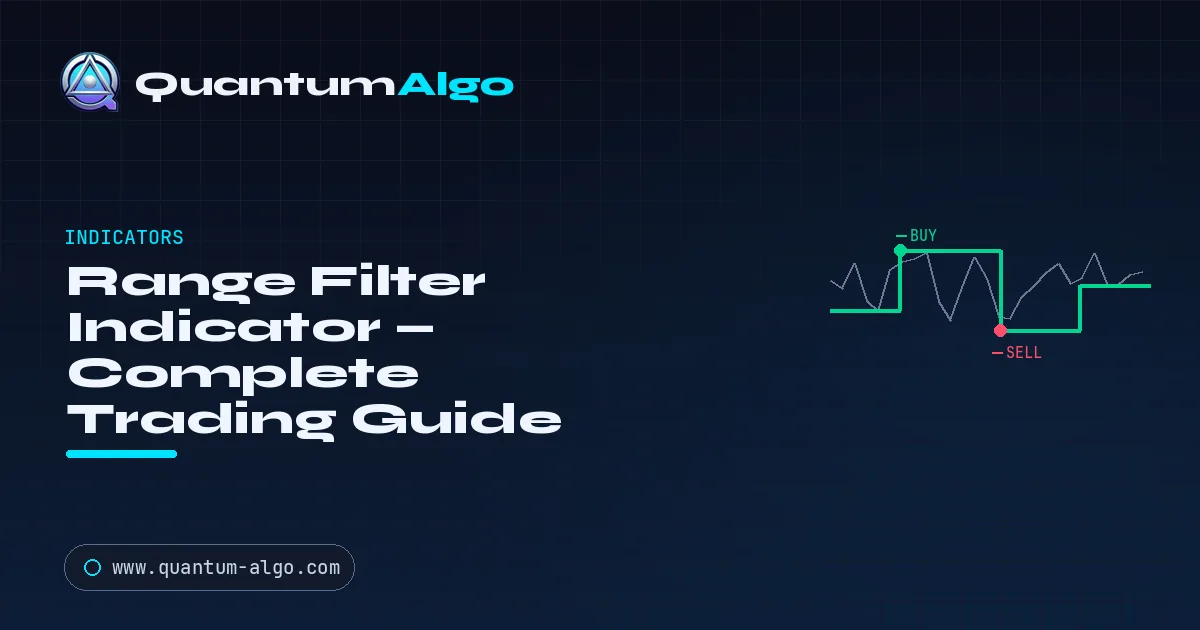
The Range Filter, by DonovanWall on TradingView, ignores moves smaller than a set range, so only meaningful moves shift its line, blue in uptrends and red in downtrends, with buy/sell labels on each flip. Key settings: sampling period (around 100) and range multiplier (near 3). It whipsaws in ranges, so trade flips only with a higher-timeframe trend or ADX filter.
The Range Filter, originally published by DonovanWall, is one of TradingView's most-copied indicators — the engine behind countless "Range Filter Buy and Sell" scripts and the basis of the widely sold "VuManChu Swing." Its job is simple and powerful: filter out minor price movement so you see the real trend. It draws a single filter line that only moves when price travels far enough to matter, colouring blue in uptrends and red in downtrends, with clean buy and sell labels on each flip.
This guide explains how the filter is calculated, what each setting does, how to trade its signals without getting chopped up in ranges, and how it compares to a moving average and to Supertrend — plus the one market condition where it fails and how to filter around it.

Automate your trades. Let Quantum Algo trade for you.
Every signal executed on your own account — 24/7, hands-off.
How does the Range Filter gate out noise?
The calculation has three steps. First, it measures a smoothed average range — roughly how far price typically travels over the sampling period. Second, it builds a filter line that only updates when price moves beyond that range from the current filter value; smaller moves are ignored ("gated" out). Third, it plots target bands above and below the filter that show the price levels needed to move the line further. The line's slope and colour then give the trend: rising and blue = uptrend, falling and red = downtrend.
Gating out the noise
Which Range Filter settings matter most?
▸ Sampling period
How many candles feed the average range calculation. Higher = smoother, slower filter that ignores more noise (fewer signals); lower = more reactive (more signals, more whipsaw). The default around 100 suits intraday; raise it for cleaner swing signals.
▸ Range multiplier
Scales how large a move must be to shift the line. Higher multiplier = wider gate = the line ignores more, flips less often, and filters more noise. This is your main lever for trading fewer, higher-quality signals.
▸ Source
Usually close. Some versions let you base the range on ATR, standard deviation, or a percentage of price for different volatility behaviour.
▸ Smoothing
Optional EMA smoothing on the range to reduce false flips. Helpful on choppy assets at the cost of a little extra lag.
How do you trade Range Filter signals without getting chopped?
The Range Filter's weakness is the same as every trend indicator: it whipsaws in ranges. When price is going sideways, the line flips blue-red-blue-red and each "signal" is a small loss. The entire skill of trading it is avoiding those conditions.
① Trade only with the higher timeframe
Set trend bias on a higher timeframe (e.g. 4H) and only take Range Filter buy signals on the entry timeframe when the higher timeframe is bullish. This single filter removes most whipsaw losses.
② Add a range/volatility gate
Pair it with ADX or a volatility measure and only take signals when the market is actually trending (e.g. ADX above 20-25). Skip signals when volatility is dead.
③ Use it as a trend filter, not a trigger
Many traders never trade the flip directly — they use the filter's colour as a directional bias and take entries from structure (an order block, a pullback) only in that direction.
How does the Range Filter compare with MAs and Supertrend?
| Tool | How it filters | Best trait | Weakness |
|---|---|---|---|
| Range Filter | Gates out moves smaller than a range | Very clean trend read, ignores noise well | Whipsaws in ranges |
| Moving average | Averages price over N bars | Simple, universally understood | Lags on turns |
| Supertrend | ATR band that flips on close through it | Dynamic stop levels built in | Also whipsaws in chop |
The Range Filter and Supertrend are close cousins — both are volatility-aware trend flippers — but the Range Filter's gating logic tends to produce a slightly steadier line in noisy conditions, while Supertrend gives you a ready-made trailing stop. Many traders run both and only act when they agree.
The "VuManChu Swing" connection
It is worth knowing: the popular "VuManChu Swing" indicator sold in some communities is, by the author's own acknowledgement, the DonovanWall Range Filter with the same settings and buy/sell labels added. If you have the original open-source Range Filter, you already have that tool for free. Understanding the underlying logic — rather than buying a relabelled version — is exactly the point of this guide.
Where does the Range Filter fail, and what is the fix?
The Range Filter is a trend tool, and no trend tool works in a range — that is not a flaw, it is the nature of the instrument. The traders who use it profitably treat its colour as a bias and combine it with a read on whether a trend exists at all. Layering an institutional-order-flow confirmation on top — so you only take a Range Filter long when structure and liquidity also point up — is how you turn a noisy flip indicator into a disciplined system. That order-flow read is what the QuantumAlgo indicator is built to provide on TradingView.
• Order block detection — filter flips that line up with institutional zones
• Liquidity sweep alerts — trend flips confirmed by a genuine stop raid, not noise
• FVG identification — continuation entries timed by fair value gap fills
• Trend-strength context — only take flips when the market is genuinely trending
• Smart alerts — notified when a Range Filter flip meets SMC confluence
◆ Only trade the flip when order flow agrees
QuantumAlgo confirms trend flips with institutional order flow — liquidity, order blocks, and structure — on TradingView, with a verified public track record.
See the indicator → Verify the track recordRelated reading: see also our HalfTrend indicator for a deeper dive into a complementary tool.
Frequently Asked Questions
The Range Filter is a trend indicator originally published by DonovanWall on TradingView. It filters out minor price movement by only updating its filter line when price travels beyond a defined range, so small wiggles are ignored and only meaningful moves shift the line. It colours blue in uptrends and red in downtrends and prints buy/sell labels on each flip, giving a clean trend read.
It calculates a smoothed average range (roughly how far price usually travels over the sampling period), then builds a filter line that only moves when price travels beyond that range from the current line value. Smaller moves are 'gated' out. Target bands above and below show the levels needed to move the line further. The line's slope and colour define the trend direction.
The two key inputs are the sampling period and the range multiplier. Higher values on both produce a smoother filter that ignores more noise and flips less often — better for swing trading and cleaner signals — while lower values make it more reactive for intraday at the cost of more whipsaw. The common defaults (around 100 sampling period, multiplier near 3) suit intraday; raise them for higher timeframes.
The direct method is to buy on a blue flip and sell on a red flip. Because it whipsaws in ranges, the profitable approach filters these signals: only take flips aligned with the higher-timeframe trend, add a volatility or ADX gate to skip ranging conditions, or use the filter's colour purely as directional bias and take entries from structure in that direction.
The core filter logic confirms on bar close, so a flip that has printed on a closed candle does not repaint. As with most indicators, the current unclosed candle's state can change until it closes, so wait for bar close before acting on a new flip. Some buy/sell label versions differ, so verify the specific script you are using confirms on close.
Both are volatility-aware trend flippers. The Range Filter gates out moves smaller than a defined range, tending to produce a steadier line in noisy conditions, while Supertrend uses an ATR band that flips when price closes through it and gives you a built-in trailing stop. Many traders run both and only act when the two agree, since each whipsaws in ranges on its own.
Effectively yes. The 'VuManChu Swing' indicator sold in some communities is, by the author's own acknowledgement, the DonovanWall Range Filter with the same settings and added buy/sell labels. If you have the original open-source Range Filter, you already have that tool for free — which is why understanding the underlying logic matters more than buying a relabelled version.
Because it is a trend indicator, and no trend indicator works in a range. When price moves sideways, the filter line flips colour repeatedly on small, meaningless moves, and each flip is a small losing signal. This is inherent to the tool. The fix is to only trade its signals when a trend or volatility filter confirms the market is genuinely moving.
It works on any timeframe, but higher timeframes produce cleaner flips with less whipsaw, while lower timeframes generate more signals and more noise. A common approach is to read trend bias from a higher timeframe and take Range Filter entries on a lower one, keeping the two aligned so you are not fighting the dominant trend.
Yes, and it is popular in crypto because the tool adapts its gate to volatility, which suits crypto's large swings. As in any market, it excels in trending conditions and struggles in ranges, so combining it with a higher-timeframe bias and a volatility filter is essential to avoid the choppy, sideways periods common between major crypto moves.
Many experienced traders never trade the flip directly. Instead they use the filter's colour as a directional bias and take their actual entries from structure — an order block, a pullback, a break of a level — only in the direction the filter points. Used this way as a bias filter rather than a raw trigger, it produces far fewer whipsaw losses.
Yes. Because on its own it whipsaws in ranges, it pairs well with a trend-strength gate like ADX, a higher-timeframe trend read, or an institutional-order-flow tool. Confirming a Range Filter flip against structure and liquidity — so you only take a long when the market is genuinely trending up and order flow agrees — is how traders turn it into a disciplined system rather than a noisy signal.
References & Related Guides
More in this topic
- ADX Indicator: Complete Trading Guide
- AlphaTrend Indicator: Complete Trading Guide
- ATR (Average True Range): Complete Trading Guide
- Awesome Oscillator: Complete Indicator Guide
- What Are the Best Volume Indicators?
- Bollinger Bands — Complete Trading Indicator Guide
- CCI Indicator: Complete Guide
- Chandelier Exit: Complete Trading Guide
- Donchian Channels: Complete Indicator Guide
- Fibonacci Bollinger Bands: Complete Trading Guide
- Fibonacci Retracement — Complete Trading Guide
- Hull Moving Average (HMA): Complete Trading Guide
- Center of Gravity Indicator Guide
Core reading
- BOS & CHoCH: Complete Market Structure Guide
- Order Blocks Trading: Complete Guide
- Best TradingView Indicators — Complete Guide
- Risk Management in Trading — Complete Guide
- Candlestick Patterns Guide — Engulfing, Pinbar & More
- All Premium Guides
- Quantum Algo on TradingView
- Public Track Record