SSL Channel Indicator: The Complete Semaphore Signal Level Guide
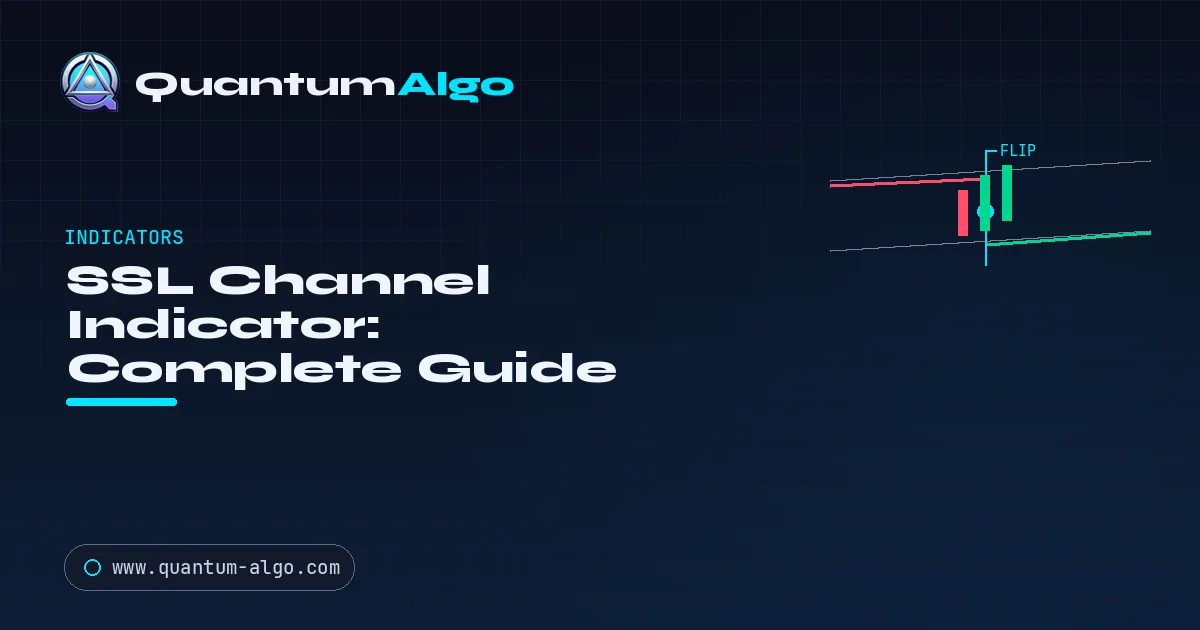
The SSL Channel (Semaphore Signal Level) plots two moving averages, one of recent highs and one of recent lows, over a 10-period default. When price closes above the high average the line turns bullish; when it closes below the low average it turns bearish, and the signal holds until the opposite side breaks. It does not repaint after bar close.
The SSL Channel — short for Semaphore Signal Level — is one of those indicators that looks almost too simple to work, yet has quietly become a staple of trend traders on TradingView, MetaTrader and NinjaTrader. It draws two colour-coded lines that follow price like an envelope, and when they cross, the colour flips and you get a clean buy or sell signal. No oscillator to interpret, no divergence to hunt — just a single line that tells you which way the trend is leaning.
This guide explains exactly how the SSL Channel is built, why the "semaphore" flip works the way it does, the settings that change its behaviour, three ways to trade it, and — just as importantly — where it fails. It is written for traders who want a mechanical trend filter they can actually trust, and who want to understand the machinery rather than just copy someone else's settings.

Automate your trades. Let Quantum Algo trade for you.
Every signal executed on your own account — 24/7, hands-off.
Is the SSL Channel just a moving-average crossover?
At its core the SSL Channel is a moving-average crossover system in disguise. But instead of crossing two moving averages of the close against each other, it does something cleverer. It calculates one moving average of the high over a lookback period and another moving average of the low over the same period. Together these two averages form a channel — an envelope that tracks price. As ChartAlert describes it, the indicator consists of an SSL High Line and an SSL Low Line that together illustrate market sentiment and momentum. For a related tool, see our Gaussian Channel guide.
The magic is in how the single visible SSL line is chosen. On each bar, the indicator checks where price closed relative to that high/low envelope. If price closes above the high-MA, the active SSL line snaps to the low-MA and turns bullish. If price closes below the low-MA, the active line snaps to the high-MA and turns bearish. The line therefore acts like a semaphore — a signalling flag — that holds its position until price decisively breaks the opposite side of the channel. StrategyQuant's codebase summarises the trading idea plainly: you trade the flip, where price moves from above both moving averages to below them and vice-versa.
Two envelope lines
One moving average of the highs, one of the lows. Together they form a channel that follows price and defines the bullish and bearish boundaries.
The semaphore flip
The visible SSL line snaps between the two envelope lines depending on where price closes — turning green in an uptrend and red in a downtrend.
Non-repainting
Once a bar closes and the flip is confirmed, the signal is fixed. It will not vanish or move on later bars — critical for live trading and automation.
How do you calculate the SSL Channel step by step?
Understanding the exact logic removes all the mystery. The classic SSL uses a lookback of 10 periods, though this is adjustable.
First, compute two simple moving averages: highMA = the average of the highs over the last N bars, and lowMA = the average of the lows over the last N bars. Second, on each new bar determine a direction value: if the close is above the highMA, direction is bullish (+1); if the close is below the lowMA, direction is bearish (−1); otherwise direction carries over from the previous bar. This "carry-over" is what stops the line flickering while price sits inside the channel. Third, plot the SSL line: when direction is bullish, the SSL line is drawn from the lowMA (support beneath price); when bearish, from the highMA (resistance above price). The colour flips with the direction, and the crossover of the two plotted lines is your signal.
The SSL Channel flip mechanic
Price trades inside the high/low envelope until it closes decisively through one side. The visible SSL line snaps to the opposite boundary and the colour flips — that flip is the signal.
Notice what this design achieves. Because the flip only fires when price closes beyond the opposite envelope line — not merely when it touches a single average — the SSL Channel filters out a lot of the noise that a naive close-vs-MA crossover would generate. The channel acts as a buffer zone. MetaTrader documentation describes exactly this benefit: the dual-line structure creates a responsive envelope that highlights meaningful momentum shifts while filtering out minor fluctuations.
Which SSL Channel settings actually matter?
The SSL Channel is refreshingly light on inputs. There are really only two you need to think about.
| Setting | What it controls | Practical effect |
|---|---|---|
| Period / Length | The lookback for both the high-MA and low-MA | Shorter (e.g. 7) = faster, more signals, more whipsaw. Longer (e.g. 20+) = smoother, fewer but higher-quality flips. 10 is the classic default. |
| MA Type | Whether the averages are simple (SMA), exponential (EMA) or other | SMA is the traditional choice and the smoothest. EMA reacts faster to recent price but flips more often. |
| Alerts | Notifications on each flip | Useful for set-and-forget monitoring, but experienced users often disable them to avoid over-trading. |
What are three ways to trade the SSL Channel?
The indicator's simplicity is its strength — it slots into several styles cleanly.
Pure flip trading
Go long when the SSL line flips green, close and reverse when it flips red. Simple and mechanical, but exposed to whipsaw in ranges — best on higher timeframes and trending assets.
Trend filter + entry trigger
Use SSL colour only to define trend direction, then take entries from a faster signal (a pullback, an order block, or an oscillator) in that direction. This is the NNFX-style confirmation use.
Multi-timeframe alignment
Require the SSL to be the same colour on two timeframes — e.g. green on the 4H and 1H — before taking a long. Alignment across timeframes dramatically cuts false flips.
How does the SSL Channel differ from a two-MA crossover?
Since the SSL is a moving-average system at heart, it is fair to ask how it differs from a plain two-MA crossover.
| Dimension | Classic MA crossover | SSL Channel |
|---|---|---|
| Inputs to the averages | Usually two MAs of the close | One MA of the highs, one of the lows |
| Signal trigger | Fast MA crosses slow MA | Price closes beyond the opposite envelope line |
| Noise handling | Prone to whipsaw around a single line | Channel buffer filters minor fluctuations |
| Visual read | Two lines you must compare | One colour-coded line — instant read |
| Repainting | No | No — signals fix on bar close |
Where does the SSL Channel fail?
Every honest guide names the weakness, and for the SSL it is unambiguous: ranging, sideways markets. Because it is fundamentally a trend-following crossover, choppy price action makes the SSL line flip back and forth, generating a string of false signals. ChartAlert lists this plainly among the indicator's cons — false signals in sideways markets and the inherent lag of any moving-average tool. Trading every flip in a range is the fastest way to bleed an account with this indicator.
The second limitation is lag. Moving averages are, by definition, backward-looking. The SSL will confirm a trend only after price has already moved through the channel, so you will never catch the exact top or bottom. That is an acceptable trade-off for a trend filter — you are trading the middle of the move, not the turn — but it means the SSL should never be your sole timing tool for entries. Pair it with a faster trigger and it becomes far more useful. This is precisely why many systematic traders, including those following the NNFX methodology, use the SSL purely as a confirmation component rather than a standalone entry signal.
How does the SSL Channel work in a real trend?
Picture a currency pair breaking out of a multi-day range. As the breakout candle closes above the high-MA, the SSL line snaps down to the low-MA and turns green — your bullish flip. A disciplined SSL trader does not chase the breakout candle; instead they wait for the first shallow pullback that holds above the green SSL line, then enter long with a stop just below it. As the trend extends, the green SSL line trails beneath price, acting as a dynamic stop. The position stays open until price finally closes below the low-MA, flipping the line red — the exit and potential reversal signal.
What makes this work is the buffer. During the uptrend, normal pullbacks dip into the channel but do not close beyond the far side, so the line stays green and you stay in the trade. Only a genuine change of character — a close through the opposite envelope — flips it. That single design choice is why the SSL keeps you in trends longer than a twitchy single-MA cross would.
Which SSL Channel variants are worth knowing?
The original SSL has spawned several popular offshoots, and it helps to know which is which. The SSL Hybrid is the most widely used modern version — it adds a "baseline" moving average (often a smoothed variant) and a colour-coded candle overlay, so you get both the SSL flip and a continuous trend-strength read in one tool. Many traders in the No Nonsense Forex community use SSL Hybrid specifically as their baseline component, entering only when price is on the correct side of it. The SSL Channel + SSL Continuation pairing adds a second, faster SSL to catch re-entries within an existing trend, while the standalone SSL Channel remains the cleanest option for those who just want the flip.
There is also a lineage point worth clearing up. Some sources note that the SSL's logic shares DNA with cycle-and-average hybrids like the Schaff Trend Cycle, which blend moving averages with oscillator concepts. Whether or not you use the fancier variants, the core principle is identical across all of them: two averages of the extremes, a channel between, and a flip when price commits to one side. Master the base SSL Channel first and the variants become easy to read.
How does the SSL Channel fit a structure-based system?
The SSL Channel earns its keep as a trend gate in a structure-based system. Let the SSL colour answer "which way is the trend?" and let Smart Money Concepts answer "where exactly do I enter?" Take longs only when the SSL is green and price is reacting from a demand order block or filling a bullish fair value gap, and mirror that for shorts. You can also stack it with a liquidity sweep for confluence: an SSL flip that occurs right after a sweep of an obvious high or low is a far higher-quality signal than a flip in the middle of nowhere.
• Order block detection — SSL flips that line up with institutional demand and supply zones
• Liquidity sweep alerts — trend flips confirmed by a genuine stop raid, not range noise
• FVG identification — entries timed by fair value gap fills in the SSL trend direction
• Multi-timeframe bias — HTF SSL trend aligned with your lower-timeframe entries
• Smart alerts — notified when an SSL flip meets SMC confluence
◆ Turn clean trend signals into high-quality entries
QuantumAlgo pairs trend context with Smart Money Concepts — order blocks, fair value gaps, and liquidity sweeps — plus a verified public track record so every signal is accountable.
See the indicator →Verify the track recordFrequently Asked Questions
The SSL Channel — Semaphore Signal Level — is a trend-following indicator built from two moving averages, one applied to recent highs and one to recent lows. Together they form an envelope, and a single colour-coded line flips between them depending on where price closes, giving a clean read on trend direction and buy or sell signals when the colour changes.
SSL stands for Semaphore Signal Level. A semaphore is a signalling flag, and the indicator behaves like one: its line holds a colour and position until price decisively breaks the opposite side of the channel, at which point it flips to signal a change of direction.
It computes a moving average of the highs and a moving average of the lows over a lookback period, typically 10. On each bar, if price closes above the high-MA the trend is bullish and the SSL line is drawn from the low-MA; if price closes below the low-MA the trend is bearish and the line is drawn from the high-MA; otherwise the previous direction carries over.
No. Once a bar closes and the flip is confirmed, the signal is fixed and will not change or disappear on later bars. This non-repainting behaviour is one of the main reasons traders trust it for live trading and automated strategies.
The period is the main dial. Around 7 gives faster, more frequent signals suited to intraday trading; 15 to 25 gives smoother, higher-quality flips suited to swing trading; 10 is the classic default. The moving-average type (SMA vs EMA) is a secondary choice — SMA is smoother, EMA reacts faster.
Because it is a trend-following crossover tool, it whipsaws in ranging or sideways markets, flipping colour repeatedly without a real trend. It also lags, since moving averages are backward-looking. Filtering signals through a higher timeframe or a structure confluence removes most false flips.
The basic method is to go long when the line flips green and close or reverse when it flips red. More robust approaches use the flip only to define trend direction and take entries from a pullback, an order block, or an oscillator in that direction, rather than chasing the flip candle itself.
Yes, in the sense that its signals are visually obvious and it does not repaint. But beginners must understand its one big weakness — whipsaw in ranges — and avoid trading every flip. Used as a trend filter alongside a second confirmation, it is an excellent learning tool.
It works on any timeframe, but higher timeframes (1H and above) produce cleaner, more reliable flips because there is less noise. On low timeframes, expect more whipsaw and use a longer period or multi-timeframe confirmation to filter it.
A standard crossover uses two moving averages of the close and signals when they cross. The SSL uses one MA of the highs and one of the lows, forming a channel, and signals when price closes beyond the opposite envelope line. The channel acts as a buffer that filters out the minor fluctuations a single-line crossover would react to.
Yes, and this is its strongest use. Let the SSL colour define trend direction and take entries only when it aligns with an order block, a fair value gap, or a liquidity sweep. An SSL flip that occurs right after a liquidity sweep is a far higher-quality signal than a flip in the middle of a range.
It is a lagging indicator, because it is built on moving averages that react to price after the fact. It confirms a trend once price has moved through the channel rather than predicting the turn, which is why it is best used as a trend filter or confirmation tool rather than a precision entry signal.
References & Related Guides
Primary and authoritative sources used in this guide:
- ◆ StrategyQuant — Semaphore Signal Level Channel (SSL) codebase entry
Describes the dual high/low moving-average construction and the flip trading technique. - ◆ TradingView — Semaphore Signal Level (SSL) Averages by Loxx
Open-source implementation and notes on the SSL as an NNFX confirmation component. - ◆ Investopedia — Moving Average (MA)
Foundational reference on the moving averages the SSL is built from and their inherent lag. - ◆ Investopedia — Moving Average Envelopes
Background on envelope-style channel indicators, of which the SSL is a colour-coded variant.