How Many Trades Should You Take Per Day?
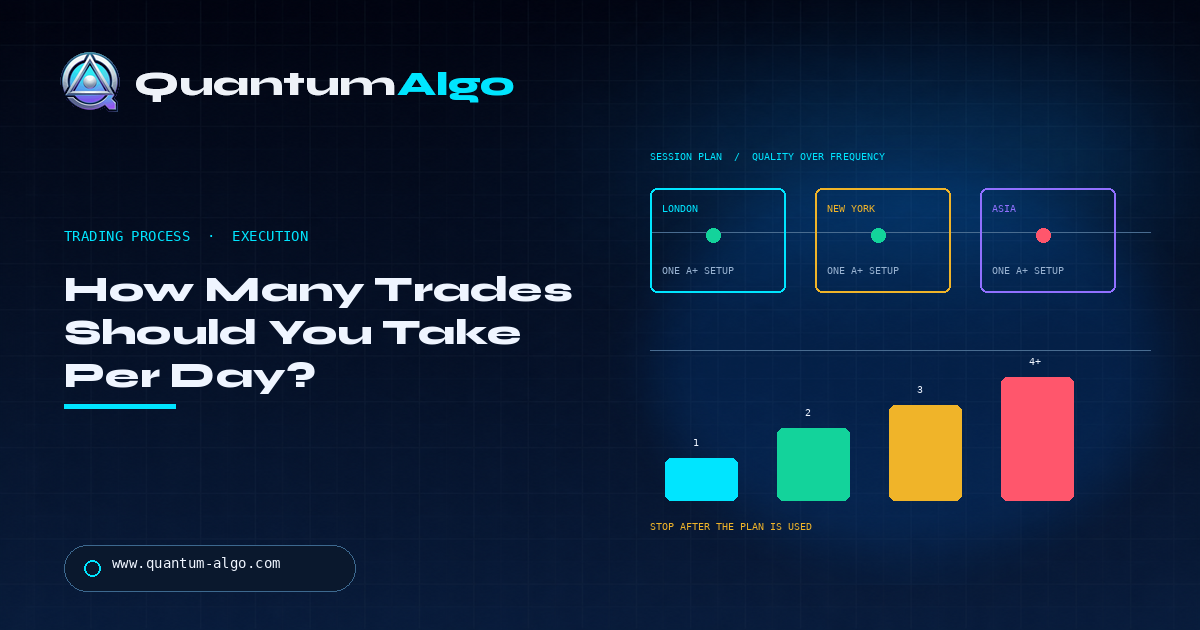
There is no profitable universal number of trades per day. Take only the qualified setups your plan allows, stop when your daily loss or process limit is reached, and review decision quality rather than chasing a quota.
I used to think a productive trading day had to look busy. A blank chart felt like wasted time, and a small loss made the next setup feel necessary. That is how a two-trade plan turns into six clicks. The useful question is not how many trades you can take; it is how many independent, risk-defined opportunities your market and session actually produce. Quantum Algo’s free public indicators help mark order blocks and fair value gaps; Zeno provides separate Buy/Sell signals with SL/TP and built-in risk management.
Indicators that prove themselves in public.
One engine, four precision tools — the Gold (XAU) Scalper, the institutional Gravity Zone, the Zeno momentum Oscillator, and Zeno Stocks for equities.
Use the guide as a decision filter, not as a collection of labels. The market, the session and the invalidation still decide whether an idea deserves risk.
How many trades should a day trader take?
For many discretionary day traders, zero to three qualified trades is a more honest starting range than a fixed quota of ten. Some sessions produce no clean setup; others produce several independent opportunities. The number depends on market, timeframe, session and strategy.
I count attempts, not clicks. A partial exit, a stop-to-breakeven adjustment and a re-entry after a planned invalidation are different events that need separate definitions. If the journal cannot tell those apart, the headline count teaches the wrong lesson.
| Style | Typical trades | Notes |
|---|---|---|
| Scalping | 10–30+ per session | Only viable with very low costs and a fast, tested edge |
| Day trading (session-based) | 1–5 per day | Most plans are complete after 2–3 qualified setups |
| Swing trading | 1–3 per week | Trade count is set by higher-timeframe setups, not by the day |
| Pattern Day Trader threshold (US) | 4+ day trades in 5 business days on a margin account under $25,000 triggers the PDT rule | A regulatory limit, not a strategy |
| Daily loss cap | 2–3% of account, then stop for the day | The most common rule that prevents revenge trading |
| Review metric | Trades taken ÷ qualified setups seen | Above 1.0 means you are trading outside the plan |
Does trading style change the right trade frequency?
A scalper on a 1-minute chart may see more signals than a 4-hour swing trader, but more signals do not equal more independent edge. On NAS100 during the New York open, five candles can create several entries that all depend on the same liquidity event. Calling them five opportunities exaggerates the sample.
A 2-hour crypto trader may take one setup across an entire day, while a London-session EURUSD trader may see two. Define the market window and setup before the session rather than borrowing a number from a trader using another instrument. Frequency belongs to the process.
What counts as a qualified trade?
A qualified trade has a directional hypothesis, a mapped level, a defined trigger, an invalidation point, a target and a position size that fits the account. If one is missing, the chart may be interesting but it is not an entry. This definition makes the count smaller, which is why it is useful.
I also require a reason the opportunity is independent. A second entry after the first stop may be new if the market swept a different level and the invalidation changed. It may be revenge trading if nothing changed except my desire to recover. The journal should record that difference in plain language.

Automate your trades. Let Quantum Algo trade for you.
Every signal executed on your own account — on your account, with the plan you define.
How do you build a daily trade-count plan?
Choose one or two markets, one session window and one setup family before the day begins. Write the maximum attempts, daily loss limit and process rule that ends the session. For example: two qualified attempts, 1% maximum daily loss, and no new trade after a rule violation. The point is not to guarantee two trades; it is to prevent boredom creating a third.
Worked example: I plan to trade EURUSD during London with 0.5% risk per attempt, a maximum of two attempts and a daily loss limit of 1%. The first setup enters at 1.0840, stops at 1.0815 and targets 1.0890: 25 pips risk, 50 pips reward, or 2R. If it loses, the second attempt is allowed only if it is independent and rule-complete. If the second loss reaches the limit, the platform closes for the day.
Why does overtrading happen after a loss or win?
A loss creates a recovery story: the next trade feels like a repair rather than a new probability. A win can create the opposite problem, where confidence makes ordinary setups look unusually clear. Both states turn count into emotional accounting. The antidote is a fixed process that makes the next trade earn its place independently.
I mark the emotional trigger in the journal: boredom, missed move, loss recovery, fear of giving back profit or a genuine new signal. That label is data. If excess trades follow a missed breakout, improve the alert process. If they follow losses, use a harder daily stop.
How should you review the number of trades you take?
Review frequency beside expectancy, not by itself. Calculate average R per qualified trade, average R per click, win rate after costs and the proportion of trades that followed the plan. A day with one planned loss can be good process; five winners outside the rules can hide a fragile habit.
Use weekly groups by symbol and session. London EURUSD, New York NAS100 and a 2-hour BTC strategy do not deserve the same count rule. The sample should show where the process generates valid opportunities and where you manufacture them. A shrinking count with improving adherence is progress.
Can a bot execute a daily trade-count rule?
Automation can enforce a maximum number of attempts or a daily loss boundary if the rule is explicit. It still needs a defined signal, duplicate-signal handling, order expiry and an answer for partial fills. A bot should stop when the rule says stop; it should not create trades to satisfy a quota.
Quantum Algo’s free public indicators mark order blocks and fair value gaps; Zeno provides confirmed Buy/Sell signals with stop-loss, take-profit and built-in risk management. QuantumBot is the $199/mo automated execution service. Plans are $19, $39 and $79 per month; cancel anytime. QuantumBot executes signals where a supported connection is available. It does not decide whether a discretionary chart is a qualified setup or guarantee the result.
| Layer | What it measures | Job in the plan |
|---|---|---|
| Qualified setup | Rule-defined opportunity | Reason to trade |
| Daily stop | Loss/process limit | Reason to close platform |
| Session window | Time boundary | Attention budget |
| Journal | Recorded evidence | Review count |
What is a good default for a new plan?
A cap of two or three qualified attempts is a practical starting point for many intraday plans, not a law. The number should be low enough that every trade can be reviewed and high enough to collect evidence over time.
If the strategy cannot find two valid events, the correct count is one or zero. A quota turns a ceiling into pressure, which is exactly the failure we are trying to avoid.
How does session choice control frequency?
Sessions create a finite search window. London EURUSD, New York NAS100 and the Asia crypto session have different volatility, liquidity and news patterns. A plan that trades all day will often count noise created outside its tested window.
Mark the opening range and the hours you will actually observe. A clear end time is as important as a clear start time because fatigue creates low-quality entries.
What should the trade log contain?
Record setup name, market, session, screenshot, entry, stop, target, risk, result in R, whether the trade was independent and the emotional trigger. The last two fields explain why raw count is not enough.
After twenty sessions, compare the first two attempts with the third and fourth. If extra trades add losses and rule breaks, the data gives you a stopping rule.
How can a winning streak increase overtrading?
Winning makes risk feel cheaper. A trader may widen the search, trade a correlated market or take a lower-quality setup to keep the day productive. That is still a process change even when the P&L is green.
Use the same qualification standard after a win as after a loss. A good outcome cannot upgrade a bad setup retroactively.
What does a daily stop protect?
A daily stop protects the sample from one emotional session. It does not prove the strategy is profitable, but it prevents a loss-recovery spiral from changing the risk distribution.
A 1% limit after two 0.5% attempts is easy to understand. If the rule is constantly moved, the account is trading the emotion rather than the plan.
Should bots use a count limit?
A bot can cap orders, reject duplicates and stop after a daily loss. It cannot know every discretionary reason a chart is untradeable unless those reasons are encoded.
That is why automation should be treated as a rule executor, not a substitute for a setup definition.
What is the practical rule?
Trade when the setup qualifies, stop when the risk or process rule says stop, and review the count beside expectancy. The best daily number may be zero.
A quiet session that preserves capital and rule adherence is not an empty result; it is part of a durable sample.
How do you separate attempts from exposure?
Two trades on EURUSD and GBPUSD can be separate clicks but one macro exposure if both depend on the same dollar move. Count both for execution discipline, but record the correlation in the risk review. Otherwise a “two-trade maximum” can hide a larger combined bet.
I prefer one primary market during a session and a second only when its setup is genuinely independent. The rule is not about being timid; it is about knowing what the loss limit actually covers.
What does a missed trade cost?
A missed setup costs attention only when the trader turns it into a new risk decision. Chasing after a breakout often creates a worse entry, a wider stop or a trade outside the planned window. The correct response may be to log the miss and wait for a new structure.
Use alerts and pre-marked levels so missing a candle does not feel like an emergency. A plan that cannot tolerate a missed move will eventually make the next trade carry an emotional debt.
How should frequency affect review cadence?
Review count weekly, not after every loss. A single quiet day says little; a month of extra entries that lower average R says more. Track first-attempt, second-attempt and excess-trade buckets separately.
That breakdown turns “I overtrade” into a measurable question. If the third trade is consistently worse, the data supports ending at two without needing a dramatic rule.
How should a trader define a re-entry?
A re-entry is not automatically a new opportunity. Define the event that makes it new: a different liquidity sweep, a new structural break, a new stop location or a new session condition. If the only change is that the first trade lost, it is usually the same idea wearing a new label.
This definition matters for backtesting and for emotional control. A plan may allow one re-entry after fresh confirmation, but the journal should count its risk and explain why it was allowed. Otherwise the strategy’s frequency is understated.
What does a good day look like when P&L is flat?
A flat day can be good when the trader took the one qualified setup, respected the stop and passed on the rest. It can also be bad when the trader churned through five flat exits outside the plan. Net result hides that difference.
Review process score, planned count, actual count, maximum adverse excursion and rule adherence. The aim is not to force a positive day; it is to make the next sample more informative. A controlled no-trade day is evidence of discipline.
How can alerts reduce overtrading?
Pre-mark levels and create alerts for the event that matters, not every price movement. An alert for “EURUSD near level” creates a review; an alert for “buy now” encourages a reflex. The wording of the alert is part of the risk system.
Use an expiry time and cancel alerts when the session ends. A stale alert is a silent invitation to take a setup in a different market condition.
How should a plan handle news?
News can compress or expand the decision window and can turn a technically valid setup into a poor execution. Put the high-impact event on the session plan and decide in advance whether trading is paused, delayed or allowed with a different rule. Do not improvise a new count because the chart suddenly moved.
If a news candle invalidates the level, the setup is gone. Count the missed opportunity as a review item, not as a reason to enter late. A professional count includes the trades deliberately not taken during conditions the plan excludes.
Why is quality control better than a daily quota?
A quota measures activity. Quality control measures whether the trade had a reason, a level, a trigger and a controlled loss. Activity can be increased instantly; a valid sample cannot. That is why a low count with clean records is more useful than a high count with vague reasons.
Use a simple pre-order gate and do not place the order until every field is filled. The gate may slow the first week, but it makes the count comparable across sessions and exposes which part of the process produces hesitation.
Trade count is an output, not a target. Define the setup, session, maximum attempts and daily loss limit before opening the platform; then let the journal decide whether more frequency actually improves the process.
◆ Interactive check
Can you set a trade count without creating a quota?
Questions traders ask about trading process
There is no universal number. Take only the rule-complete opportunities your market and session produce, with a maximum-attempt rule and a daily loss limit.
Three can be reasonable or excessive depending on the strategy, independence of setups and risk. Judge the trades by plan adherence and expectancy rather than the number alone.
Yes. If no setup meets the written conditions, staying flat is a successful risk decision. A forced trade turns time at the screen into a liability.
A scalper may see more valid events, but the count should come from a tested setup and a defined session. Do not confuse multiple entries around one liquidity event with independent opportunities.
Overtrading is taking trades outside the plan, often because of boredom, loss recovery or fear of missing a move. A clear setup definition, daily stop and journal make it measurable.
That can be a sensible rule if it matches the account’s daily risk limit and testing. The exact number matters less than having a pre-defined boundary that prevents emotional escalation.
Not automatically. More trades can dilute the edge if the extra entries are lower quality, increase costs and create correlated exposure.
Quantum Algo provides tools and signals, not a universal personal quota. Free public indicators mark order blocks and fair value gaps; Zeno provides Buy/Sell signals with SL/TP and built-in risk management.
An automated execution service can enforce explicit limits where the connection supports them. The user still needs to define risk, duplicate handling and what counts as an attempt.
Quantum Algo publishes a timestamped ledger showing 75% across 160 posted trades, with 120 wins and 40 losses. That record is evidence to verify, not a frequency promise.
References & Related Guides
Read next
Authoritative sources
- CME Group: trading and analysis education
- Investor.gov: day trading overview
- FINRA: day-trading risk information