Williams Alligator: Jaw, Teeth and Lips, and How to Trade the Wake
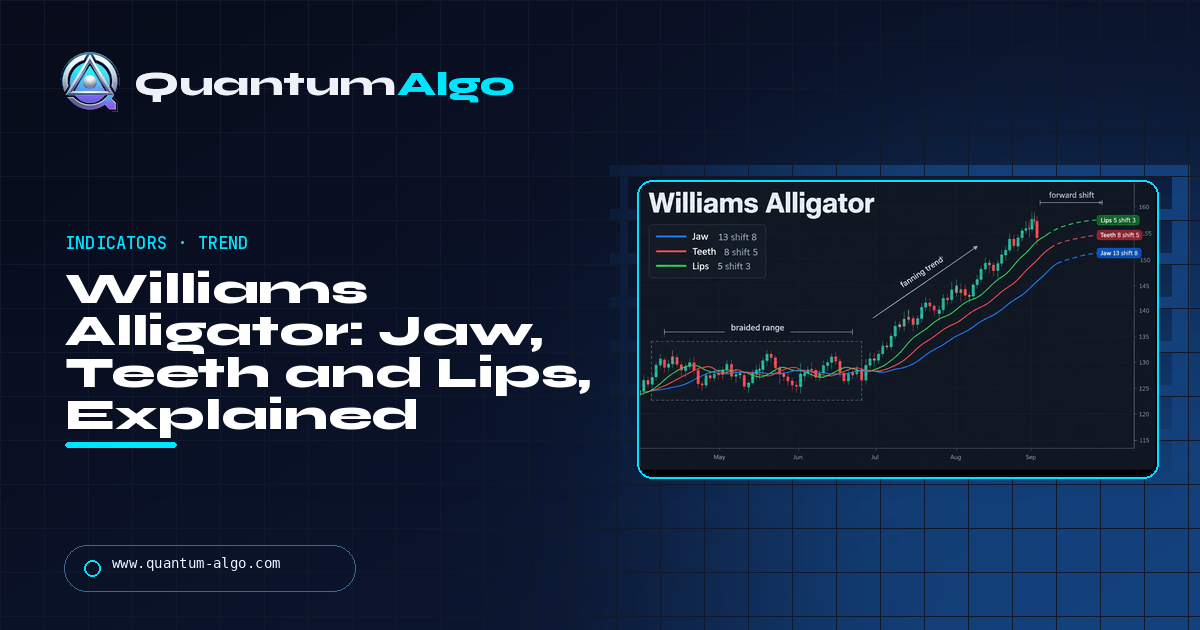
The Williams Alligator is three smoothed moving averages of the median price, each shifted forward: the Jaw (13 periods, 8 bars ahead), the Teeth (8 periods, 5 ahead) and the Lips (5 periods, 3 ahead). When the lines braid together the alligator is asleep and you do not trade; when the Lips cross the Teeth and the lines fan apart in order it is awake and eating — a trend. Bill Williams' entry was a fractal breaking outside the Teeth after a sleep, with the stop under the Jaw and the exit when the Lips cross back through the Teeth. Without the fractal rule it is a 5/8 moving-average cross, and trades like one.
The Alligator is the indicator everyone has seen and almost nobody trades the way its author did, because the part that makes it work — do nothing while it sleeps, enter only on a fractal break outside the Teeth — is the part that gets dropped. This page is the three lines and why they are shifted, the four phases, the Williams entry step by step, an ETHUSDT 4-hour trend caught after a fourteen-day sleep and the false wake that preceded it, and the comparison with Ichimoku and EMA ribbons. The calculator computes the lines from highs and lows and names the phase.
Indicators that prove themselves in public.
One engine, four precision tools — the Gold (XAU) Scalper, the institutional Gravity Zone, the Zeno momentum Oscillator, and Zeno Stocks for equities.
What the Williams Alligator is
The Williams Alligator is three smoothed moving averages of the median price, each shifted forward into the future: the Jaw (13 periods, pushed 8 bars ahead), the Teeth (8 periods, 5 bars ahead) and the Lips (5 periods, 3 bars ahead). Bill Williams introduced it in Trading Chaos (1995) as the centrepiece of his system, with the animal metaphor doing real work: when the three lines braid together the alligator is asleep and the market is ranging; when they fan apart in order — Lips on top, then Teeth, then Jaw for an uptrend — it is awake and eating; when the Lips turn back toward the Teeth it is satiated and the move is ending.
Two things make it more than three moving averages with colours. The forward shift means the lines sit ahead of price, so price crossing them is a comparison against where the average was several bars ago — a built-in lag that filters small pullbacks. And the "sleeping" state is an explicit no-trade signal, which most moving-average systems do not have: the Alligator is one of the few classic indicators whose main output is "do nothing".
What it does not do: it does not predict. It is a trend-following filter with a lag of several bars, it enters late by design, and in a range it will cross and uncross the same way any MA set does — which Williams handled by refusing to trade until a fractal broke outside the Teeth, a rule that most people using the indicator today have dropped and should not have.
The three lines
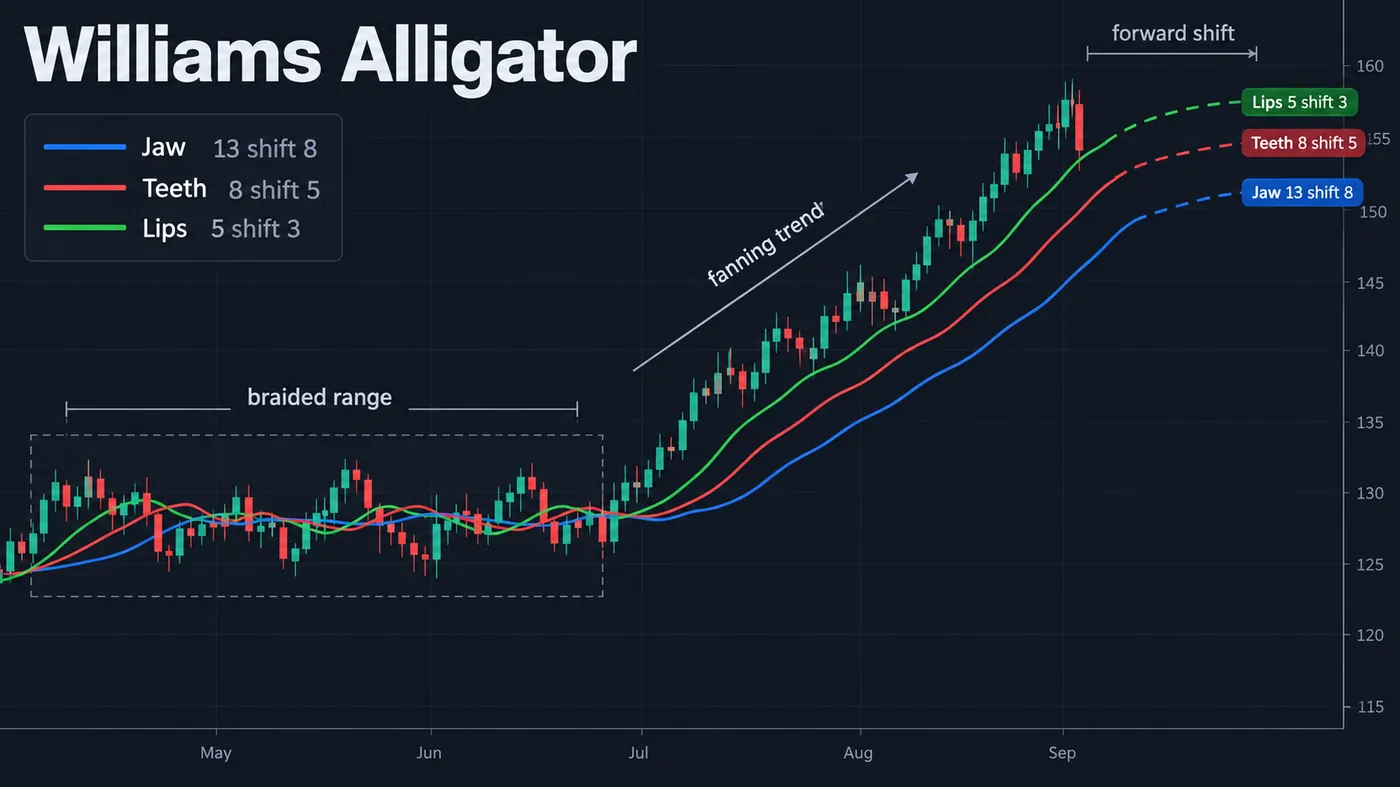
| Line | Colour (Williams) | Formula | Shift | Role |
|---|---|---|---|---|
| Jaw | Blue | SMMA of median price, 13 periods | 8 bars forward | The balance line of the longest timeframe; the slowest |
| Teeth | Red | SMMA of median price, 8 periods | 5 bars forward | The middle timeframe; the line a fractal must break for an entry |
| Lips | Green | SMMA of median price, 5 periods | 3 bars forward | The fastest; price rides it in a trend and its cross back through the Teeth is the exit |
Median price is (high + low) ÷ 2. SMMA is the smoothed moving average — Wilder's smoothing, the same as in RSI and ATR — so the lines are slower than an EMA of the same length. The shift is the unusual part: TradingView plots each line offset to the right by its shift, which is why the Alligator extends past the last candle. When you read a value on the current bar you are reading an average computed three, five or eight bars ago.
The four phases
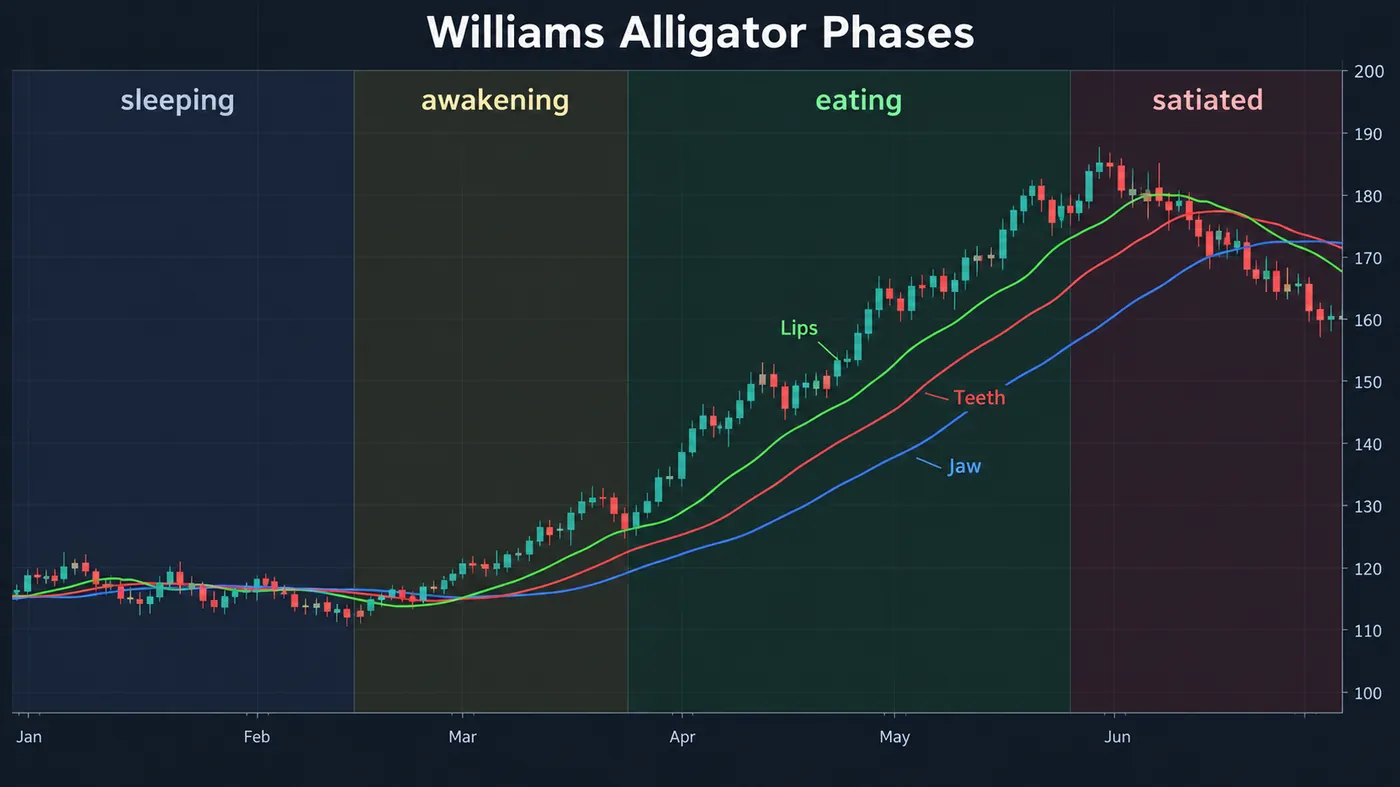
Sleeping. The three lines braid together and cross repeatedly with almost no spread between them. Williams' rule: the longer the sleep, the hungrier the alligator, and the larger the move that follows. The only job in this phase is to mark the fractals forming above and below the range.
Awakening. The Lips cross above the Teeth and Jaw (bullish) or below them (bearish) and the lines begin to separate. On its own this is a moving-average cross and it fails in ranges like any other. Williams' confirmation was a fractal — a five-bar high with two lower highs on each side — breaking above the Teeth. That break is the entry.
Eating. The lines are fanned in order, Lips above Teeth above Jaw, and price rides above the Lips, pulling back to it and no further. This is the phase the indicator is for. Adding on pullbacks to the Lips is the textbook management.
Satiated. The Lips turn down and cross back through the Teeth. The trend is over or pausing; Williams closed the position here and went back to waiting for the next sleep to end.

Automate your trades. Let Quantum Algo trade for you.
Every signal executed on your own account — on your account, with the plan you define.
How to trade it
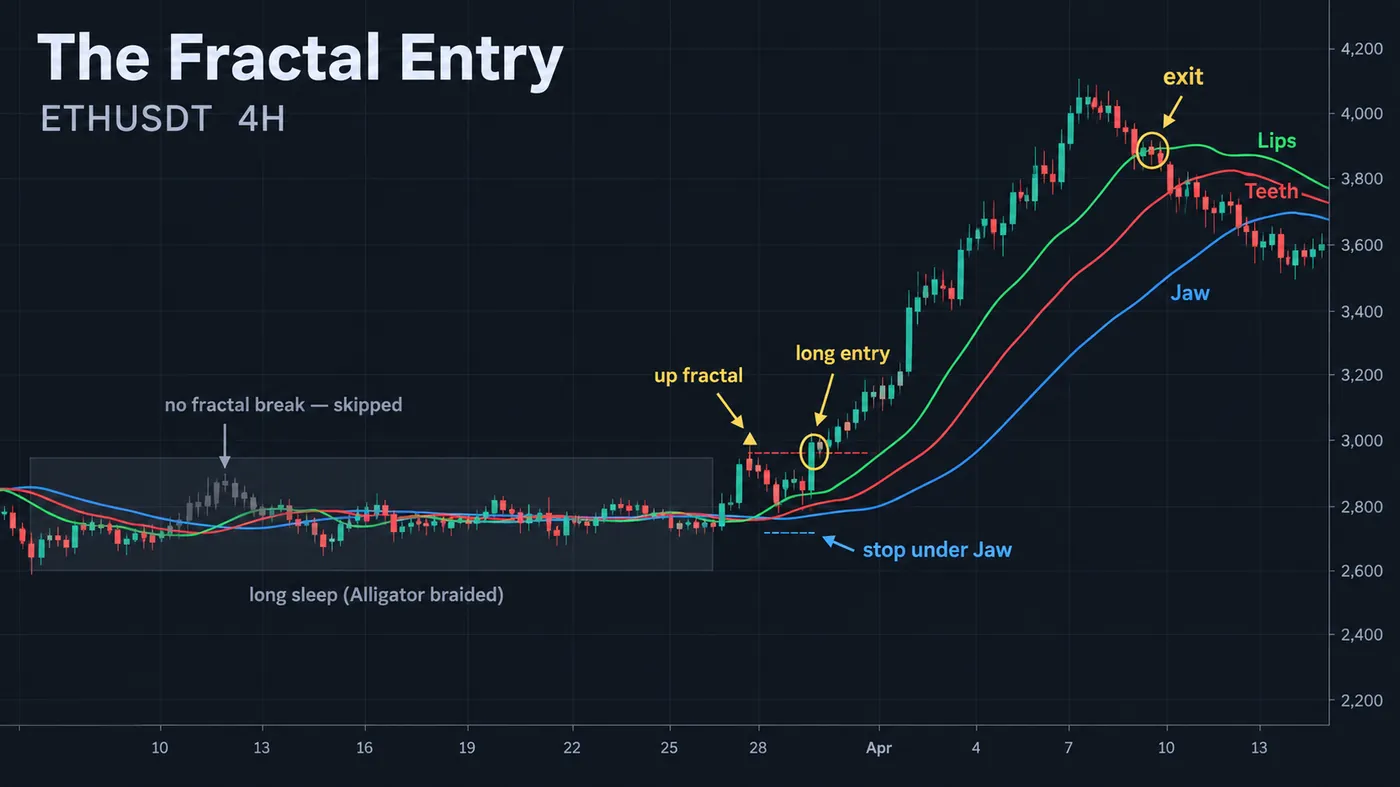
- Wait for a sleep. Braided lines for ten or more bars. No trades. Mark the up and down fractals that print during the sleep; they are the levels the breakout will use.
- Enter on the fractal break outside the Teeth. A buy stop one tick above the most recent up fractal that sits above the Teeth (bullish); a sell stop below the down fractal below the Teeth (bearish). This is Williams' first wise-man entry and it is what stops the MA cross from being traded on its own.
- Confirm the wake. By the time the fractal breaks, the Lips should be above the Teeth and separating. If the lines are still braided when the fractal breaks, it is a range breakout and half of them fail — halve the size.
- Stop under the Jaw. The Jaw is the slowest line and the last one price should be on the wrong side of in a trend. Under the last down fractal is the tighter alternative.
- Add on pullbacks to the Lips. In the eating phase, each touch of the Lips that holds is an add, with the stop moved to the Teeth.
- Exit when the Lips cross back through the Teeth. Or, more conservatively, on a close below the Teeth. Do not wait for all three lines to cross; by then the move is long gone.
Alligator calculator
Paste a series of bar highs and lows (oldest first) and the tool computes the median price, the three smoothed averages with their shifts, the order of the lines and the phase — sleeping, awakening, eating up or down — using the same SMMA the TradingView built-in uses.
Alligator versus other moving-average systems
| System | Lines | Smoothing | Range handling | Where the Alligator differs |
|---|---|---|---|---|
| Alligator | 13 / 8 / 5 SMMA of median, shifted 8 / 5 / 3 | Wilder | Explicit "sleeping" no-trade state; fractal entry | — |
| EMA ribbon | Several EMAs of close | Exponential | None — crosses continuously | No shift, no no-trade state, faster and noisier |
| Ichimoku | Tenkan, Kijun, cloud shifted 26 forward | Midpoint of range | Cloud as neutral zone | Closest cousin: both shift lines into the future and both define a no-trade zone |
| Golden cross | 50 / 200 SMA of close | Simple | None | Far slower; a regime read, not an entry system |
| Supertrend | ATR trailing line | ATR-based | Whipsaws in ranges | Supertrend flips on volatility; the Alligator on price averages |
The honest comparison is with Ichimoku. Both push their slow lines forward, both define a zone where you are not supposed to trade, and both work for the same reason: they force you to wait for price to be clearly on one side of a lagging structure. The Alligator is simpler and the fractal rule is the part that makes it a system rather than a chart decoration.
Reference data
| Item | Value |
|---|---|
| Origin | Bill Williams, Trading Chaos (1995) and New Trading Dimensions (1998) |
| Input | Median price (high + low) ÷ 2 |
| Jaw | SMMA 13, shifted 8 bars forward (blue) |
| Teeth | SMMA 8, shifted 5 bars forward (red) |
| Lips | SMMA 5, shifted 3 bars forward (green) |
| Phases | Sleeping (braided) · awakening (Lips cross) · eating (fanned in order) · satiated (Lips turn back) |
| Entry (Williams) | A fractal breaking outside the Teeth after a sleep |
| Stop | Under the Jaw, or under the last opposite fractal |
| Exit | Lips crossing back through the Teeth |
| Companion tools | Fractals, Awesome Oscillator, Accelerator Oscillator (the rest of the Williams system) |
| TradingView | Built-in "Williams Alligator" with the 13/8/5 and 8/5/3 defaults; "Williams Fractal" separately |
Worked example: ETHUSDT 4-hour, a long sleep and a clean wake
ETHUSDT perpetual, 4-hour chart. The alligator slept for fourteen days — eighty-four bars — while price ranged between 3,380 and 3,480. Four up fractals printed during the sleep; the highest at 3,478. On the eighty-fifth bar the Lips crossed above the Teeth at 3,431 and the lines began to separate; on the eighty-seventh a candle closed at 3,491, through the 3,478 fractal that sat above the Teeth. The buy stop at 3,479 filled on that bar. Stop under the Jaw, which read 3,418 on that bar, sixty-one dollars of risk.
The eating phase ran eleven days. Price pulled back to the Lips five times — 3,512, 3,548, 3,590, 3,634, 3,671 — and held each time; two of those were adds with the stop trailed to the Teeth. The Lips crossed back down through the Teeth on the twelfth day at 3,742, and the position closed there: 263 dollars on the original entry, 4.3R, with the adds contributing another 1.8R at their own risk.
The trap on the same chart: on the fortieth bar of the sleep the Lips had crossed above the Teeth and a 5-minute trader's eye would have called it a wake. No fractal broke outside the Teeth — the highest fractal held — and the lines re-braided four bars later. The cross was there; the confirmation was not. That distinction is the whole difference between Williams' system and a three-MA cross, and it is the rule most people drop.
Where the Alligator fails
Ranges without a proper sleep. Short, choppy ranges where the lines braid for three bars and cross for three bars produce endless false wakes. Require a sleep of at least ten bars before you count a wake.
Traded as an MA cross. The Lips crossing the Teeth is a 5/8 moving-average cross. Without the fractal confirmation it has the win rate of a 5/8 cross, which is poor.
Late entries and late exits. The shift and the smoothing mean the entry is several bars into the move and the exit several bars after the top. In fast markets the give-back at the end is large; the Lips close-below exit helps.
Low timeframes. On 1- and 5-minute charts the alligator is never truly asleep and never truly eating. 1-hour and above for crypto and indices, daily for stocks.
V-reversals. A market that reverses hard without a sleep gives the alligator no setup at all. The indicator only catches trends that start from a range, which is many but not all of them.
Mistakes traders make with the Alligator
- Skipping the fractal. The Lips crossing the Teeth is the wake; the fractal breaking outside the Teeth is the entry. They are different events.
- Trading during the sleep. The braid is a no-trade signal, and it is the indicator's best signal.
- Reading the shifted lines as current. The value plotted on this bar was computed 3, 5 or 8 bars ago; the shift is the point.
- Exiting when all three lines cross. Wait for the Lips to cross the Teeth, not for the Jaw; the Jaw is eight bars behind the move.
- Changing the parameters. 13/8/5 with 8/5/3 shifts are the system. Faster settings turn it into a ribbon.
- Using it on 1-minute charts. There is no sleep at that resolution.
The Alligator and the free indicators
The TradingView built-ins for the Alligator and the Williams Fractal are exact and sufficient. What the library adds is the reason a wake is worth taking: the Smart Money Concepts Engine shows whether the fractal break is also a break of structure, the Adaptive Trend Sentinel reads the regime the alligator is trying to detect, and the Trendline Architect draws the range the sleep is happening in. The premium engine, Zeno, prints buy and sell signals with a stop and targets; a Zeno buy signal on the first pullback to the Lips after a confirmed wake is a continuation entry the Williams system would recognise.
Three shifted averages and one rule that matters: do not trade the sleep, and do not trade the wake without a fractal breaking outside the Teeth. Enter on that break, stop under the Jaw, add on pullbacks to the Lips, leave when the Lips cross back through the Teeth. Keep 13/8/5 and 8/5/3; use it on 1-hour and above. Traded as a bare MA cross it is a bare MA cross.
◆ Interactive check
Do you know the three lines?
Questions traders ask about the Williams Alligator
Three smoothed moving averages of the median price, each shifted forward into the future: the Jaw (13 periods, 8 bars ahead), Teeth (8 periods, 5 ahead) and Lips (5 periods, 3 ahead). Bill Williams introduced it in Trading Chaos (1995) as a trend filter with an explicit no-trade state — the "sleeping" alligator, when the lines are braided.
Jaw 13 with an 8-bar shift, Teeth 8 with a 5-bar shift, Lips 5 with a 3-bar shift, all smoothed moving averages of (high + low) ÷ 2. These are the TradingView defaults and the system; faster settings turn it into an ordinary EMA ribbon.
Wait for a sleep of at least ten bars with the lines braided. Mark the fractals that print during it. Enter with a stop order at the break of a fractal that sits outside the Teeth, once the Lips have crossed the Teeth. Stop under the Jaw, add on pullbacks to the Lips, and exit when the Lips cross back through the Teeth.
The three lines are intertwined with little spread between them — the market is ranging. Williams' rule is not to trade, and that the longer the sleep the larger the move that follows. The sleeping state is the indicator's most valuable output.
So that price is compared with where the average was several bars ago rather than where it is now. The shift builds in lag deliberately: small pullbacks do not reach the shifted lines, and only a real change of direction crosses them. It is the same idea as Ichimoku's cloud being plotted 26 bars ahead.
A five-bar pattern: an up fractal is a bar whose high is higher than the two bars either side; a down fractal is the mirror. Williams used the break of a fractal outside the Teeth as the entry trigger, which is the confirmation that separates his system from a plain moving-average cross.
On 1-hour, 4-hour and daily BTCUSDT and ETHUSDT charts, yes — the worked example on this page is a 4-hour ETH trade. On 1- and 5-minute charts the alligator is never clearly asleep or eating and the crosses are noise.
No. Each line is a smoothed average of completed bars, plotted forward by a fixed offset; values do not change after the bar closes. The forward-plotted portion beyond the last bar is simply the last computed values displayed at their shift.
Both shift their slow lines into the future and both define a zone where you do not trade (the braid, the cloud). Ichimoku uses range midpoints and has five lines plus a cloud; the Alligator uses smoothed averages and three lines with a separate fractal entry. Same logic, different machinery.
The TradingView built-ins for the Alligator and the Williams Fractal are exact. The library adds context: the Smart Money Concepts Engine for whether the fractal break is also a break of structure, the Adaptive Trend Sentinel for regime, and the Trendline Architect for the range the sleep is in. Zeno, the premium engine, prints signals with stops and targets.
References & Related Guides
Read next
- Ichimoku Cloud: Complete Guide
- Moving Averages: Complete Guide
- Awesome Oscillator
- Supertrend Indicator
- Golden Cross and Death Cross
- Aroon Indicator
- Choppiness Index
- BOS & CHoCH: Market Structure
- Adaptive Trend Sentinel (free indicator)
- Trendline Architect (free indicator)
- Smart Money Concepts Engine (free indicator)
- Zeno — the premium engine
Primary sources
- Williams, Trading Chaos (Wiley, 1995) — the Alligator, fractals and the wise-man entries
- Williams and Gregory-Williams, New Trading Dimensions (Wiley, 1998)
- TradingView: Williams Alligator (built-in indicator documentation)
- Wilder, New Concepts in Technical Trading Systems (1978) — the smoothed moving average