Smart Order Routing Explained: How Your Broker Decides Where Your Order Goes, and How to Check Your Fills
Smart order routing (SOR) is software at your broker that decides where each order goes. In the US the same stock trades on more than a dozen exchanges plus dark pools and wholesalers, so the router reads quotes, fees and fill rates across all of them and sends the order, often split into pieces, wherever it expects the best overall price and the fastest fill. Your broker is legally required to seek best execution, and it publishes where it routes orders every quarter.
When you press buy, your order rarely goes to 'the stock exchange'. It goes to a router that picks from dozens of places to trade in a fraction of a millisecond. That choice decides your fill price, how much of the order fills, and sometimes who gets paid for it. Here is how the router thinks, what the rules require, and how to tell whether yours is doing a good job.
What is smart order routing?
Smart order routing is the automated process of choosing where to send an order and how to break it up. Instead of a fixed destination, a smart order router (SOR) looks at every venue it is connected to, compares the price and size each one shows, adds its fees, and estimates the chance that the order will actually fill there. It then sends the order, or slices of it, to the best combination.
Routers exist because markets are fragmented. A US stock can trade at once on the NYSE, Nasdaq, Cboe and IEX families of exchanges, on dozens of dark pools (alternative trading systems that do not show their orders), and with wholesale market makers that fill retail orders internally. Crypto and FX are even more scattered across exchanges and liquidity providers.
How does a smart order router split an order?
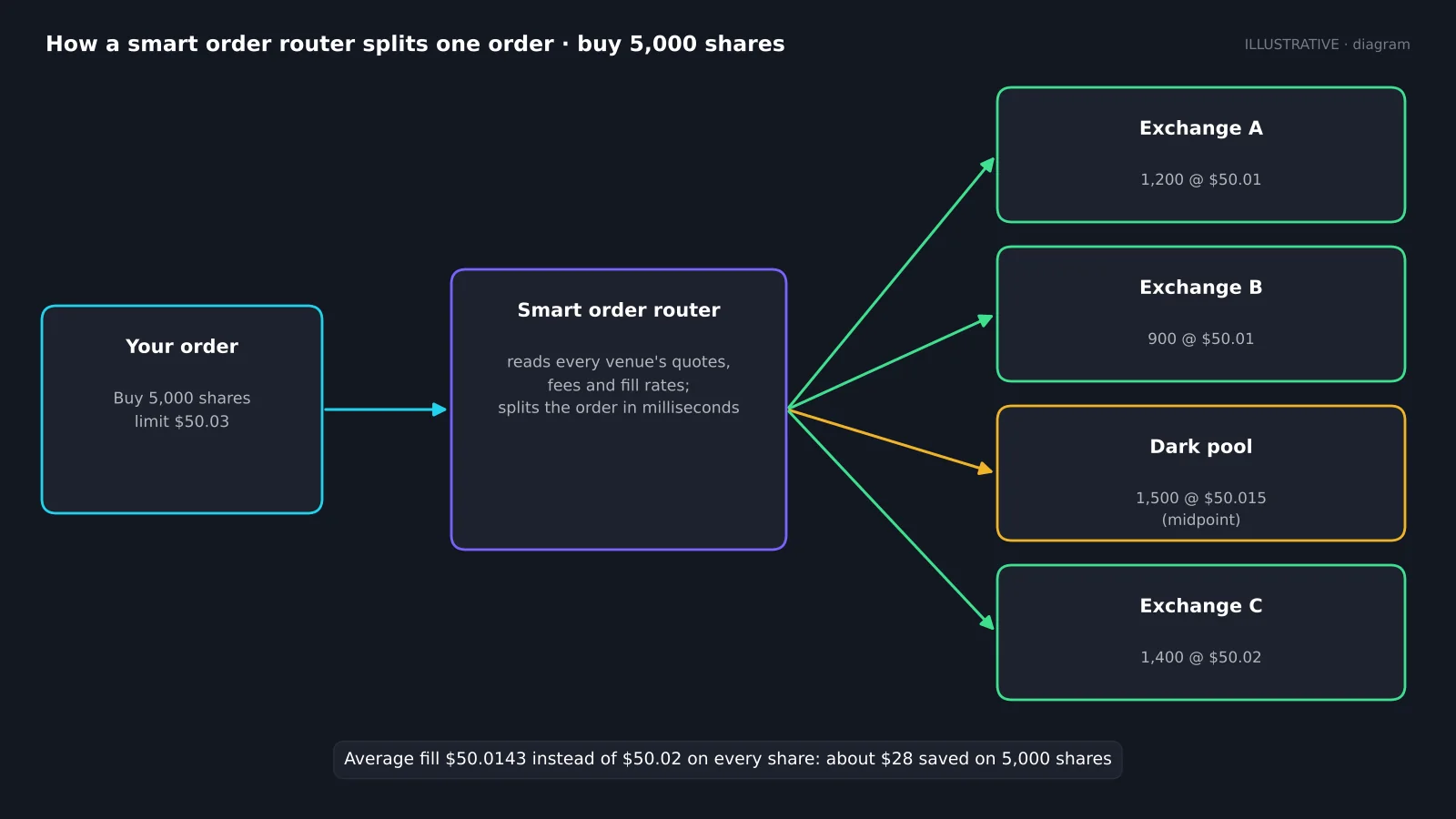
Say you want to buy 5,000 shares with a limit of $50.03. Two exchanges offer 2,100 shares between them at $50.01, a dark pool can match 1,500 at the midpoint of $50.015, and a third exchange has 1,400 at $50.02. The router takes the cheapest liquidity first, across all venues at once, and the whole order fills at an average of about $50.0143.
Sent to one exchange alone, the order would have taken that venue's $50.01 shares, then climbed to worse prices as it ate through the book. Routing across venues saves about $28 here; on larger orders, in thinner stocks, the gap grows quickly. The same logic underlies institutional execution algorithms like TWAP and POV, which decide when to trade, while the router decides where.
What does a smart order router take into account?
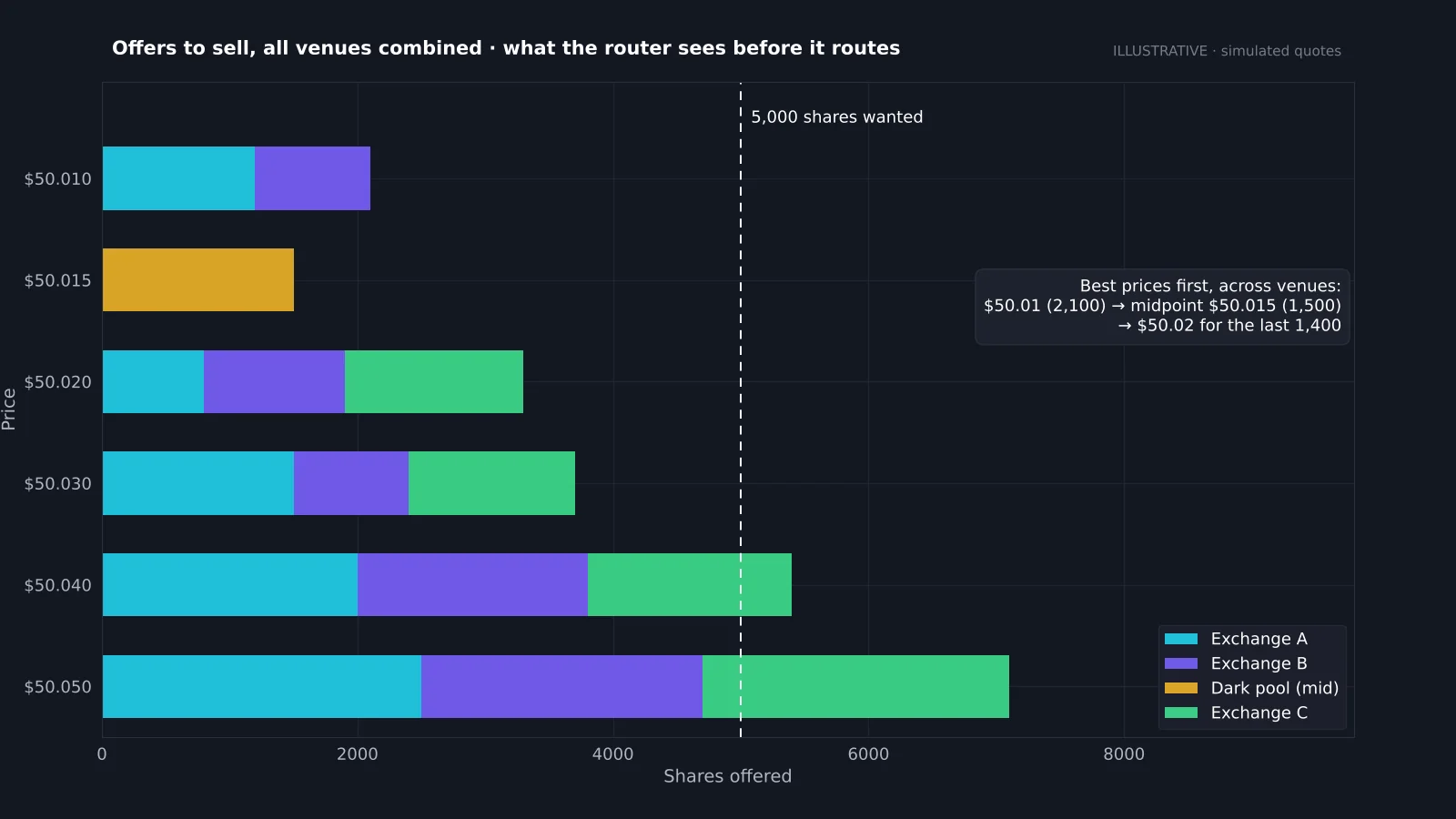
- Displayed price and size on every lit exchange, built into one consolidated book.
- Hidden liquidity: dark pools and midpoint orders that may fill without showing size.
- Fees and rebates: exchanges charge takers and pay makers small amounts per share; routers count them.
- Fill probability: historical stats on how often each venue actually fills at the shown price.
- Latency: sending to slower venues first so all slices arrive together and quotes do not fade.
- Information leakage: avoiding venues where showing an order tends to move the price against you.
Good routers update all of this continuously. Poor ones send to a default venue or to whoever pays the broker most, which is why routing quality varies so much between brokers.
What do Reg NMS and best execution require?
In the US, Regulation NMS (2005) ties the exchanges together. Its order protection rule bars trading through a better displayed quote on another exchange, so routers must sweep or route to the best price first. FINRA Rule 5310 then requires brokers to use reasonable diligence to get the best market for each customer order, looking at price, size, speed and likelihood of execution, and to review their routing regularly.
Reg NMS is being updated. The SEC approved smaller price increments for some actively traded stocks and lower exchange access-fee caps in 2024; the compliance date has since been pushed back, most recently to November 2027. When it arrives, half-penny quotes in liquid stocks will make routing decisions even finer-grained. In Europe, MiFID II imposes a similar best-execution duty.
What is payment for order flow, and how does it affect routing?
Most commission-free US apps send retail stock and options orders to a handful of wholesale market makers, who pay the broker a small amount per share or contract for the order flow. The wholesaler fills the order itself, usually at or slightly better than the best quoted price, and earns the spread.
The debate is whether the payment steers routing away from venues that would give you a better price. Supporters point to the price improvement wholesalers give against the national best bid and offer; critics note that the broker has a conflict of interest and that retail orders rarely reach the lit exchanges. Brokers must disclose these payments in their quarterly Rule 606 reports, and the UK, Canada and the EU restrict or ban the practice.
Direct routing vs smart routing: which should you use?
Some brokers, especially those aimed at active traders, let you route an order to a specific exchange yourself. Direct routing gives you control: you can post a limit order where it earns a rebate, target a venue with more size, or avoid one you suspect is leaking information. It also makes you responsible for the trade-offs the router would have handled.
| Smart routing | Direct routing | |
|---|---|---|
| Who picks the venue | The broker's algorithm | You |
| Splits across venues | Yes, automatically | No, one venue per order |
| Good for | Marketable orders, most traders | Passive limit orders, rebates, thin stocks |
| Typical brokers | All brokers by default | Active-trader platforms (e.g. IBKR Pro, DAS-based brokers) |
| Risk | Routing conflicts (PFOF) | Slower or worse fills if you pick badly |
For most traders, a good broker's smart router beats manual routing on marketable orders. Direct routing helps more with passive limit orders and in thin stocks you know well. Our order types guide explains how limit, stop and bracket orders interact with routing.
How does order routing work in crypto and forex?
Crypto has no national best price and no Reg NMS. Each exchange runs its own order book, and prices can differ by more than a spread between them. Crypto 'smart routing' exists at aggregators and some brokers, which split an order across exchanges or liquidity providers; on a single exchange you get only that exchange's book. Large buyers use OTC desks instead, as in our guide to OTC crypto trading.
Spot forex is dealer-based. Your broker either takes the other side itself or passes the order to banks and liquidity providers it aggregates. Execution quality shows up as spreads, slippage and rejects (last look), so comparing fills on the same news events tells you more than any marketing page.
How can you check your broker's order routing?
- Read the Rule 606 report. Every US broker publishes quarterly where it routed non-directed orders and what it was paid. It is usually linked in the site footer as "order routing disclosure".
- Look at Rule 605 statistics. Market centres publish execution quality: effective spreads, price improvement and fill speed.
- Compare your own fills. Note the bid and ask when you send a market order and the price you get. Price improvement means you were filled inside the spread.
- Test limit orders. See how often your limit orders at the bid or ask fill, and how fast.
- Log it. Add fill price and the quote at send time to your trading journal; after a few dozen trades the pattern is clear.
Which order types work best with smart routing?
Marketable orders, meaning market orders and limit orders priced at or through the opposite side, are where routing quality shows most, because the router decides which liquidity you take. Use a marketable limit rather than a pure market order so the router can never fill you beyond a price you accept.
Passive limit orders behave differently. The router posts them on a venue and they wait. Where they rest affects queue position and whether you earn a rebate or pay a fee. For large orders, splitting over time matters as much as splitting across venues; the iceberg orders guide covers showing only part of your size.
Reference data
| Item | Value |
|---|---|
| US equity exchanges | 16+ registered exchanges, plus 30+ ATSs (dark pools) |
| Order protection | Reg NMS Rule 611 (no trade-throughs) |
| Best execution | FINRA Rule 5310 |
| Routing disclosure | SEC Rule 606, quarterly |
| Execution quality stats | SEC Rule 605 |
| Access-fee cap (current) | $0.003 per share; lower caps and half-penny ticks delayed to Nov 2027 |
| EU equivalent | MiFID II best execution |
Order routing savings calculator
Enter the number of shares, the price you would pay on one venue and the average price the router achieved. The calculator shows the saving per share, in total and in basis points, and what it adds up to over a year of similar trades.
What should active traders look for in a broker's routing?
- Price improvement statistics published or available on request, not just "best execution" wording.
- A choice of direct routes if you trade thin stocks or post liquidity.
- Clear fee and rebate pass-through on direct-routed orders.
- Fast, stable connectivity, since quotes move while slow orders travel.
- Honest disclosure of payment for order flow in the 606 report.
Execution quality is one input among many. Our guide to the best trading platforms compares brokers on charts, data and costs as well.
Does smart order routing matter for retail traders?
For a buy-and-hold investor trading a few hundred shares of a large stock a few times a year, the difference between routers is pennies. For an active trader, small-cap trader or anyone trading size, it adds up: a cent a share on 1,000 shares a day is about $2,500 a year. The router you get is part of the broker you choose.
Use marketable limit orders, read your broker's 606 report once, check your own fills against the quote, and switch brokers if the numbers are consistently poor. That is most of the edge available on execution.
Smart order routing chooses venues for your order and splits it to find the best overall price and fill. It weighs quoted prices, hidden liquidity, fees, fill odds and speed. US rules (Reg NMS and FINRA best execution) set the floor; payment for order flow creates a conflict brokers must disclose in Rule 606 reports. Use marketable limit orders, check your price improvement, and log fills to judge your broker.
◆ Interactive check
Do you know where your order goes?
Questions traders ask about order routing
Generally yes. It finds the best displayed and hidden prices across venues faster than a person can. The quality depends on the broker's router and its incentives.
A router decides where an order goes; an execution algorithm such as TWAP or VWAP decides when and how much to trade. Algos usually use a router for each slice.
Not necessarily. Wholesalers often fill inside the spread. The concern is the conflict of interest and that you cannot easily compare with what other routing would have done.
Read your broker's quarterly Rule 606 report. Many brokers can also show the execution venue on each trade confirmation.
On many active-trader platforms, yes, through direct routing. Commission-free apps usually do not allow it.
A trading venue that does not display its orders. Trades there often happen at the midpoint of the public bid and ask.
Yes. Prices differ between exchanges and there is no rule forcing the best one, so aggregators and OTC desks matter more.
Being filled at a better price than the best quoted bid or offer when you sent the order.
References & Related Guides
Read next
- Order Types Explained
- What Is Slippage?
- How to Read Level 2
- Iceberg Orders
- TWAP Explained
- POV Algorithm Trading
- Interactive Brokers for Day Trading
- Best Trading Platforms
- Order Flow Trading
- OTC Crypto Trading