POV Trading Algorithm: The Complete Percentage of Volume Guide
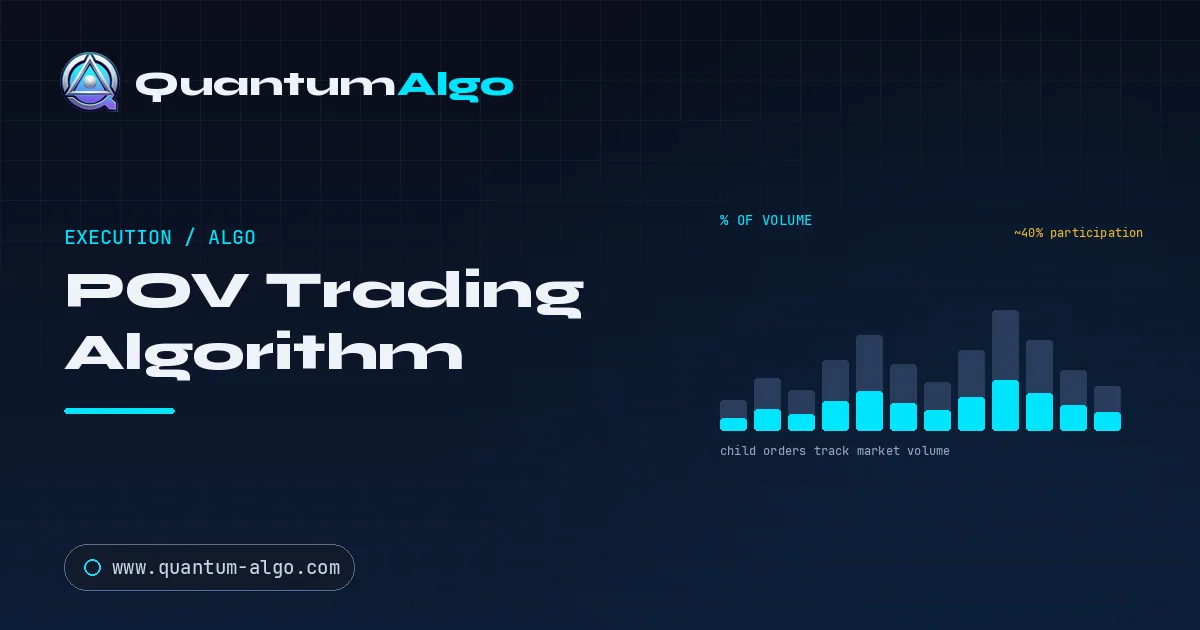
A POV (Percentage of Volume) algorithm is an execution algorithm that fills a large order by trading a fixed share of the market's ongoing volume, say 10%, until the order is complete. It splits the parent order into small child orders, trading more when the market is active and less when quiet, to minimize market impact and hide intent.
The POV algorithm — Percentage of Volume — is an execution algorithm, which is a different kind of tool from the indicators most retail traders know. It does not decide whether to buy or sell; it decides how to fill a large order once that decision is made, by trading a fixed percentage of the market's ongoing volume until the order is complete. Its whole purpose is to work a big position into the market quietly, without moving the price against itself or revealing the trader's hand.
This guide explains what the POV algorithm is, how it works, why institutions rely on it, how it compares to related execution algorithms like VWAP and TWAP, and what retail traders should understand about it even if they never run one directly. It is a clear look at the execution side of trading that most indicator guides ignore entirely.
What does a percentage of volume algorithm do?
Percentage of Volume is a participation-based execution algorithm. When a trader or fund needs to buy or sell a quantity far too large to execute in one go without disturbing the price, they hand the order to a POV algorithm with a target participation rate. The algorithm then breaks the parent order into many small child orders and releases them so that, over time, its trading makes up roughly that target percentage of the total volume trading in the market. If the rate is set to 10% and the market trades a million shares in an interval, the algorithm aims to execute about a hundred thousand of them.
The defining characteristic is that the algorithm's pace is tied to the market's actual activity, not to the clock. When volume surges, the algorithm trades more to keep its share constant; when volume dries up, it slows down. This makes it naturally adaptive — it is most active exactly when there is plenty of liquidity to absorb its orders, and it steps back when trading thin. The result is a large order worked into the market in proportion to real flow, which minimises the footprint it leaves behind.
Child orders track market volume
The algorithm trades a fixed share of whatever the market is doing — more in active periods, less in quiet ones.

Automate your trades. Let Quantum Algo trade for you.
Every signal executed on your own account — 24/7, hands-off.
What problem does a POV algorithm solve?
The problem POV solves is market impact. A large order dropped into the market all at once consumes the available liquidity, pushing the price away from the trader before the order is even filled — a buyer drives the price up against themselves, a seller drives it down. On top of that cost, a sudden large order signals intent to other participants, who can trade ahead of it. Execution algorithms exist to minimise both effects, and POV does so by hiding a big order inside the market's natural volume.
By never taking more than its set share of volume, a POV algorithm keeps its individual child orders small relative to what is already trading, so each one is easily absorbed and barely moves the price. Because it trades more when others are trading heavily, its activity blends into busy periods where it is hardest to detect. For a fund that needs to accumulate or distribute a position over hours or days, this quiet, proportional participation is often the difference between a good average price and a costly one — which is why POV is a staple of institutional execution desks.
How does the participation rate change speed and footprint?
The participation rate is the single most important setting, and it embodies a direct trade-off. A higher rate — say 30% — fills the order faster but leaves a larger footprint, since the algorithm is a bigger fraction of the market and its orders are more noticeable and more impactful. A lower rate — say 5% — is stealthier and gentler on the price but takes much longer to complete, exposing the order to the risk that the market moves away during the extended execution. Choosing the rate is a balance between urgency and impact.
The participation-rate trade-off
Higher rate fills faster but leaves a bigger footprint; lower rate is stealthier but slower.
Real implementations add nuance to keep the algorithm from being too predictable or too rigid. They often randomise the size and timing of child orders around the target so the pattern is harder to detect, cap participation during unusual volume spikes so a single burst does not drag the algorithm into over-trading, and let the trader set price limits beyond which it will pause. The core logic stays the same — trade a share of volume — but these refinements make it robust in messy real markets.
Higher rate
Faster completion, larger market footprint, more impact and detectability. Suited to more urgent orders where speed outweighs stealth.
Lower rate
Stealthier and gentler on price, but slower — and more exposed to the market drifting away during a long execution. Suited to patient, impact-sensitive orders.
Randomisation
Varying child-order size and timing around the target rate makes the algorithm harder for others to detect and trade against.
Volume caps & limits
Caps during volume spikes and price limits stop the algorithm from over-trading or chasing the market beyond acceptable levels.
How does POV differ from VWAP and TWAP?
POV is one of a family of execution algorithms, and it is best understood alongside its two closest relatives, VWAP and TWAP. All three work a large order into the market over time, but they schedule the trading differently.
Three ways to schedule a large order
TWAP follows the clock, VWAP follows a volume forecast, POV follows live volume in real time.
TWAP (Time-Weighted Average Price) simply divides the order into equal slices across a time period, ignoring volume — predictable but blind to liquidity. VWAP (Volume-Weighted Average Price) schedules trading to match a forecast of the day's volume distribution, aiming to beat or match the volume-weighted average price. POV differs from both by reacting to actual, live volume rather than a clock or a forecast: it does not care how long execution takes, only that it maintains its share of whatever is really trading. That makes POV the most adaptive to real-time conditions, at the cost of an uncertain completion time.
What can retail traders learn from POV?
Most retail traders will never run a POV algorithm — their orders are small enough to fill instantly without moving the market. But understanding execution algorithms is valuable anyway, for two reasons. First, they explain a lot about how markets actually move: the steady, volume-proportional buying or selling of large participants working orders through POV and VWAP is part of why price behaves the way it does around order blocks and liquidity, and it connects directly to the footprints that Smart Money Concepts traders try to read.
Second, the principles scale down. Even a retail trader entering a larger-than-usual position — for instance when scalping a thin market can borrow the core idea — break the order up, trade with the flow rather than against it, and avoid dumping size into a quiet book — to get a better fill. And anyone building or using automated trading systems benefits from understanding that execution is a distinct discipline from signal generation: a good signal filled badly can still lose money — a hidden cost even careful risk management can miss, which is why serious automated strategies treat execution with as much care as entries.
When should you use POV, VWAP or TWAP?
Choosing among POV, VWAP, and TWAP comes down to the order's urgency, the trader's benchmark, and the market's liquidity. The table below summarises when each tends to fit best.
| Algorithm | Schedules by | Completion time | Best when |
|---|---|---|---|
| POV | Live volume (fixed share) | Uncertain | You want to blend into real flow, impact matters most |
| VWAP | Forecast volume curve | Fixed window | Your benchmark is the volume-weighted average price |
| TWAP | Even time slices | Fixed window | Simplicity, or volume data is unreliable |
None is universally best. A desk with an urgent order and a hard deadline may prefer VWAP or an aggressive POV rate; a desk prioritising stealth in a liquid name may run a low POV rate and accept an uncertain finish. The skill is matching the algorithm and its settings to the specific order and market — the same judgment, scaled up, that a day trader uses when deciding how patiently to enter a position.
Execution versus signal generation
The POV algorithm highlights a distinction that serious traders internalise: generating a trade idea and executing it are two separate disciplines. An indicator or strategy tells you what to trade; an execution algorithm decides how to get filled. Both affect your bottom line, but they are optimised differently.
Execution is a separate discipline from the signal
A good idea filled badly still loses; both sides need care.
Signal side
Deciding direction, entries, and exits — the job of indicators, structure, and strategy. This is where an edge is found.
Execution side
Getting the decided order filled at the best possible average price with minimal impact — the job of algorithms like POV, VWAP, and TWAP.
Why both matter
A good signal filled badly can still lose, and a great fill of a bad idea still loses. Automated systems that ignore execution quietly bleed edge through slippage.
Limitations of the POV algorithm
POV is powerful but not flawless, and its trade-offs matter. Because its pace depends on market volume, its completion time is unpredictable — a quiet market can leave a large order unfilled far longer than intended, exposing it to adverse price moves. It can also be gamed: because it must trade more when volume rises, other participants can, in principle, generate artificial volume to lure a POV algorithm into trading at unfavourable prices, which is why real implementations cap participation during suspicious spikes.
It is also purely an execution tool with no view on price — it will diligently work a bad decision to a good average price, filling a losing trade as efficiently as a winning one. Execution quality and trade quality are separate; a POV algorithm optimises the former and says nothing about the latter. Understood within those limits, it remains one of the most widely used and effective ways to move size through a market with minimal disturbance.
• Institutional footprints — Liquidity, order blocks and structure that large execution algorithms leave behind
• Trade with the flow — Context to position alongside institutional accumulation and distribution
• Accountable performance — A verified public track record behind every signal
◆ Read the footprints of institutional flow
Quantum Algo's Smart Money Concepts tools map the liquidity, order blocks and market structure that large execution algorithms leave behind — helping you trade alongside institutional flow rather than against it, all backed by a verified public track record.
See the indicator → Verify the track recordFrequently Asked Questions
POV stands for Percentage of Volume. It is an execution algorithm that fills a large order by trading a fixed percentage of the market's ongoing volume until the order is complete. It does not decide whether to buy or sell — that decision is already made — it decides how to work a big position into the market quietly, trading more when the market is active and less when it is quiet so the order blends into natural flow and minimises price impact.
You give the algorithm a parent order and a target participation rate, say 10%. It breaks the order into many small child orders and releases them so that, over time, its trading makes up roughly that percentage of total market volume. If the market trades a million shares in an interval at a 10% rate, the algorithm executes about a hundred thousand. Its pace is tied to actual market activity, so it speeds up when volume surges and slows when volume dries up.
To minimise market impact. A large order executed all at once consumes available liquidity and pushes the price against the trader, while also signalling intent to others who can trade ahead of it. A POV algorithm keeps its child orders small relative to what is already trading, so each is easily absorbed and barely moves the price, and it blends into busy periods where it is hardest to detect. For accumulating or distributing a big position over hours or days, this quiet participation often means a much better average price.
The participation rate is the share of market volume the algorithm targets, and it is the key setting. A higher rate (e.g. 30%) fills the order faster but leaves a larger, more detectable footprint with more impact. A lower rate (e.g. 5%) is stealthier and gentler on price but takes longer, exposing the order to the risk that the market drifts away during execution. Choosing the rate balances urgency against impact.
Both are volume-aware execution algorithms, but they schedule trading differently. VWAP (Volume-Weighted Average Price) schedules its trading against a forecast of how the day's volume will be distributed and aims to match or beat the volume-weighted average price over a fixed window. POV reacts to actual live volume in real time, maintaining a set share of whatever is really trading, with no fixed completion time. POV is more adaptive to real-time conditions; VWAP is anchored to a benchmark and schedule.
TWAP (Time-Weighted Average Price) divides an order into equal slices spread evenly across a time period, ignoring volume entirely — it is simple and predictable but blind to liquidity. POV instead ties its trading to live market volume, taking a fixed share of whatever is actually trading. TWAP finishes in a known time regardless of conditions; POV adapts to real flow but has an uncertain completion time. TWAP suits simplicity or unreliable volume data; POV suits blending into natural liquidity.
Most retail traders never need one, because their orders are small enough to fill instantly without moving the market. However, the principles scale down: when entering a larger-than-usual position in a thin market, a retail trader can borrow the core idea — break the order up, trade with the flow, and avoid dumping size into a quiet book — for a better fill. Understanding POV also clarifies how large participants move markets and why execution is a discipline separate from signal generation.
In principle, yes. Because a POV algorithm must trade more when volume rises, other participants can attempt to generate artificial volume to lure it into trading at unfavourable prices. This is why real implementations include safeguards such as capping participation during suspicious volume spikes, randomising child-order size and timing to be less predictable, and letting traders set price limits beyond which the algorithm pauses. These refinements make it more robust against manipulation and messy real-market conditions.
Its main limitations stem from its volume dependence. Completion time is unpredictable — a quiet market can leave a large order unfilled far longer than intended, exposing it to adverse price moves. It can be gamed by artificial volume, requiring caps during spikes. And it is purely an execution tool with no view on price: it will efficiently work a bad decision to a good average price, filling a losing trade as diligently as a winning one. Execution quality and trade quality are separate things.
Neither — it is an execution algorithm. Indicators and strategies decide what to trade and when; an execution algorithm like POV decides how to get a already-decided order filled at the best possible average price with minimal market impact. This distinction matters: a good trading signal filled badly can still lose money through slippage, which is why professional and automated trading treat execution as its own discipline alongside signal generation.
Execution algorithms like POV and VWAP are part of how large institutional participants move size through the market, and their steady, volume-proportional buying and selling contributes to the liquidity dynamics and order-flow footprints that Smart Money Concepts traders try to read. Understanding that big orders are worked quietly into natural volume — rather than dumped at once — helps explain why price reacts around liquidity, order blocks, and key levels the way SMC frameworks describe.
Quantum Algo's Smart Money Concepts tools map the liquidity, order blocks, and market structure that large execution algorithms leave behind as they work size into the market. Instead of running an execution algorithm yourself, you use these tools to identify where institutional flow is likely accumulating or distributing and to trade alongside it rather than against it. With a verified public track record behind the signals, it turns an understanding of institutional execution into actionable retail positioning.
References & Related Guides
More in this topic
- VWAP Trading Guide
- Liquidity in Trading: Complete Guide — Order Blocks, Raids & Kill Zones
- Order Blocks Trading: Complete Guide (Identify, Grade & Trade OBs)
- Best Trading Bots — Ranked: Automate Your Trading
- Smart Money Concepts (SMC): Ultimate Trading Guide
- Day Trading Strategies Guide
- Scalping Trading Strategy: Complete Guide | Quantum Algo
- What Are the Best Indicators for Day Trading?
- What Are the Best Volume Indicators?
- Risk Management in Trading — The Complete Survival Guide
- Backtesting Trading Strategy — Complete Validation Guide
- Liquidity Sweep Trading: Stop Hunts Explained
- Crypto Trading for Beginners: Complete Guide
- Best TradingView Indicators
Core reading
- VWAP Trading Guide
- Liquidity in Trading: Complete Guide — Order Blocks, Raids & Kill Zones
- Best Trading Bots — Ranked: Automate Your Trading
- All Premium Guides
- Public Track Record
- Quantum Algo on TradingView