OTC Crypto Trading Explained: How OTC Desks Work, When They Beat an Exchange, Minimums, Settlement and Scams
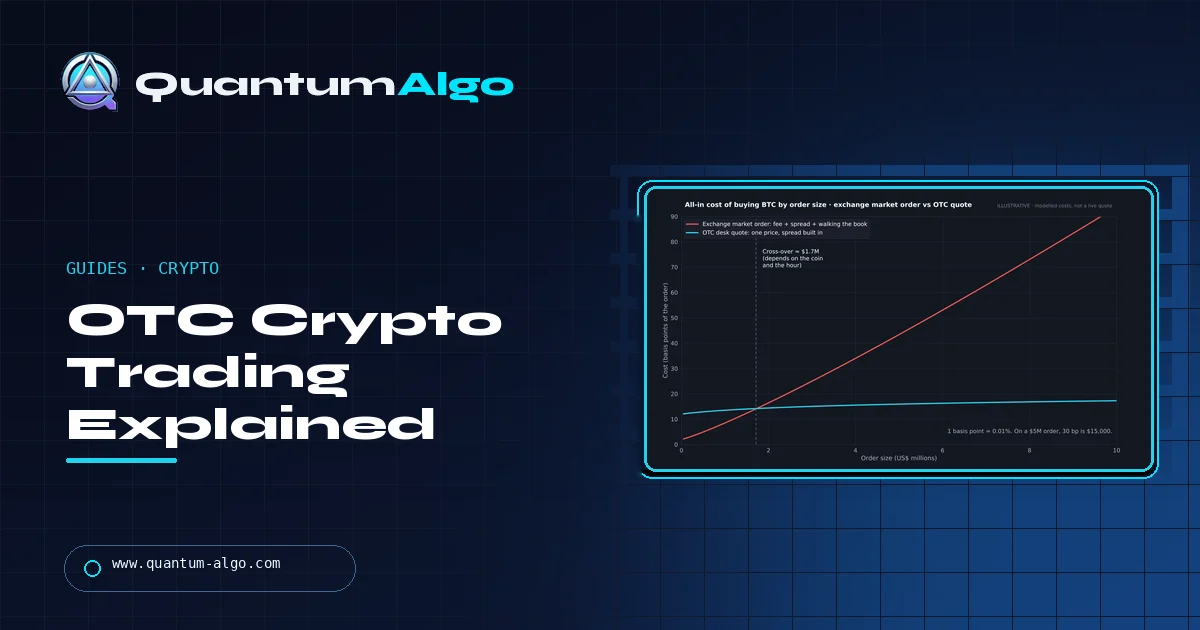
OTC (over-the-counter) crypto trading means buying or selling a large amount of crypto directly with a trading desk instead of through an exchange order book. You ask for a quote, the desk gives you one all-in price for the full size, and if you accept, the trade settles privately between you and the desk. It avoids the slippage of a big market order and keeps the trade off the public book. Major desks usually start at $50,000 to $250,000 per trade and require full identity checks.
If you have ever placed a big market order on a thin altcoin and watched the fill price run away from you, you already understand why OTC desks exist. Above a certain size, the order book simply does not hold enough coins near the current price. I'll show you how an OTC trade works from onboarding to settlement, where the break-even sits against an exchange, what the major desks ask for, and the warning signs of the fake "OTC brokers" that target people with large balances.
What is OTC crypto trading?
Over-the-counter trading is any trade agreed directly between two parties rather than matched on a public exchange. In crypto, it usually means a client trading with an OTC desk: a team at an exchange, a market maker or a broker that quotes prices for large orders and fills them from its own inventory or by sourcing liquidity across many venues.
The trade never appears on the exchange's order book. The client sees one price for the whole size, agrees to it, and the two sides swap cash and coins. It is the crypto version of the block trading that institutions have used in stocks and bonds for decades. If you are still learning how exchanges work, our crypto trading beginner's guide covers the basics first.
How does an OTC crypto trade work?
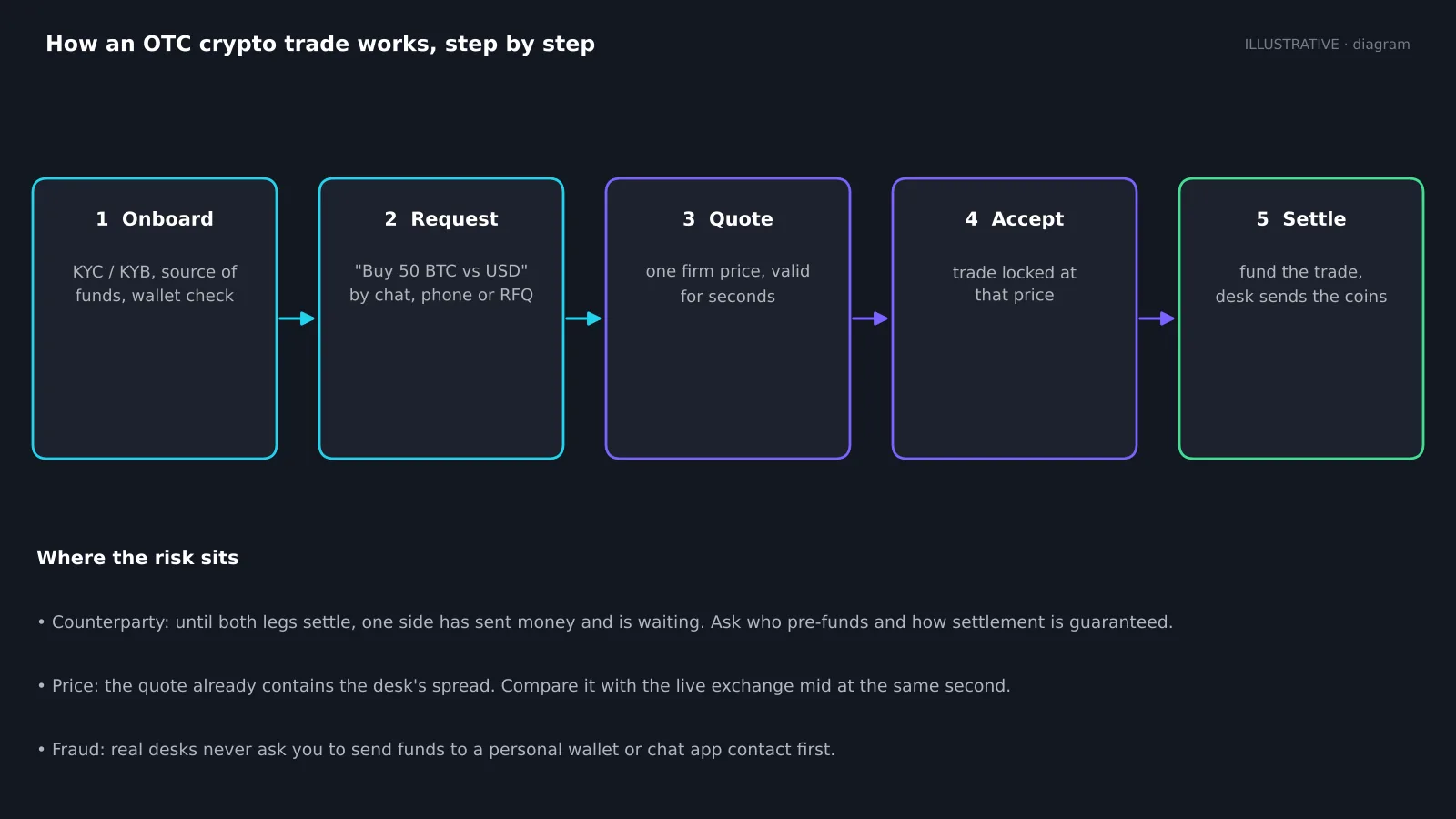
The process is similar at every serious desk:
- Onboard. Full identity checks (KYC for individuals, KYB for companies), source of funds, and wallet verification. This can take days, so do it before you need to trade.
- Request a quote. Tell the desk the coin, side and size, for example "buy 50 BTC against USD", by chat, phone or an RFQ screen.
- Get a price. The desk returns one firm price, valid for a few seconds.
- Accept. The trade is locked at that price. Nothing hits the public order book.
- Settle. You fund the trade and the desk delivers the coins, or the reverse when you sell, usually the same day.
Many exchange-run desks, such as Kraken OTC, settle directly into your exchange account, which removes most of the transfer risk. Independent desks may settle wallet to wallet and bank to bank, which is where the risk sits.
Why do large traders use OTC desks?
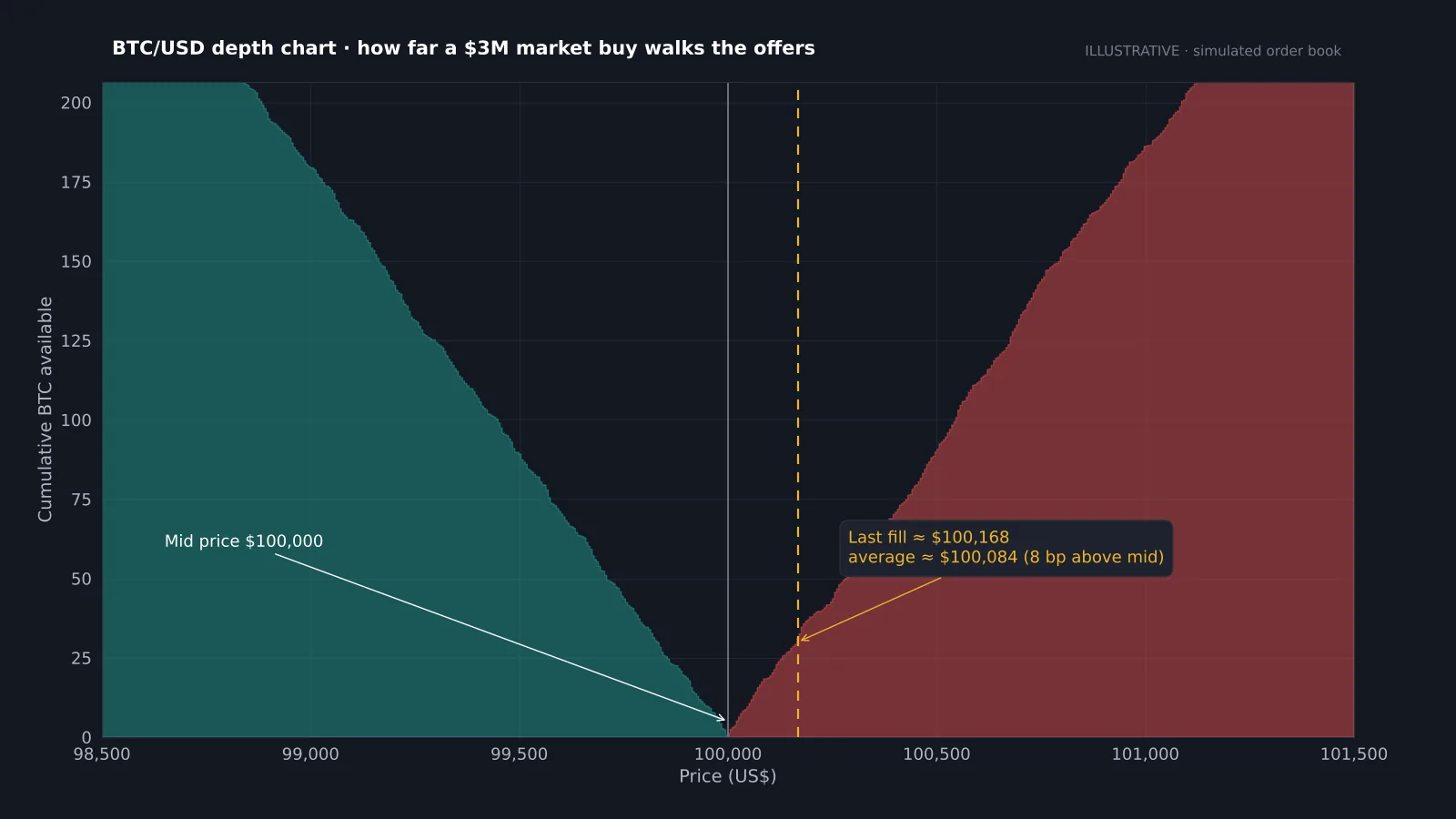
Because big market orders are expensive. An order book only holds so many coins near the current price. A large market buy takes every offer at the best price, then the next level, then the next, until it is filled. The average price you pay can end up well above the price you saw.
In the example above, a $3 million market buy walks the offers from $100,000 to about $100,168, for an average fill roughly 8 basis points above the mid-price. On $3 million that is about $2,400 lost to slippage before fees. On a smaller altcoin with thinner books, the same order could move the price several percent. A large visible order can also tip off other traders, who move the price ahead of you. OTC solves both problems: one price, no footprint on the book.
OTC vs exchange: when does OTC actually save money?
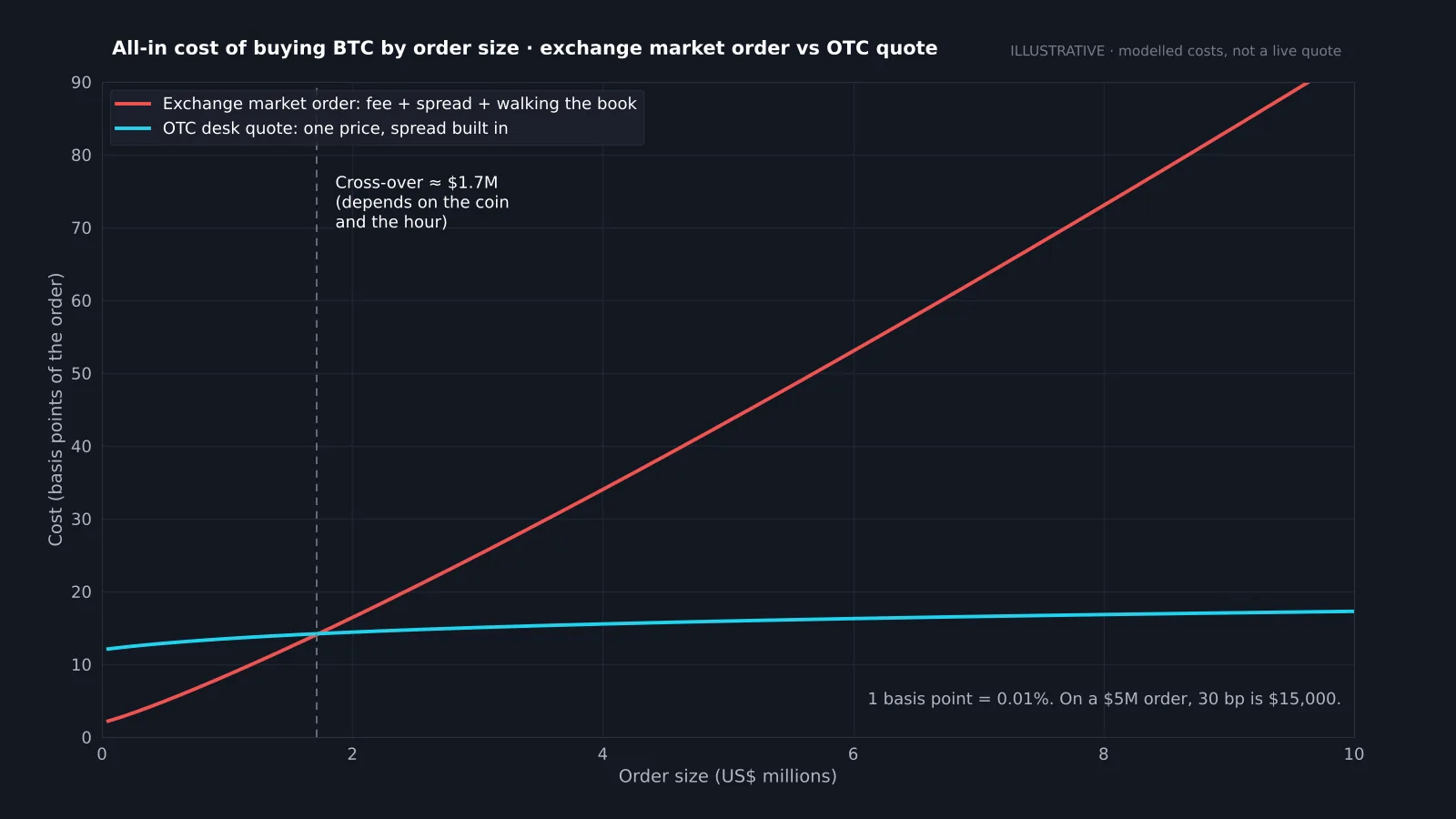
On an exchange, cost grows with size: fee, plus half the spread, plus market impact that rises as the order eats deeper into the book. An OTC quote has a spread built in, but it stays fairly flat as size grows, because the desk can fill from inventory and hedge over time. Below the cross-over point, the exchange is cheaper. Above it, OTC wins, and the gap widens quickly.
| Exchange | OTC desk | |
|---|---|---|
| Price | Fills across many levels | One firm price for the full size |
| Cost | Fee + spread + market impact | Spread built into the quote |
| Visibility | Public order book | Private |
| Minimum size | None | About $50k–$250k |
| Speed | Instant | Seconds to quote, same-day settlement |
| Best for | Small and medium orders | Large orders and illiquid coins |
The cross-over depends on the coin, the time of day and current depth. For bitcoin during busy hours it can be in the low millions; for a mid-cap altcoin it might be tens of thousands. The calculator below lets you test your own numbers.
Which OTC desks are there, and what are the minimums?
OTC desks fall into three groups: desks run by exchanges, desks run by trading firms and market makers, and brokers that route between them. Minimums change and are often negotiable, so treat these as starting points and confirm with the desk:
| Desk | Type | Typical minimum |
|---|---|---|
| Kraken OTC | Exchange desk | $50,000+ |
| Coinbase Prime | Exchange institutional platform | About $50,000+ |
| Binance OTC | Exchange desk | About $50,000+ |
| Cumberland (DRW) | Trading firm | About $100,000+ |
| Galaxy | Trading firm | About $200,000+ |
| Wintermute | Market maker | About $200,000+ |
Exchange-run desks are usually the simplest route for an individual, because onboarding and settlement use the account you already have. Institutional desks focus on funds and companies and may ask for more documentation.
What do you need to trade OTC?
- Size: enough to meet the desk's minimum on each trade.
- Verified identity: full KYC, and KYB documents for a company, often including beneficial owners.
- Source of funds: bank statements or tax records showing where the money came from, especially for large first trades.
- Whitelisted accounts: bank accounts and wallet addresses registered in advance.
- A plan for custody: know where the coins will sit after settlement, on the exchange or in your own wallet.
Legitimate desks are strict about this. A desk that skips identity checks is a red flag, not a convenience.
How is an OTC quote priced?
Most desks quote an all-in price with no separate commission. Their fee is the spread between the quote and the market mid-price. For major coins in normal conditions that spread is often in the region of 0.1% to 0.35%; for illiquid coins or volatile moments it is wider.
To judge a quote, check the live mid-price on two or three large exchanges at the same second and calculate the difference. Ask for quotes from more than one desk for big trades. And remember the quote is only valid for seconds: if you hesitate, the desk will requote at the new market price. Understanding the order book helps you judge whether the quote beats what the exchange would have given you.
What are the risks of OTC crypto trading?
The biggest risk is settlement. Until both sides have delivered, one party has sent money and is waiting. Ask every desk three questions: who sends first, how long the gap lasts, and what happens if the other side fails to deliver. Exchange-run desks that settle inside your account largely remove this. With independent desks, prefer those that use custodian-based or simultaneous settlement.
The second risk is price. You lock the price at acceptance, but if you settle later and the market moves, nothing changes for you; it does for the desk. Some desks protect themselves with credit limits or pre-funding. The third is regulatory: rules for crypto brokers differ by country, so check that the desk is licensed or registered where you live.
How do you spot a fake OTC crypto broker?
Scammers love the word "OTC" because it suggests privacy and big money. Watch for these signs:
- Contact through Telegram, WhatsApp or social media instead of a company website and account manager.
- Prices below the market, or "discounted" coins.
- Requests to send funds first to a personal wallet or a third-party bank account.
- No identity checks, or checks done by a person rather than a verification platform.
- Pressure to decide quickly, or a "minimum deposit" to see prices.
Real desks never ask you to pre-fund a personal wallet or to move money through a chat contact. If you are offered crypto below market, assume it is a scam. Our guide to safe trading platforms lists the regulator checks that apply here too.
Reference data
| Item | Value |
|---|---|
| Typical OTC minimum | About $50,000–$250,000 per trade |
| Kraken OTC minimum | Trades over $50,000 |
| Typical spread on major coins | About 0.10%–0.35% vs mid |
| Quote validity | Seconds |
| Usual settlement | Same day; exchange desks settle in-account |
| Onboarding | KYC / KYB, source of funds, whitelisted accounts |
| 1 basis point | 0.01% · $100 on $1M |
Exchange vs OTC cost calculator
Enter your order size and the costs you see. The calculator estimates the all-in cost of a market order on an exchange against an OTC quote and shows where the cross-over sits. Market impact is simplified as a fixed number of basis points per $1 million, so use it as a guide, not a quote.
What if your order is below the OTC minimum?
Most traders will never need an OTC desk, but the same principle applies at any size: do not let your order push the price. A few habits cut the cost of mid-sized orders on an exchange:
- Use limit orders instead of market orders; see order types explained.
- Split the order into smaller pieces over minutes or hours.
- Trade during the busiest hours, when books are deepest.
- Check depth before you trade, especially on smaller coins and on perpetual futures vs spot markets.
And watch where the large players are positioned. Big liquidation clusters and liquidity pools often attract price; the free Liquidation Magnet indicator maps them on TradingView.
Should you use an OTC crypto desk?
If you regularly trade six or seven figures at a time, or trade coins with thin order books, an OTC desk will usually save you money and keep your trades private. Start with the desk at an exchange you already use, onboard before you need it, compare the quote with the live mid and settle through the safest route the desk offers.
If your trades are smaller, an exchange with good limit-order habits is cheaper and simpler. Either way, never send funds to anyone who contacted you first claiming to be an OTC broker.
OTC crypto trading fills large orders directly with a desk at one quoted price, avoiding order-book slippage and keeping the trade private. Desks usually start around $50,000 to $250,000 and require full KYC. Exchanges are cheaper for small orders; OTC wins above a cross-over that depends on the coin and liquidity. The main risks are settlement and fake brokers, so use regulated or exchange-run desks and never pre-fund a personal wallet.
◆ Interactive check
Do you understand OTC crypto trading?
Questions people ask about OTC crypto trading
Over-the-counter: a trade agreed directly with a desk at one quoted price, outside the exchange order book.
Most desks start between about $50,000 and $250,000 per trade. Kraken OTC, for example, serves trades over $50,000.
Yes, when done through licensed or registered desks that follow KYC and anti-money-laundering rules. Rules vary by country.
For large orders, usually yes, because there is no slippage. For small orders, an exchange is cheaper.
Not directly, because they do not hit the public order book. Desks may hedge on exchanges afterwards, spread out over time.
Usually the same day. Exchange-run desks often settle instantly inside your account.
Yes, if they meet the minimum and pass identity and source-of-funds checks.
It onboards you through a company platform, checks your identity properly, settles to verified accounts and never asks you to send funds to a personal wallet.
References & Related Guides
Read next
- Crypto Trading for Beginners
- What Is Slippage?
- How to Read Level 2
- Order Types Explained
- Day Trading Crypto
- Perpetual Futures vs Spot
- Stablecoin Dominance
- Crypto Prop Firms
- Is Jane Street a Prop Trading Firm?
- Liquidation Heatmap Trading