Martingale Strategy in Trading: How Doubling Down Works, Why It Fails, and the Math Behind It
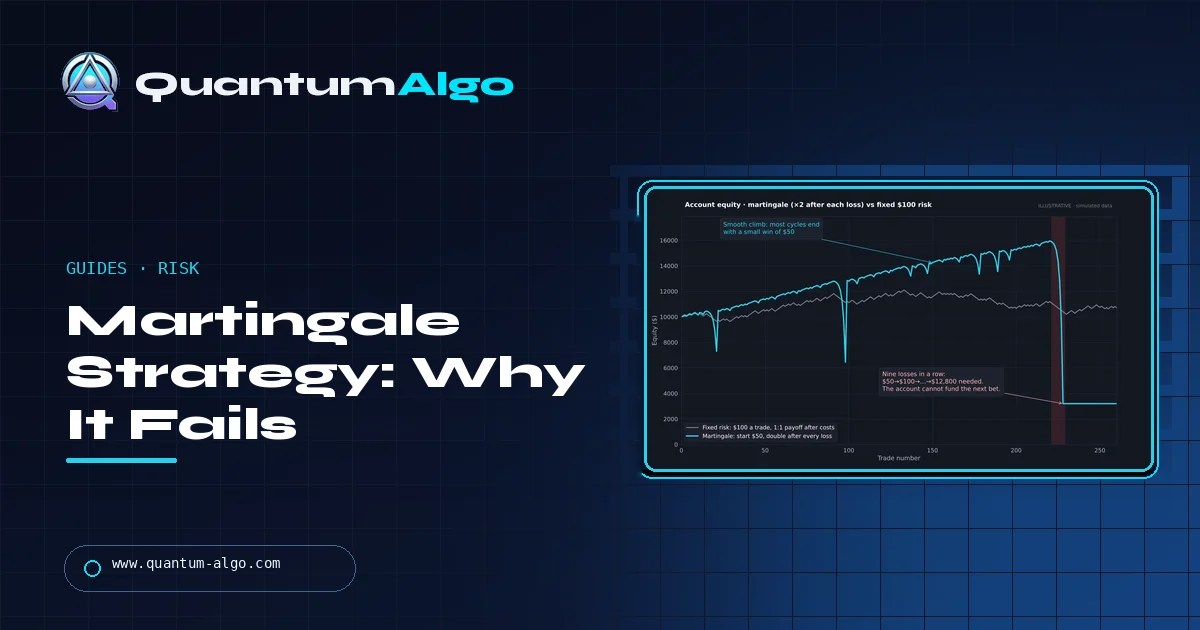
The martingale strategy doubles the position size after every loss, so the first win recovers all earlier losses plus one unit of profit. It wins small and often, which makes the equity curve look smooth, but the stake grows exponentially: ten losses in a row need 1,024 times the first bet. A long enough losing streak is certain over time, so martingale trades many small gains for a rare loss that wipes out the account.
Martingale is the oldest money-management system there is, and it keeps coming back as forex EAs, grid bots and "recovery" strategies. It feels safe because it wins almost every cycle. This guide shows exactly how the doubling works, the arithmetic of a losing streak, why trading makes it worse than a casino, the variants you will meet, and a calculator that shows the odds of ruin for your own numbers.
What is the martingale strategy?
The martingale strategy is a betting system from 18th-century France. You bet one unit; if you lose, you double the bet; you keep doubling until you win, then go back to one unit. Because each bet is larger than all previous losses combined, the first win always recovers everything and leaves a profit of exactly one unit.
In trading, the same idea shows up as doubling the lot size after a losing trade, adding a bigger position each time price moves against you, or opening grid orders at wider intervals. The goal is always the same: get back to break-even on a small bounce instead of needing the original trade to be right. It is the opposite of fixed-risk position sizing, where every trade risks the same share of the account.
How does martingale work in a trade?
Take a base stake of $50 on a trade that pays 1:1. Lose, and the next stake is $100. Lose again, $200, then $400. When a trade finally wins, it pays the current stake, which equals all previous losses plus $50.
| Losses before the win | Stakes placed | Total lost before the win | Winning stake | Net result |
|---|---|---|---|---|
| 0 | $50 | $0 | $50 | +$50 |
| 1 | $50, $100 | $50 | $100 | +$50 |
| 2 | $50, $100, $200 | $150 | $200 | +$50 |
| 4 | … $800 | $750 | $800 | +$50 |
| 6 | … $3,200 | $3,150 | $3,200 | +$50 |
| 8 | … $12,800 | $12,750 | $12,800 | +$50 |
Every row ends the same way: a net gain of $50, the size of the first bet. That is the appeal. The table also shows the problem: the amount at risk to win that $50 doubles on every row, and by the eighth loss you need $12,800 on the next trade to win back $50.
Why does the martingale strategy fail?
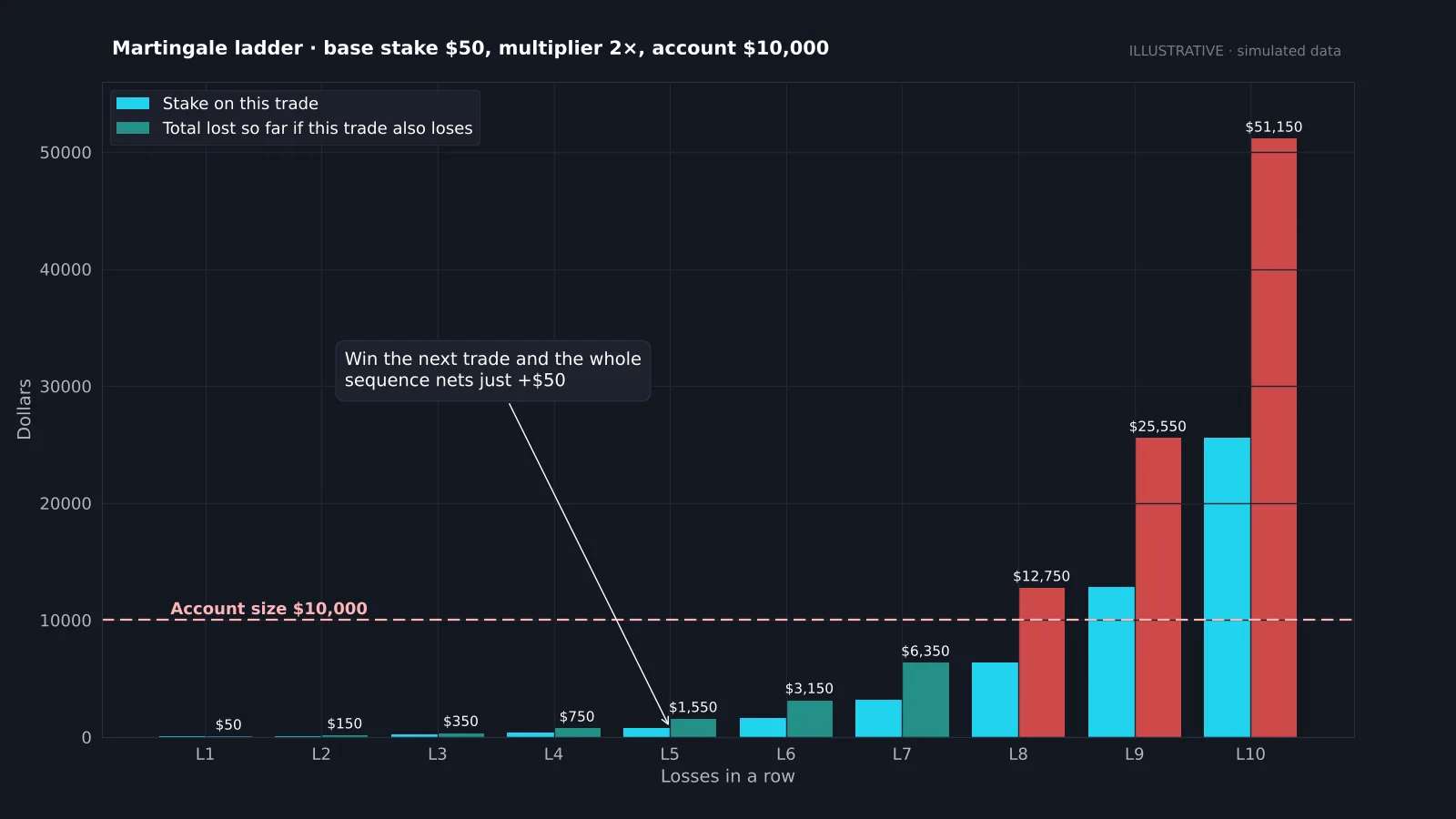
Martingale fails for one reason: the stake grows exponentially while the reward stays fixed. After n losses the next stake is 2ⁿ times the base, and the total already lost is 2ⁿ − 1 base units. With a $10,000 account and a $50 base, the seventh loss leaves $3,650; the eighth stake would be $6,400; after the eighth loss the account cannot fund the ninth bet at all.
A long streak is not a freak event. With a 50% chance of losing each trade, the chance of eight losses in a row starting on any given trade is about 0.4%. That sounds small, but over 1,000 trades the chance of seeing at least one such streak is roughly 86%. The calculator below works this out for your own win rate and account. Martingale does not remove risk; it gathers many small risks into one large one and postpones it.
Two more limits make it worse in practice. Brokers and prop firms cap position size, so the ladder can hit a wall before the account does. And margin requirements rise with the stake, so a broker may close positions before the winning trade arrives.
Indicators that prove themselves in public.
One engine, four precision tools — the Gold (XAU) Scalper, the institutional Gravity Zone, the Zeno momentum Oscillator, and Zeno Stocks for equities.
Why does a martingale equity curve look so good?
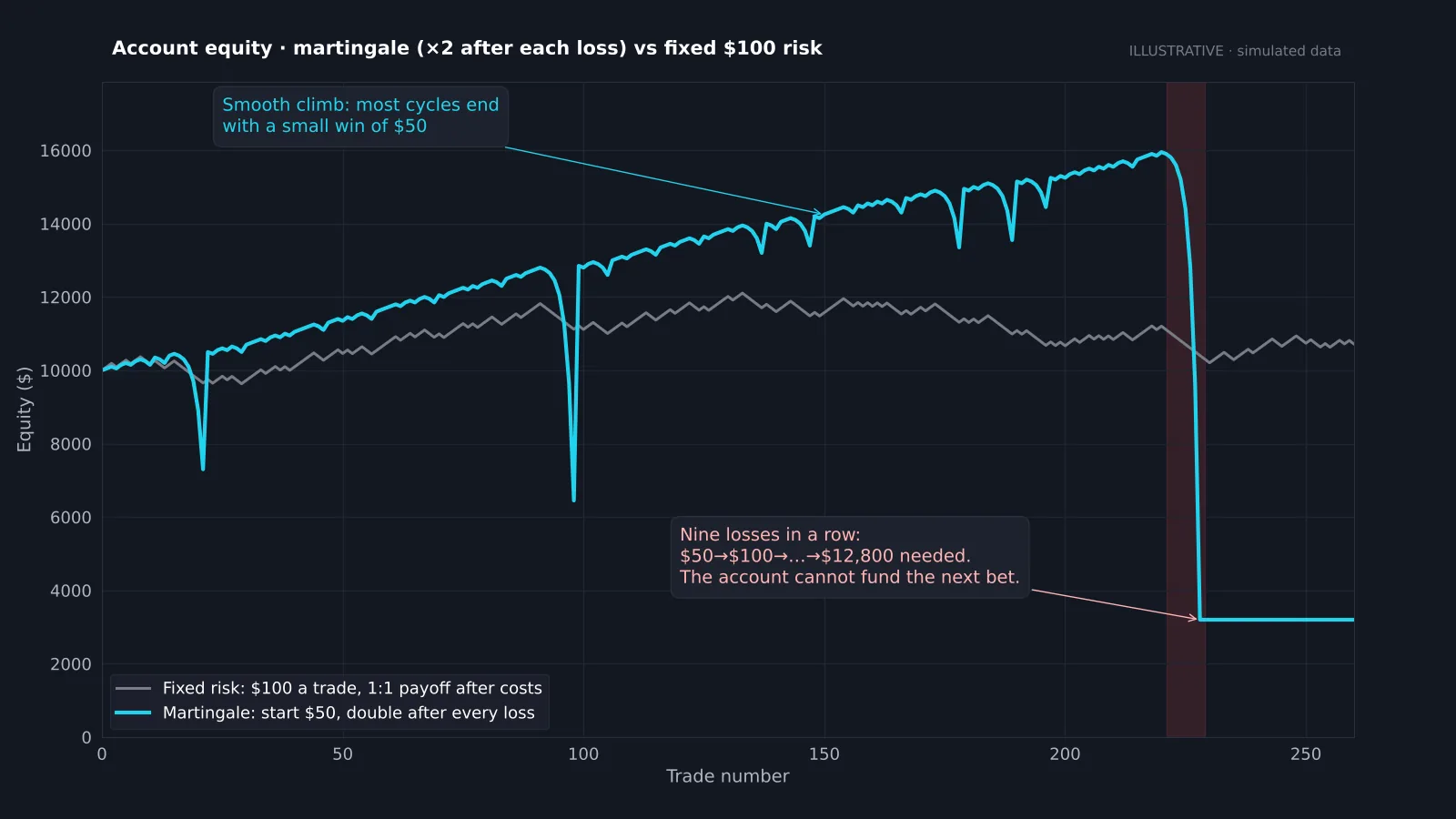
Most cycles end with a win within two or three trades, so the equity curve climbs in a smooth, steady line, with dips that recover quickly. A fixed-risk account trading the same signals moves up and down far more. For weeks or months the martingale curve looks like the better system.
Then a long streak arrives. In the simulation above, the account gains more than 50% over 220 trades, then nine losses in a row take it below a third of its starting value in a few trades, and the ladder cannot continue. This is why martingale EAs sell well on track-record sites: short histories look perfect. Our Myfxbook review explains how to spot doubling lot sizes and deep drawdowns on a verified account.
Is martingale in trading the same as at a casino?
It is worse in three ways.
- Losses are not fixed. A roulette bet loses exactly the stake. A trade can gap through its stop, so a losing streak can cost more than the table above shows. Read our guide to gaps.
- Outcomes are not independent. Markets trend. The same conditions that produced the last loss (a strong trend against you) often produce the next one, so long streaks are more common than coin-flip maths suggests.
- Costs grow with size. Spreads, commissions and swaps are paid on the whole position, so the doubled trades cost double. A strategy with a 1:1 payoff before costs has a negative edge after them.
Trading also offers a variant casinos do not: averaging down without a stop, where the "next bet" is simply adding to an open loser. That turns a losing streak into a single open position that keeps growing until the margin call.
What variants of martingale will you meet?
Few products call themselves martingale. These are the names to look for.
| Variant | How it sizes | Why it is risky |
|---|---|---|
| Classic martingale | Double after each loss, reset after a win | Exponential stake growth |
| Soft martingale (×1.3 to ×1.6) | Multiply by less than 2 | Needs several wins to recover; still exponential |
| Grand martingale | Double and add one unit | Grows even faster than classic |
| Averaging down | Add to a losing position at worse prices | One position keeps growing; no defined stop |
| Martingale grid | Pending orders at intervals, larger lots further away | Several stacked losers in a trend |
| Recovery zone / hedging EA | Opposite trades with growing lots | Same exponential exposure, harder to see |
The grid trading strategy guide covers grids in detail; most of what makes grids dangerous is the martingale sizing many of them add.
Martingale risk-of-ruin calculator
Enter your account, starting stake and multiplier, your win rate and how many trades you plan. The calculator shows how many losses in a row the account survives and the chance of meeting a longer streak.
The chance assumes each trade is independent and losses equal the stake. Real markets have trends and gaps, so treat the result as a best case.
What is the anti-martingale strategy?
Anti-martingale (sometimes called reverse martingale) does the opposite: increase size after wins and cut it after losses. Fixed-fraction sizing, where you risk the same percentage of current equity on every trade, is the most common form. When the account grows, the dollar risk grows; when it shrinks, the dollar risk shrinks.
Its weakness is the mirror image of martingale's: many small losses and fewer, larger wins, so the curve is bumpier. Its strength is that a losing streak can never wipe out the account by itself, because each loss is smaller than the last. That is why professional risk management and prop firm rules are built around it. Sizing can be tuned with the Kelly criterion, but most traders use a fixed 0.5% to 1% per trade.
Does martingale ever work?
Martingale works until it does not. It can produce months of steady gains, and some traders run it with very small base stakes, strict caps on the number of doublings and a stop on the whole cycle. Those rules limit the damage but also remove the promise: once you cap the ladder at, say, four doublings, you accept a defined loss on the fifth, and the system becomes an ordinary strategy that needs a real edge.
That is the core point. Martingale is a sizing rule, not a source of edge. If the underlying trades have a negative expectation after costs, any sizing rule loses in the long run; martingale just makes the loss arrive in one piece. If the trades have a positive expectation, fixed-fraction sizing captures it with far less risk. Our guide to whether swing trading is profitable shows how to measure that expectation.
Reference data
| Item | Value |
|---|---|
| Stake after n losses (×2) | Base × 2ⁿ |
| Total lost after n losses | Base × (2ⁿ − 1) |
| Net result of a completed cycle | +1 base unit (1:1 payoff, no costs) |
| Losses survivable with $10,000 and $50 base | 7 (the 8th loss leaves too little for the 9th bet) |
| Chance of 8 losses in a row at 50% (any start) | about 0.39% |
| Chance of seeing such a streak in 1,000 trades | about 86% |
| Safer alternative | Fixed-fraction (anti-martingale) sizing |
Can you use martingale at a prop firm?
In practice, no. Prop firm evaluations have a maximum drawdown and often a daily loss limit, so a single long ladder ends the account. Many firms also ban grid and martingale EAs outright in their prohibited practices, and position limits stop the doubling early. TradeDay, for example, bans automated systems and caps contracts by account size.
The same logic applies to a personal account with a broker: the broker's margin call is your drawdown limit. If you want to grow a small account faster, compound with fixed risk and track every cycle in a trading journal instead.
How do you spot a martingale EA or signal?
- Win rate above 85% with small average wins and occasional losses many times larger.
- Lot sizes that grow after losses in the trade history, often in steps of 1.5× to 2×.
- Several open trades in the same direction at worse and worse prices.
- Balance curve smooth, equity curve with deep dips: losing positions are held open until they recover.
- A short track record or one restarted with a custom start date.
- Marketing words: "recovery", "smart averaging", "no stop loss needed", "never had a losing month".
If two or more apply, assume the account will eventually meet the losing streak it is built to hide. Check the trading bots guide for what a robust automated system looks like instead.
Should you use the martingale strategy?
For almost every trader, no. Martingale converts a strategy's risk into a rare, catastrophic event, and the arithmetic guarantees that event if you trade long enough. It does not improve a weak strategy, and it adds needless danger to a strong one.
If you want steadier results, work on the edge and keep the risk per trade fixed. Mark structure and liquidity with the free Quantum Algo indicators, define the stop before the entry, and let compounding do the growing.
Martingale doubles the stake after each loss so one win recovers everything plus one unit. Stakes grow as 2ⁿ, so a long losing streak, which becomes near-certain over hundreds of trades, wipes out the account. Trading makes it worse: trends, gaps and costs. Use fixed-fraction sizing instead, and treat any EA with growing lots after losses as a martingale.
◆ Interactive check
Do you understand the martingale math?
Questions traders ask about the martingale strategy
A sizing rule that doubles the position after every losing trade and returns to the base size after a win, so the first win recovers all previous losses plus one base unit.
It produces small, frequent wins but eventually meets a losing streak the account cannot fund. Over enough trades that streak is close to certain, so it fails in the long run.
Leverage lets stakes grow fast, trends make losing streaks longer, gaps make losses bigger than planned, and margin calls can close the ladder before a win arrives.
Martingale increases size after losses; anti-martingale increases size after wins and cuts it after losses, which protects the account during losing streaks.
With a 2× multiplier, an account of B base units survives about log₂(B + 1) − 1 consecutive losses. A $10,000 account with a $50 base survives seven.
Not always. A grid with equal lot sizes is not, but many grid bots and EAs increase lot size at each level, which makes them martingale grids.
A high win rate makes long streaks rarer but not impossible, and the payoff stays tiny compared with the loss when one arrives. It does not create an edge.
Most ban martingale and grid EAs or make them impractical with drawdown limits, daily loss limits and position caps.
References & Related Guides
Read next
- Position Sizing
- Risk Management
- Grid Trading Strategy
- Myfxbook Review
- Is Swing Trading Profitable?
- Best Trading Bots
- What Is Margin Trading?
- Leverage Trading
- Trading Journal
- Prop Firm Trading Strategy
Primary sources
- Investor.gov (SEC) — margin call
- CFTC — forex trading scams and automated systems
- NFA — investor advisories
- Wolfram MathWorld — runs of consecutive outcomes