Hyperliquid Review: Fees, Leverage, Vaults, Risks, Pros and Cons
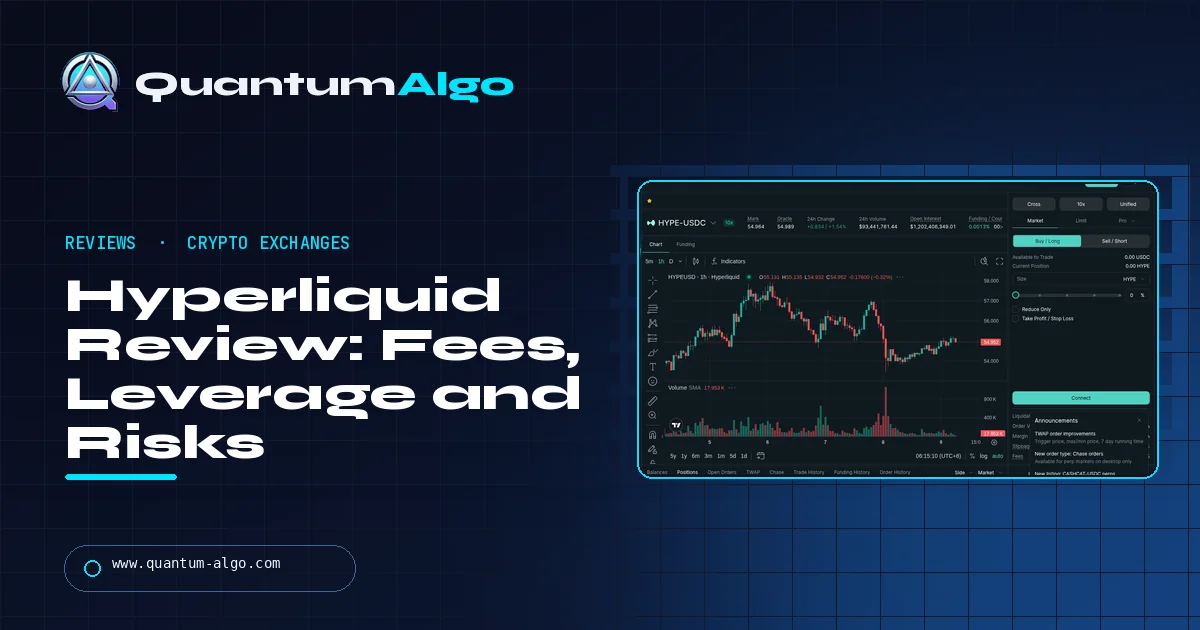
Hyperliquid is a decentralised exchange for crypto perpetual futures and spot, running on its own blockchain with a fully on-chain order book. You trade from your own wallet with no KYC, pay 0.045% taker and 0.015% maker on perps at the base tier, deposit USDC (mainly from Arbitrum) and can use leverage up to 40x on the largest markets. It is fast and cheap, but it does not serve US persons, and its validator set and past market-manipulation incidents are real risks to weigh.
Hyperliquid went from a niche decentralised exchange to one of the largest venues for crypto perpetual futures by doing something most DEXs could not: matching orders on a central limit order book that feels like a centralised exchange, without handing over custody or passing KYC. That combination comes with trade-offs that are easy to miss in the marketing. This review uses our own screenshots of the platform, taken in October 2026, to cover how it works, what it really costs, the vaults, the incidents that shaped its risk controls, who can use it and how it compares.
Indicators that prove themselves in public.
One engine, four precision tools — the Gold (XAU) Scalper, the institutional Gravity Zone, the Zeno momentum Oscillator, and Zeno Stocks for equities.
What is Hyperliquid?
Hyperliquid is a decentralised exchange (DEX) for crypto perpetual futures and spot trading. Unlike most DEXs, which use automated market makers or off-chain matching, it runs a fully on-chain central limit order book on its own layer-1 blockchain. Orders, cancellations, trades and liquidations are all recorded on chain, yet the experience is close to a centralised exchange: limit orders, depth, one-click trading and fast fills.
The project was built by Hyperliquid Labs, led by Jeff Yan, who previously ran the crypto market-making firm Chameleon Trading. It is widely reported to have launched without outside venture capital. Its native token, HYPE, launched on 29 November 2024 with a large airdrop to early users, and is used for staking, fee discounts and securing the network.
Technically the chain has two parts. HyperCore is the trading engine (order books, margin, liquidations, vaults). HyperEVM is an Ethereum-compatible smart-contract layer on the same chain, where other projects build lending, liquid staking and other DeFi applications. Consensus is a proof-of-stake algorithm the team calls HyperBFT. Since late 2025, the HIP-3 standard also lets third parties deploy their own perpetual markets on Hyperliquid's infrastructure, which is how markets beyond the core crypto pairs appear.
How does trading on Hyperliquid work?
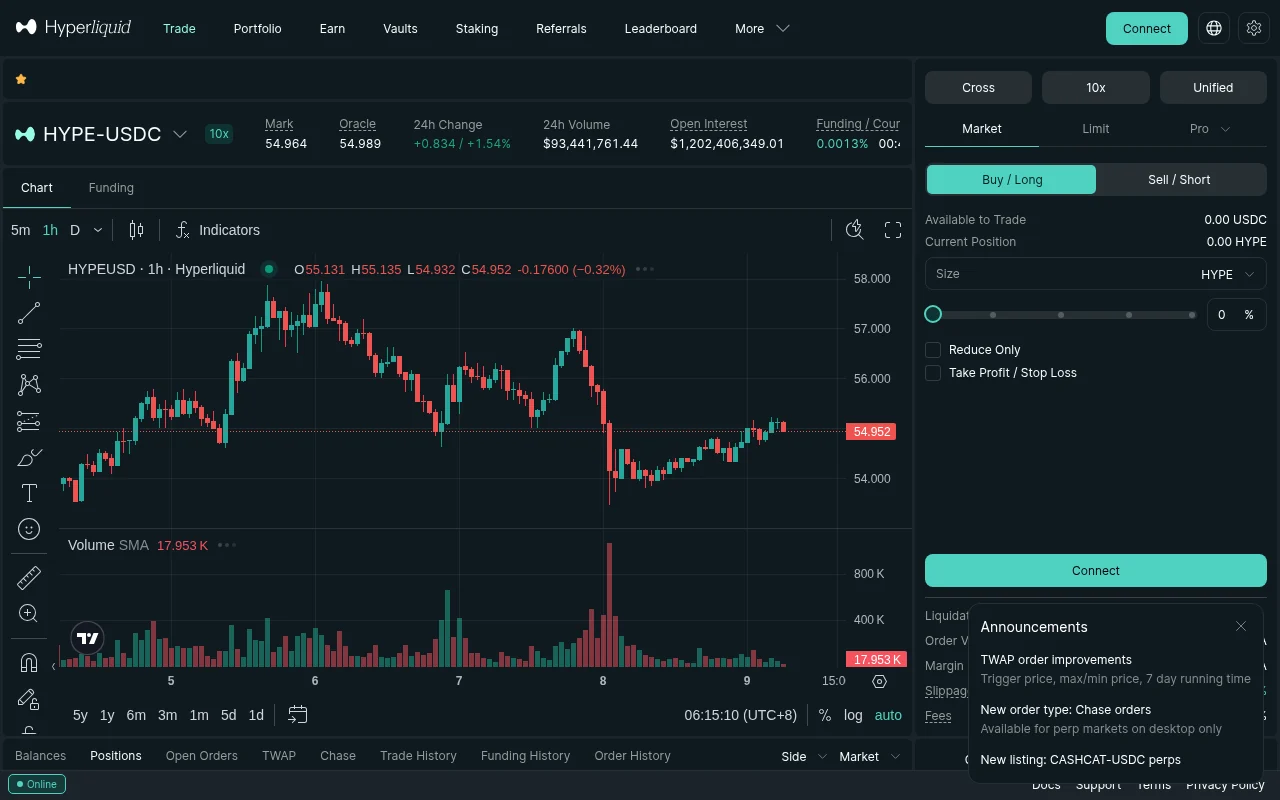
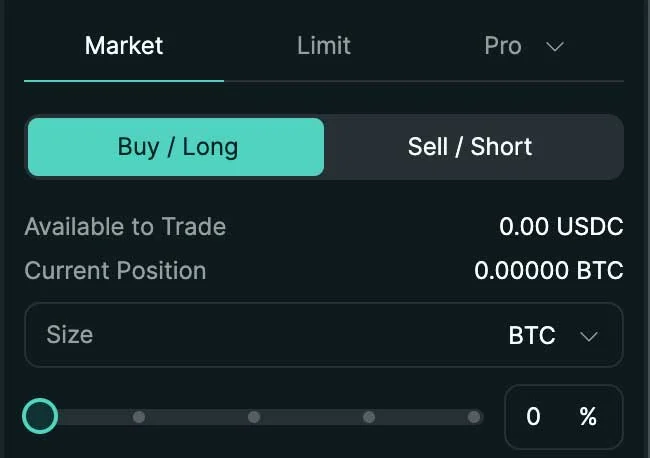
The trade screen will feel familiar to anyone who has used a centralised exchange. Across the top: the mark price (used for liquidations and unrealised P&L), the oracle price (an index of spot prices from external exchanges), 24-hour volume, open interest and the funding rate with a countdown. The chart is TradingView-based. The order panel sits on the right, and positions, open orders, TWAP orders and funding history sit below.
| Feature | Detail |
|---|---|
| Contracts | Linear perpetuals margined in USDC (a few, such as HYPE-USD, are USDC-denominated); spot pairs |
| Leverage | Up to 40x on the largest markets; many markets are capped at 3x–20x |
| Margin | Cross or isolated, per position; a unified account mode is also available |
| Funding | Paid every hour, not every eight hours |
| Order types | Market, limit, stop and take-profit, TWAP, scale; Pro menu for advanced types |
| Gas | None for trading; you only pay gas to deposit |
Two details deserve attention. First, hourly funding: rates are shown per hour, so a figure that looks tiny (0.0013% in our screenshot) adds up to about 0.03% a day or roughly 11% a year if it persisted. Our funding rate guide explains how to read it. Second, liquidation uses the mark price, not the last trade, which makes it harder for a single print to liquidate you but means you should place stops with the mark price in mind.
What are Hyperliquid's fees?
Fees are a percentage of notional, set by your 14-day weighted volume, with optional discounts for staking HYPE. Base rates, as published in Hyperliquid's documentation and checked in October 2026:
| Tier | 14-day weighted volume | Perps taker | Perps maker | Spot taker | Spot maker |
|---|---|---|---|---|---|
| 0 | Under $5M | 0.045% | 0.015% | 0.070% | 0.040% |
| 1 | >$5M | 0.040% | 0.012% | 0.060% | 0.030% |
| 2 | >$25M | 0.035% | 0.008% | 0.050% | 0.020% |
| 3 | >$100M | 0.030% | 0.004% | 0.040% | 0.010% |
| 4–6 | >$500M to >$7B | 0.028%–0.024% | 0.000% | 0.035%–0.025% | 0.000% |
Spot volume counts double toward your tier. Staking HYPE cuts every fee by 5% (more than 10 HYPE) up to 40% (more than 500,000 HYPE). Very active makers can also earn small rebates (−0.001% to −0.003%). Markets deployed under HIP-3 can carry an extra deployer fee on top, so check the market before trading it.
For a typical retail trader, the base tier is what applies: 0.045% to take liquidity, 0.015% to provide it. A $10,000 position opened and closed with market orders costs about $9 in fees. Using limit orders for entries cuts that to about $6. These are competitive with the largest centralised exchanges' standard tiers, and there is no withdrawal-heavy fee schedule on top. The trading calculator and the cost calculator below show what that means for your own trade frequency.
How do deposits and withdrawals work?
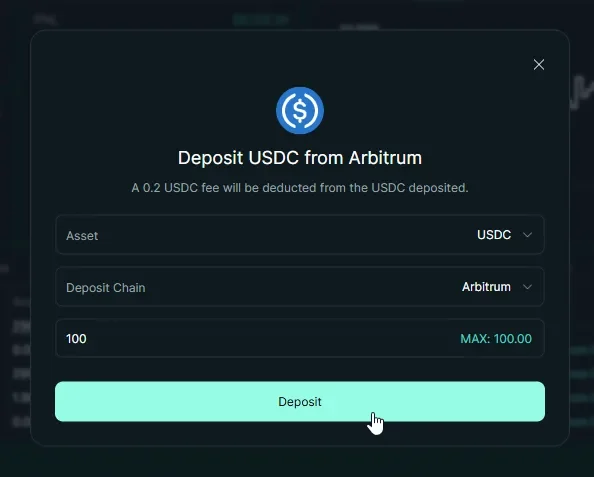
You connect an EVM wallet (MetaMask, Rabby, Coinbase Wallet, WalletConnect and others) or log in with an email address, which creates a wallet for you. With a wallet, the standard route is to deposit USDC on Arbitrum, which you send through Hyperliquid's bridge; you need a little ETH on Arbitrum to pay gas for the deposit. The email route also accepts USDC from Ethereum, Base and Polygon. Some other assets (BTC, ETH, SOL and a few more) can be deposited and then sold for USDC.
In our test, depositing 100 USDC from Arbitrum showed a 0.2 USDC fee deducted from the deposit. Withdrawals go back through the bridge with a small flat fee, and trading itself costs no gas. Funds arrive in your trading account in a few minutes in normal conditions.
Because it is self-custody, nobody can freeze your account, but nobody can recover it either. Losing your wallet's seed phrase means losing the funds. Use a hardware wallet or at least a dedicated wallet for trading, and never sign transactions you do not understand.
What are Hyperliquid vaults and HLP?
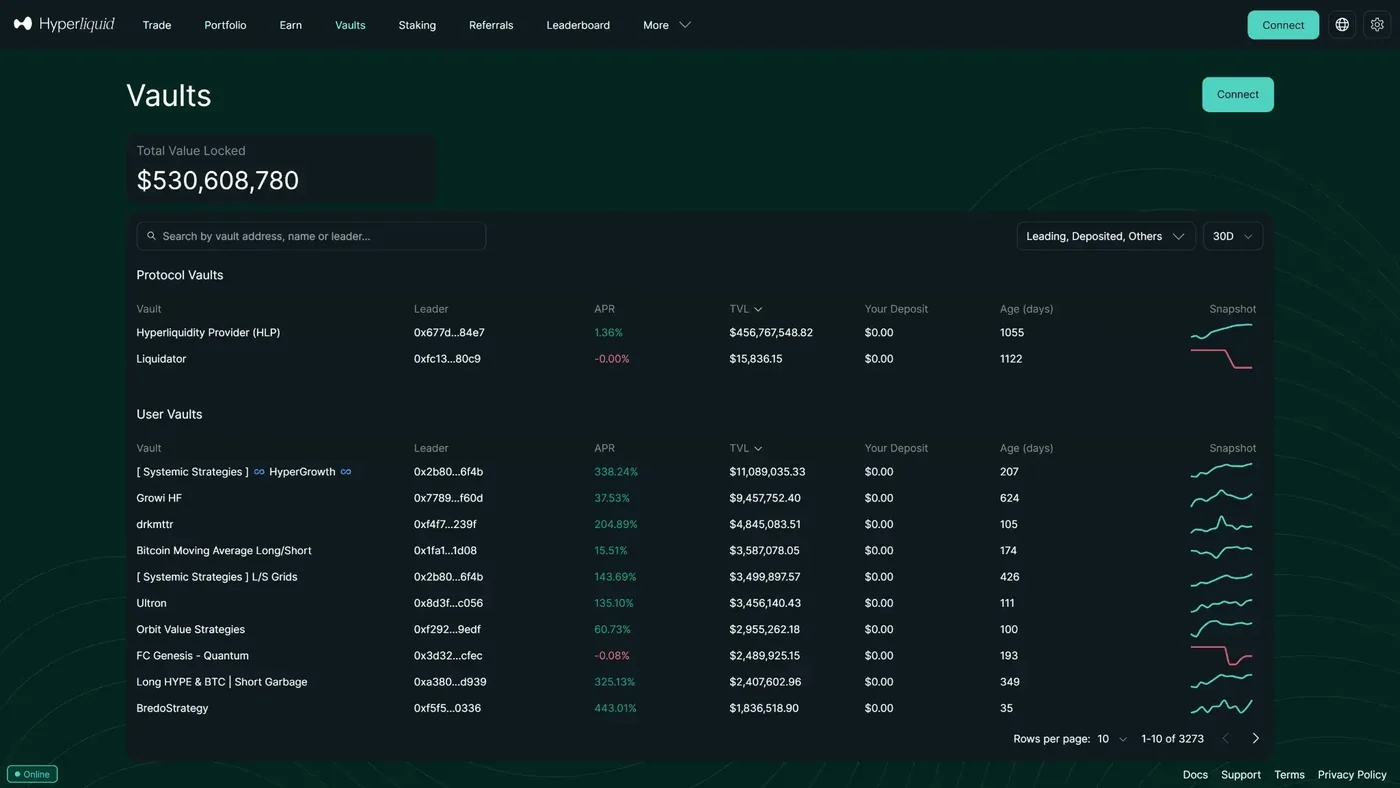
Vaults let you deposit USDC into a strategy run by someone else. There are two kinds.
| Vault | Run by | What it does | Key terms |
|---|---|---|---|
| HLP (Hyperliquidity Provider) | The protocol | Market making across markets, liquidations, supplying USDC to Earn; takes a share of trading fees | 4-day lock-up after each deposit; profits and losses shared by depositors |
| User vaults | Individual traders ("leaders") | Whatever the leader trades | Leader takes a share of profits; terms vary by vault |
HLP is the counterparty of last resort: when a liquidation cannot be absorbed by the order book, HLP takes over the position. That makes it profitable in most market crashes (it earned tens of millions of dollars during the liquidation cascade of 10 October 2025) but also the vault that absorbs losses when a market is manipulated. In our screenshot its 30-day APR was 1.36%, a reminder that returns swing between strong and flat.
User vault APRs on the same page ranged from negative to over 400% over 30 days. Treat those like any leaderboard: a short window, survivorship bias and leverage you cannot see. A vault is copy-trading with extra steps; size it as you would a single high-risk trade.
What incidents has Hyperliquid had?
No exchange review is complete without the failures, and Hyperliquid's are instructive because they shaped its current rules.
| Date | Event | Outcome |
|---|---|---|
| March 2025 | A trader opened a huge position in a thin ETH market and withdrew collateral, leaving HLP to absorb the unwinding | HLP took a loss of several million dollars; Hyperliquid lowered maximum leverage on BTC and ETH and raised margin requirements |
| 26 March 2025 | JELLYJELLY: a trader shorted the memecoin's perp and pumped its spot price, pushing HLP into a large unrealised loss | Validators voted within minutes to delist the market and settle it at a set price; HLP ended slightly profitable. The intervention drew sharp criticism about decentralisation |
| 10 October 2025 | Market-wide crash; more than $10 billion of positions liquidated on Hyperliquid | The first cross-margin auto-deleveraging (ADL) in over two years; no bad debt reported |
| 12 November 2025 | POPCAT manipulation attack | About $4.9 million of bad debt for HLP |
The pattern is consistent: the core BTC and ETH markets have worked well under stress, while thin, low-cap markets have been attacked, and the protocol vault has paid for it. The JELLY response also showed that a relatively small validator set can and will intervene. Whether you see that as a safety feature or a centralisation risk, it is part of what you are trusting.
Auto-deleveraging is worth understanding before you trade large size: if an account goes negative and the liquidation cannot be absorbed, profitable positions on the other side are closed at the previous mark price, starting with the most profitable and most leveraged. A trader with no open positions never shares those losses. The liquidation guide covers the mechanics.
Is Hyperliquid safe, and who can use it?
"Safe" has three parts here.
- Custody risk: lower than a centralised exchange in one sense (no company holds your funds, so an exchange bankruptcy cannot freeze them) and higher in another (your wallet security is entirely on you, and the bridge holding deposited USDC is a high-value target).
- Protocol risk: bugs, oracle issues and manipulation of thin markets, as above. The validator set is smaller and more concentrated than on the largest blockchains.
- Legal access: Hyperliquid's terms say it does not serve US persons, and the app can show a restriction notice to visitors from US IP addresses. Other jurisdictions restrict crypto derivatives too. Using a VPN to get around a restriction breaks the terms and can leave you with no recourse; check your local rules first.
There is no deposit insurance or investor-compensation scheme. Leverage up to 40x is available, and that is the biggest risk for most users: a 2.5% move against a 40x position wipes out the margin. Our leverage guide covers sizing; the calculator below shows the liquidation distance for your settings.
Hyperliquid cost calculator
Enter a position size, leverage, how you enter and exit, how often you trade and how long you hold, plus the current hourly funding rate. The calculator estimates the monthly fees and funding at the base tier (or with volume and staking discounts) and the approximate move that would liquidate an isolated position.
What are the pros and cons of Hyperliquid?
| Pros | Cons |
|---|---|
| Low fees: 0.045% / 0.015% on perps at the base tier, with volume and staking discounts | Not available to US persons |
| Self-custody and no KYC | Wallet security is your responsibility; no recovery |
| Deep on-chain order book on major markets | Thin markets have been manipulated; HLP has taken losses |
| Hourly funding and transparent, on-chain liquidations | Validators have intervened in a market (JELLY) |
| No gas on trades; fast, CEX-like interface | Deposits mainly via USDC on Arbitrum; bridge risk |
| Vaults, staking and an EVM ecosystem on the same chain | No deposit protection; leverage up to 40x invites mistakes |
Hyperliquid vs centralised exchanges and other DEXs
| Factor | Hyperliquid | Large centralised exchanges (e.g. Binance, Bybit) | Other perp DEXs |
|---|---|---|---|
| Custody | Your wallet | The exchange | Your wallet |
| KYC | None | Required | Usually none |
| Matching | On-chain order book | Off-chain matching engine | Varies: order book, AMM or oracle-priced |
| Base perp fees | 0.045% / 0.015% | Similar at standard tiers | Varies widely |
| Funding interval | 1 hour | Usually 8 hours | Varies |
| Markets | Major and many smaller coins; HIP-3 markets | The widest range, plus options and earn products | Usually fewer |
| Main risk | Protocol, bridge, thin markets | Counterparty and account freezes | Protocol and liquidity |
If you want the widest product range, fiat on-ramps and customer support, a centralised exchange still wins. If you want low costs on major perps without handing over custody, Hyperliquid is the most liquid on-chain option. For more context, see the spot vs futures guide and the best trading platforms guide.
Reference data
| Item | Detail |
|---|---|
| Type | Decentralised perpetual and spot exchange on its own layer-1 chain |
| Built by | Hyperliquid Labs (Jeff Yan) |
| Token | HYPE (genesis 29 November 2024) |
| Architecture | HyperCore (trading engine) + HyperEVM (smart contracts); HyperBFT consensus |
| Collateral | USDC |
| Deposits | USDC on Arbitrum (wallet); Ethereum, Base, Polygon via email login; some other assets |
| Perp fees (base) | 0.045% taker / 0.015% maker |
| Max leverage | Up to 40x on the largest markets |
| Funding | Hourly |
| HLP lock-up | 4 days after the latest deposit |
| US persons | Not served, per its terms |
| Screenshots | Taken by Quantum Algo, October 2026 |
Is Hyperliquid worth it, and how does it fit with Quantum Algo?
For a trader outside the US who wants to trade major crypto perpetuals cheaply without handing funds to an exchange, Hyperliquid is one of the strongest options available: low fees, real depth on BTC and ETH, and full transparency of liquidations. Keep leverage modest, avoid thin markets, treat vaults as high-risk positions and secure the wallet properly. If you need fiat, US access or a broad product menu, a regulated centralised exchange is the better fit.
Whatever venue you choose, the edge comes from the plan, not the exchange. The free Quantum Algo indicators mark structure, liquidity and funding-driven extremes on TradingView, where you can chart Hyperliquid's markets. Zeno, the premium engine from Quantum Algo (QuantumAlgo), prints crypto signals with an entry, a stop and two targets, and every call is on the public track record.
Hyperliquid is a decentralised perp and spot exchange with an on-chain order book, low fees (0.045% / 0.015% on perps at the base tier), hourly funding, leverage up to 40x and self-custody without KYC. Its weak points are access (no US persons), a concentrated validator set that has intervened before, and thin markets that have been manipulated at the protocol vault's expense. Use it for major markets with moderate leverage, secure your wallet and size vault deposits like single high-risk trades.
◆ Interactive check
How well do you know Hyperliquid?
Questions traders ask about Hyperliquid
A decentralised exchange for crypto perpetual futures and spot trading that runs a fully on-chain order book on its own layer-1 blockchain.
At the base tier, perps cost 0.045% taker and 0.015% maker, and spot 0.070% taker and 0.040% maker. Higher 14-day volume lowers them, and staking HYPE gives a further 5%–40% discount.
Up to 40x on the largest markets such as BTC; many other markets are capped between 3x and 20x.
It removes exchange custody risk but adds wallet, bridge and protocol risks. Thin markets have been manipulated and the validator set has intervened. There is no deposit insurance.
No. Its terms say it does not serve US persons, and the app may show a restriction notice to US IP addresses.
No. You connect a wallet or log in with an email address.
Send USDC on Arbitrum through the Hyperliquid bridge from your wallet (you need a little ETH on Arbitrum for gas). Email-login users can also deposit USDC from Ethereum, Base or Polygon.
Hyperliquidity Provider, the protocol vault that market-makes, performs liquidations and earns a share of fees. Deposits are locked for 4 days, and depositors share its profits and losses.
Hyperliquid's native token, launched on 29 November 2024 with a large airdrop. It is used for staking, network security and trading-fee discounts.
Hyperliquid's own trade screen uses a TradingView-based chart, and its markets can also be charted on TradingView.
References & Related Guides
Read next
- Funding Rate Trading
- Leverage Trading
- Liquidation in Trading
- Spot vs Futures
- Open Interest
- Day Trading Crypto
- Crypto Prop Firms
- Best Trading Platforms
- Notional Value
- Best Crypto Indicator
- Free TradingView indicators
- Zeno — the premium engine
Primary sources
- Hyperliquid Docs — Fees
- Hyperliquid Docs — Contract specifications
- Hyperliquid Docs — Protocol vaults (HLP)
- Hyperliquid Docs — Auto-deleveraging
- Hyperliquid Docs — How to start trading
- CoinGecko — Hyperliquid HLP vault analysis
- The Defiant — Hyperliquid and the JELLYJELLY incident
- OneKey — Hyperliquid geo-blocks and US users