How to Short Crypto: Six Ways to Profit From Falling Prices, What Each Costs and How to Avoid Liquidation
To short crypto you open a position that gains when the price falls. The main ways are perpetual futures on a crypto exchange, dated futures on a regulated exchange such as CME, borrowing and selling coins on margin, buying put options, buying an inverse exchange-traded product, or simply selling coins you hold. Futures and margin carry leverage and liquidation risk, and losses can exceed what you put in if you do not use a stop; puts and inverse products cap or limit the loss. Which ones you can use depends on where you live: UK retail traders, for example, cannot buy crypto derivatives.
Bitcoin fell from about $97,900 in mid-January 2026 to under $63,000 three weeks later. Traders who knew how to short it, and how to size the trade, made money on the way down; traders who shorted with 50x leverage a week earlier were mostly liquidated on the last rally. This guide covers each method, what it really costs to hold, how liquidation works, a real trade from that move, and a calculator for your own numbers.
What does it mean to short crypto?
Shorting means opening a trade that profits when the price falls. With shares you borrow and sell them, then buy back later. With crypto you can do the same on margin, but most traders use derivatives instead: contracts whose value moves with the coin, so you never need to borrow it.
The trade-off is the same in every version. The most you can make on a short is 100% of the entry price (if the coin goes to zero), while a rally has no ceiling. That asymmetry is why risk control matters more on the short side. Our guide to short selling explains the mechanics in stocks.
What are the ways to short crypto?
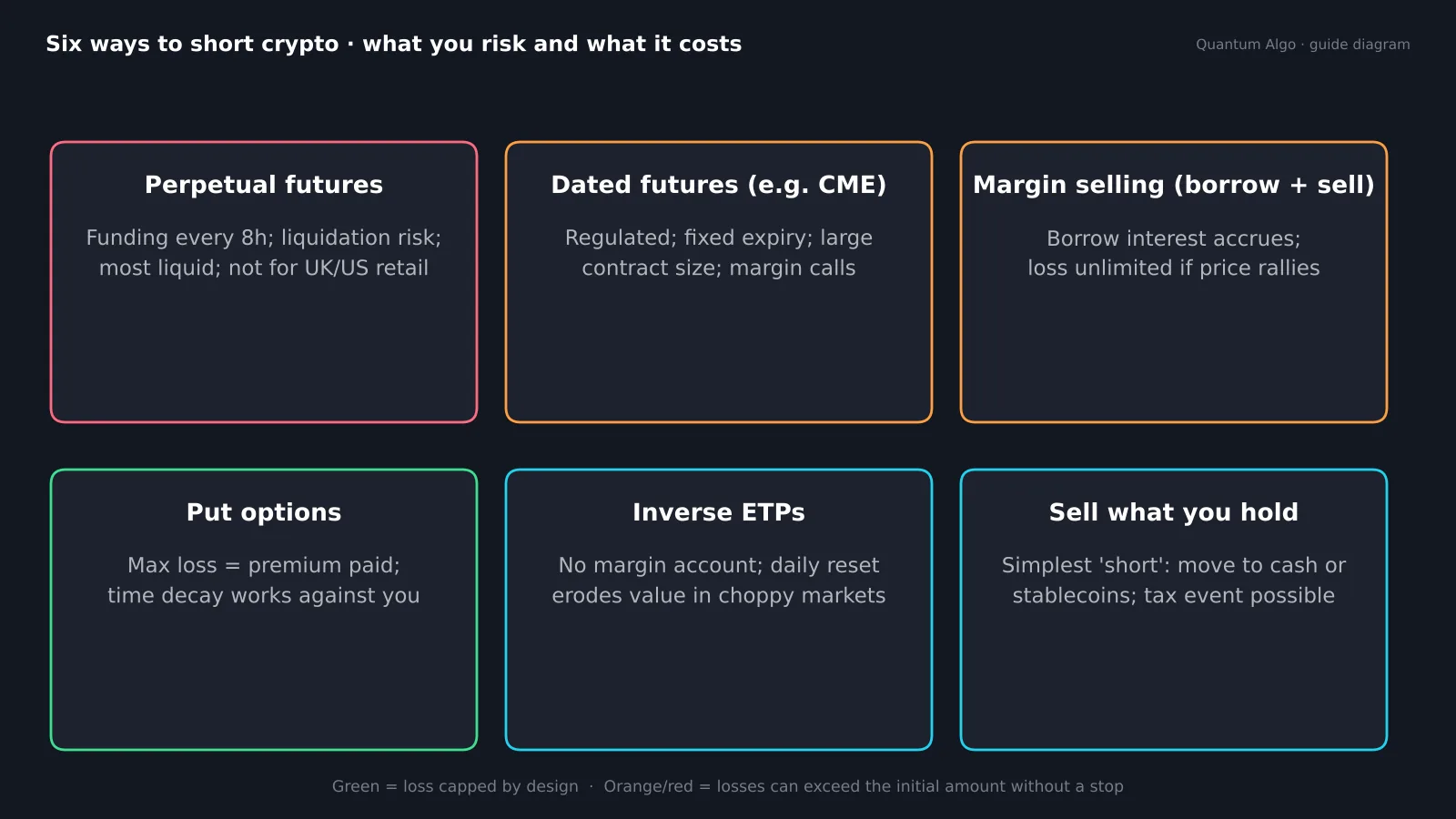
| Method | How you profit | Max loss | Main cost |
|---|---|---|---|
| Perpetual futures | Sell a contract with no expiry | Your margin (liquidation), more without isolated margin | Funding every 8 hours, fees |
| Dated futures (CME) | Sell a contract that expires monthly | Can exceed margin | Fees, roll costs, large size |
| Margin short | Borrow coins, sell, buy back lower | Unlimited in theory | Borrow interest |
| Put options | Right to sell at a strike | The premium paid | Premium and time decay |
| Inverse ETP | Fund rises when the coin falls | Your investment | Fees, daily-reset decay |
| Sell holdings | Avoid the drop, buy back lower | Missing a rally | Fees, possible tax |
For most traders the realistic choice is between perpetual futures (cheapest and most liquid, but only on offshore or locally licensed exchanges), regulated futures, and put options. Selling coins you already hold is the simplest "short" of all if your goal is only to avoid a decline.
How do you short crypto with perpetual futures?
A perpetual future is a contract that tracks the coin's price and never expires. To short, you choose the contract (for example BTCUSDT), select "sell/short", set the size and leverage, and post margin. If the price drops, the contract gains; if it rises, you lose and the exchange may liquidate you when your margin runs out.
The price is kept close to spot by the funding rate, usually exchanged every eight hours. When funding is positive, longs pay shorts, so a short collects a little. When it turns negative, which happens after sharp drops when everyone is short, shorts pay longs. At a typical 0.01% every eight hours, funding is worth about 0.03% a day or roughly 11% a year on the position size. Our funding rate guide covers how traders use it as a sentiment signal.
At what price does a crypto short get liquidated?
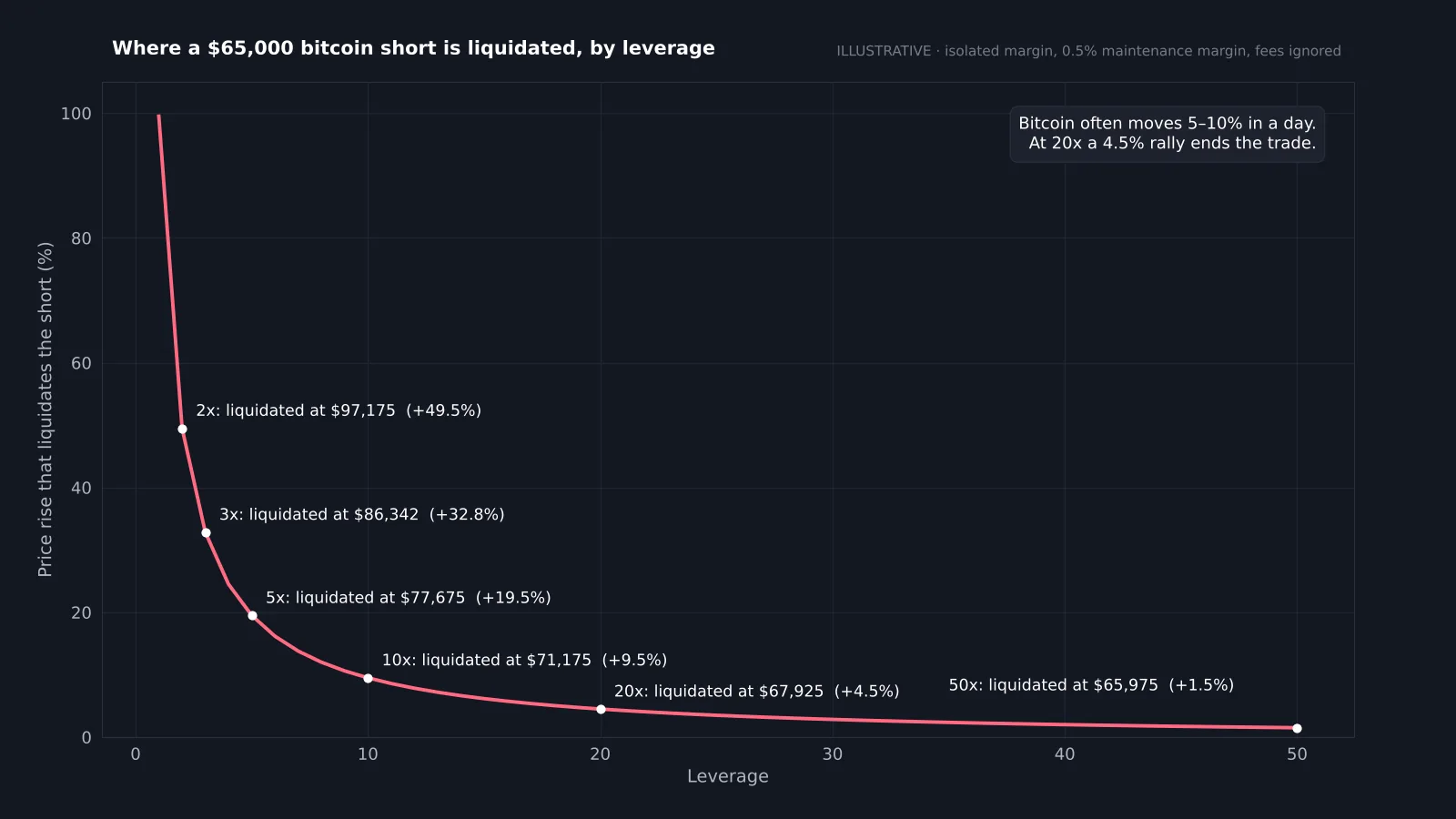
With isolated margin, a short is liquidated when the loss eats through the margin, minus a small maintenance margin. For a short at $65,000 with a 0.5% maintenance requirement, that is about $97,175 at 2x leverage, $77,675 at 5x, $71,175 at 10x and $67,925 at 20x.
At 20x a rally of only 4.5% ends the trade, and bitcoin regularly moves that much in a few hours. Exchanges calculate liquidation slightly differently and add fees, so always read the liquidation price the exchange shows before you confirm. Better still, place your own stop well before it. See our liquidation guide for cross versus isolated margin.
Can you short bitcoin on a regulated exchange?
Yes. CME Group lists cash-settled bitcoin and ether futures for institutions and larger traders, plus micro contracts sized at a fraction of a coin for smaller accounts. They trade through regulated futures brokers, settle in dollars and expire monthly, so a longer short has to be rolled.
The CFTC treats bitcoin as a commodity and regulates these futures, but warns in its customer advisory that leverage can lead to losses greater than the initial investment. Our futures trading for beginners guide explains margin calls and rolling.
What does a real crypto short look like?
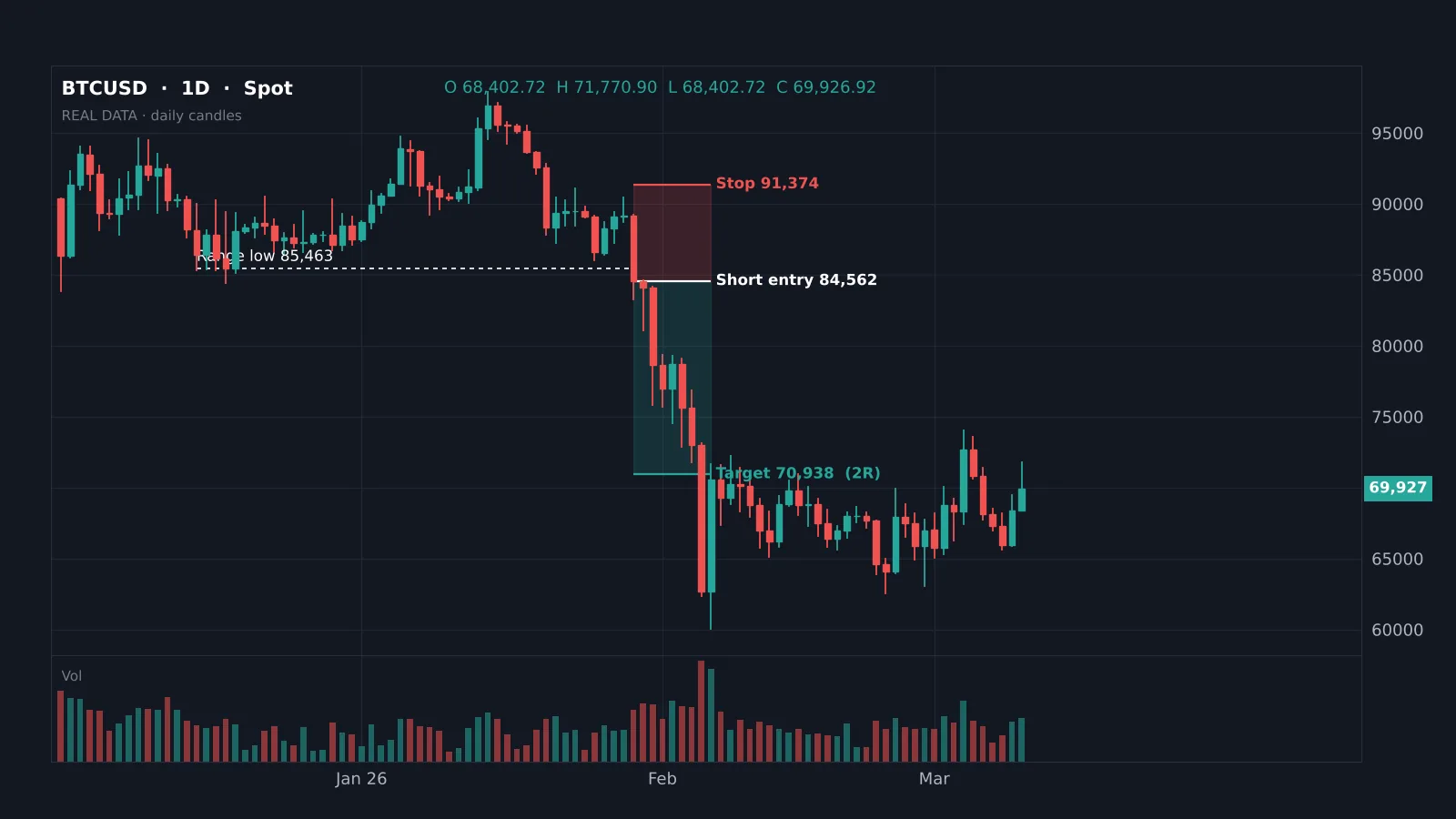
Bitcoin ranged between roughly $85,500 and $90,000 on a closing basis from mid-December 2025 to early January 2026, spiked to about $97,900 on 14 January, then rolled over. On 29 January it closed at $84,562, below the range low. That is the trigger in the chart: a daily close below support after a failed breakout.
A stop just above the highest high of the previous week, $91,374, put the risk at $6,812 per coin. A 2R target sat at $70,938. On 5 February bitcoin fell through it intraday, reaching $62,354. Risking 1% of a $20,000 account ($200) would have meant a position of about 0.029 BTC, roughly $2,480 of exposure, which needs only modest leverage.
How do put options and inverse ETPs work for shorting crypto?
Put options give the right to sell at a set strike before expiry. You pay a premium up front, and that premium is the most you can lose. If bitcoin falls well below the strike, the put gains; if it does not fall far or fast enough, time decay erodes it. Options are listed on crypto venues and on CME.
Inverse exchange-traded products aim to return the opposite of the coin's daily move, so you can short through an ordinary brokerage account without margin. Because they reset daily, they lose value in choppy markets even if the price ends flat, the same decay explained in our leveraged ETF guide. They suit short holding periods.
Is shorting crypto legal where you live?
Shorting itself is legal in most countries, but access to the tools differs. In the UK the FCA has banned the sale of crypto derivatives, including CFDs, futures and options, to retail consumers since 6 January 2021. In the EU, retail crypto CFDs are limited to 2:1 leverage. In the US, retail traders can use CFTC-regulated futures and options, while many offshore exchanges block US users from their perpetual contracts.
Using a VPN to reach a platform that excludes your country breaks its terms and can lead to frozen funds. If you are not sure, start with your local regulator's register.
How much does it cost to hold a crypto short?
Opening fees are small: crypto futures commonly charge a few hundredths of a percent of the position as taker fees. The cost that matters is time. On perpetual futures you receive or pay funding every few hours; in strong uptrends shorts usually receive it, but after crashes, when shorts are crowded, funding turns negative and they pay. A short held for a month at −0.03% per eight hours costs about 2.7% of the position, often more than the move you were hoping for.
Margin shorts pay a borrowing rate on the coins, which can spike when many traders want to borrow the same coin. Dated futures embed the cost in the price difference to spot, and puts lose time value every day. Count these costs before choosing how to short.
Reference data
| Item | Value |
|---|---|
| Typical perpetual funding interval | Every 8 hours (some venues 1–4 hours) |
| 0.01% per 8 hours equals | ≈0.03% a day, ≈11% a year on position size |
| Liquidation, $65,000 short, 0.5% maintenance | 2x $97,175 · 5x $77,675 · 10x $71,175 · 20x $67,925 |
| EU retail crypto CFD leverage cap | 2:1 (ESMA) |
| UK retail crypto derivatives | Banned since 6 January 2021 (FCA) |
| Example trade (BTC, 2026) | Entry 84,562 · stop 91,374 · target 70,938 (hit 5 Feb) |
Crypto short calculator
Enter your entry and exit prices, position size, leverage, funding rate and days held. The calculator shows profit or loss, return on margin, funding received or paid, and an estimated isolated-margin liquidation price.
What are the biggest risks of shorting crypto?
- Short squeezes. When many traders are short, a rally forces liquidations that buy back contracts and push price higher still.
- Leverage. Most losing shorts are not wrong about direction; they are too large to survive the noise.
- Negative funding after crowded sell-offs can make holding a short expensive.
- Exchange risk. Offshore platforms can freeze withdrawals or fail; keep only trading margin there.
- Weekend gaps and wicks. Crypto trades nonstop, and thin weekend liquidity produces sudden spikes through stops.
Track every short, including funding paid, in a trading journal.
What is the best way to short crypto?
For a defined, limited risk, buy put options. For flexibility and low cost, use perpetual futures with isolated margin, leverage of 2–5x and a hard stop placed well before the liquidation price. For a regulated route in the US, use CME micro futures through a futures broker. Whichever you choose, short only when the chart already shows weakness, such as a close below support or a lower high, and size the trade from the stop.
You can short crypto with perpetual futures, dated futures, margin, put options, inverse ETPs or by selling holdings. Futures and margin carry leverage and liquidation risk: at 20x a 4.5% rally can wipe out a short. Funding and borrowing costs add up over time. Puts cap the loss at the premium. Rules differ by country; UK retail traders cannot buy crypto derivatives. Use low leverage, a stop above structure and risk of 0.5–1% per trade.
◆ Interactive check
Could you short crypto safely?
Questions traders ask about shorting crypto
Open a short on perpetual or dated bitcoin futures, borrow and sell BTC on margin, buy put options, or buy an inverse bitcoin ETP. Each gains when the price falls.
Availability depends on your country. Some exchanges offer futures or margin to eligible users in certain regions only; check the platform's terms for where you live.
With futures or margin, yes, unless you use isolated margin and a stop. With put options or inverse ETPs, the loss is limited to what you paid.
Buying put options, because the most you can lose is the premium. Low-leverage futures with a hard stop are the next most controlled route.
Low: 2–5x with a stop well before liquidation. At 20x a rally of about 4.5% can liquidate a position.
When the funding rate is positive, shorts receive it; when it is negative, shorts pay. It is exchanged every few hours on most exchanges.
Shorting is legal, but the FCA bans selling crypto derivatives to retail consumers, so most UK retail traders cannot use crypto futures, options or CFDs.
When the chart already shows weakness, such as a close below support or a lower high in a downtrend, not just because the price looks too high.
References & Related Guides
Read next
- What Is Short Selling?
- Funding Rate Trading
- Liquidation in Trading
- Leverage Trading
- Spot vs Futures Trading
- Day Trading Crypto
- Crypto Fear and Greed Index
- Open Interest Explained
- Best Crypto Indicator
- Crypto Trading for Beginners