Leveraged ETFs Explained: How 2x and 3x Funds Work, Why They Decay, and How Traders Use Them
A leveraged ETF uses swaps and futures to deliver a multiple, usually 2x or 3x, of an index's return for one day. Because the leverage resets every day, returns over weeks or months are not 2x or 3x the index: steady trends can beat the multiple, while choppy markets erode the fund even if the index ends flat. That is why leveraged ETFs are built as short-term trading tools, not long-term holdings.
Leveraged ETFs look like a simple shortcut: three times the Nasdaq, three times the gains. The catch is in one word on every prospectus, daily. I'll show what that does to your returns with real arithmetic, when the effect works for you and when it quietly eats the position, what the funds cost to hold, and how traders who use them actually manage the risk.
What is a leveraged ETF?
A leveraged ETF is an exchange-traded fund that aims to return a fixed multiple of an index over a single day. A 2x S&P 500 fund aims for +2% on a day the S&P rises 1%; a 3x Nasdaq-100 fund aims for −6% on a day the Nasdaq-100 falls 2%. Inverse versions (−1x, −2x, −3x) aim for the opposite of the index's daily move, so they rise when it falls.
You buy and sell them like any stock, in a normal brokerage account, with no margin and no options approval. That ease of access is exactly why regulators keep warning about them: the product behaves very differently from what the label suggests once you hold it for more than a day. If you are newer to leverage in general, read leverage trading explained first.
How do leveraged ETFs get their leverage?
The fund holds the index's stocks or cash and adds exposure with derivatives, mainly total return swaps with banks and index futures. At the end of each trading day the manager rebalances so that exposure is back to exactly 2x or 3x of the fund's assets.
That rebalance is mechanical. After an up day the fund has more assets, so it must buy more exposure; after a down day it must sell. In other words, the fund buys strength and sells weakness every afternoon, which is the source of both the compounding gains in trends and the losses in back-and-forth markets. The large leveraged funds' rebalancing flows are big enough that traders watch them near the close on volatile days.
Why does the daily reset matter? The math in two days
Take an index at 100 and a 3x fund at 100. Day one the index rises 10% to 110; the fund rises 30% to 130. Day two the index falls 9.09% back to 100. The fund falls 27.27%, to 94.55. The index is flat over two days; the fund is down 5.45%.
| Index (1x) | 2x fund | 3x fund | |
|---|---|---|---|
| Start | 100.00 | 100.00 | 100.00 |
| Day 1: index +10% | 110.00 | 120.00 | 130.00 |
| Day 2: index −9.09% | 100.00 | 98.18 | 94.55 |
| Two-day return | 0.00% | −1.82% | −5.45% |
Nothing went wrong with the fund: it delivered exactly 3x each day. The loss comes from compounding a larger percentage swing in both directions, and it grows with volatility and with the leverage multiple. This is why the 2x and 3x labels only hold for one day.
What is volatility decay in leveraged ETFs?
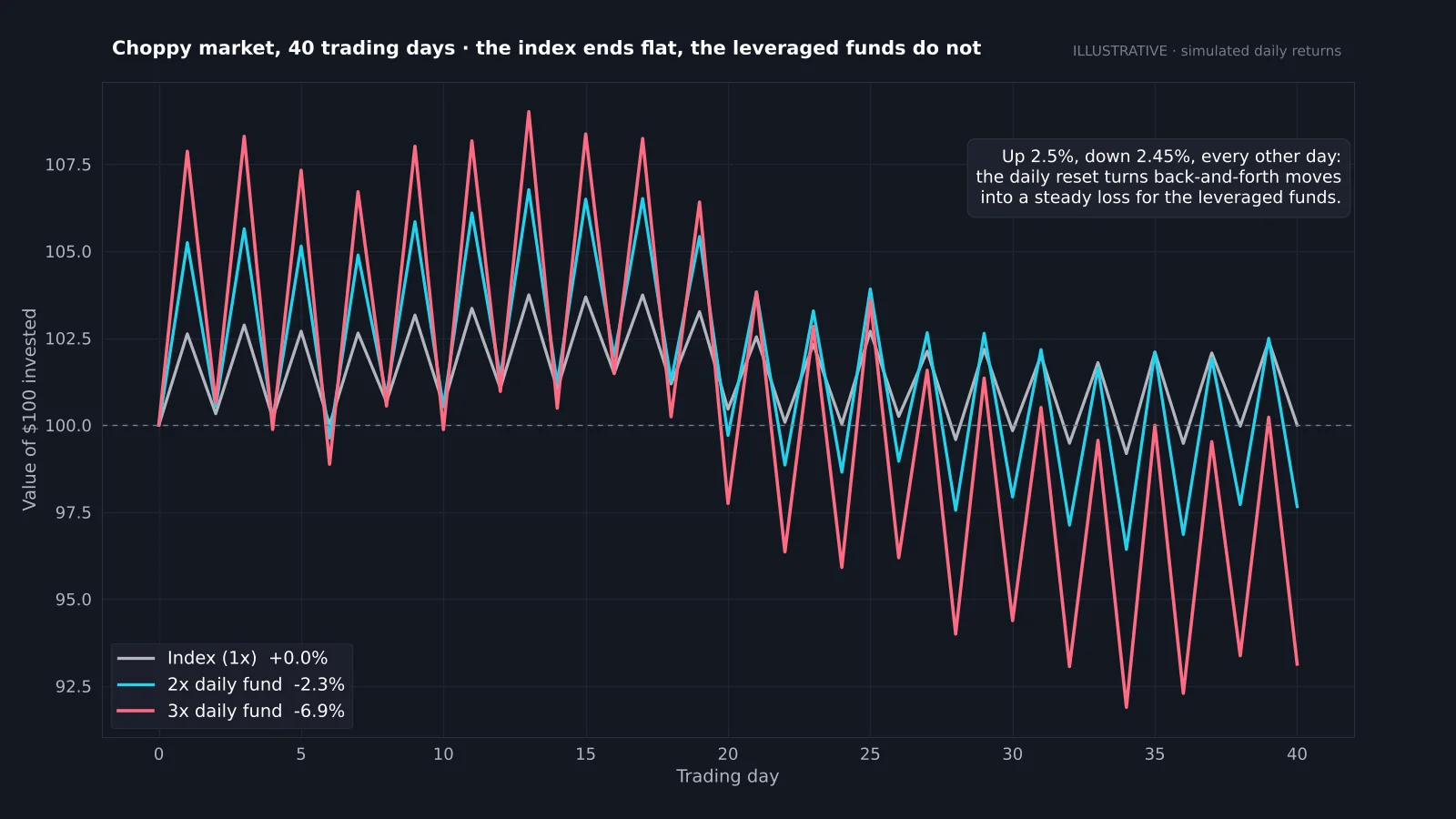
Volatility decay (also called beta slippage or volatility drag) is the gap between the fund's actual multi-day return and the multiple of the index's return, caused by the daily reset in choppy markets. In the simulation above, the index swings about 2.5% every day and ends 40 days exactly flat. The 2x fund ends about 2.3% lower and the 3x fund about 6.9% lower.
A useful approximation: over a period, a fund with leverage L loses roughly (L² − L) ÷ 2 × variance compared with L times the index return. For a 3x fund that is three times the index variance. Double the volatility and the drag roughly quadruples, which is why the same fund can be fine in a calm uptrend and brutal in a whipsaw.
Can leveraged ETFs return more than 3x in a trend?
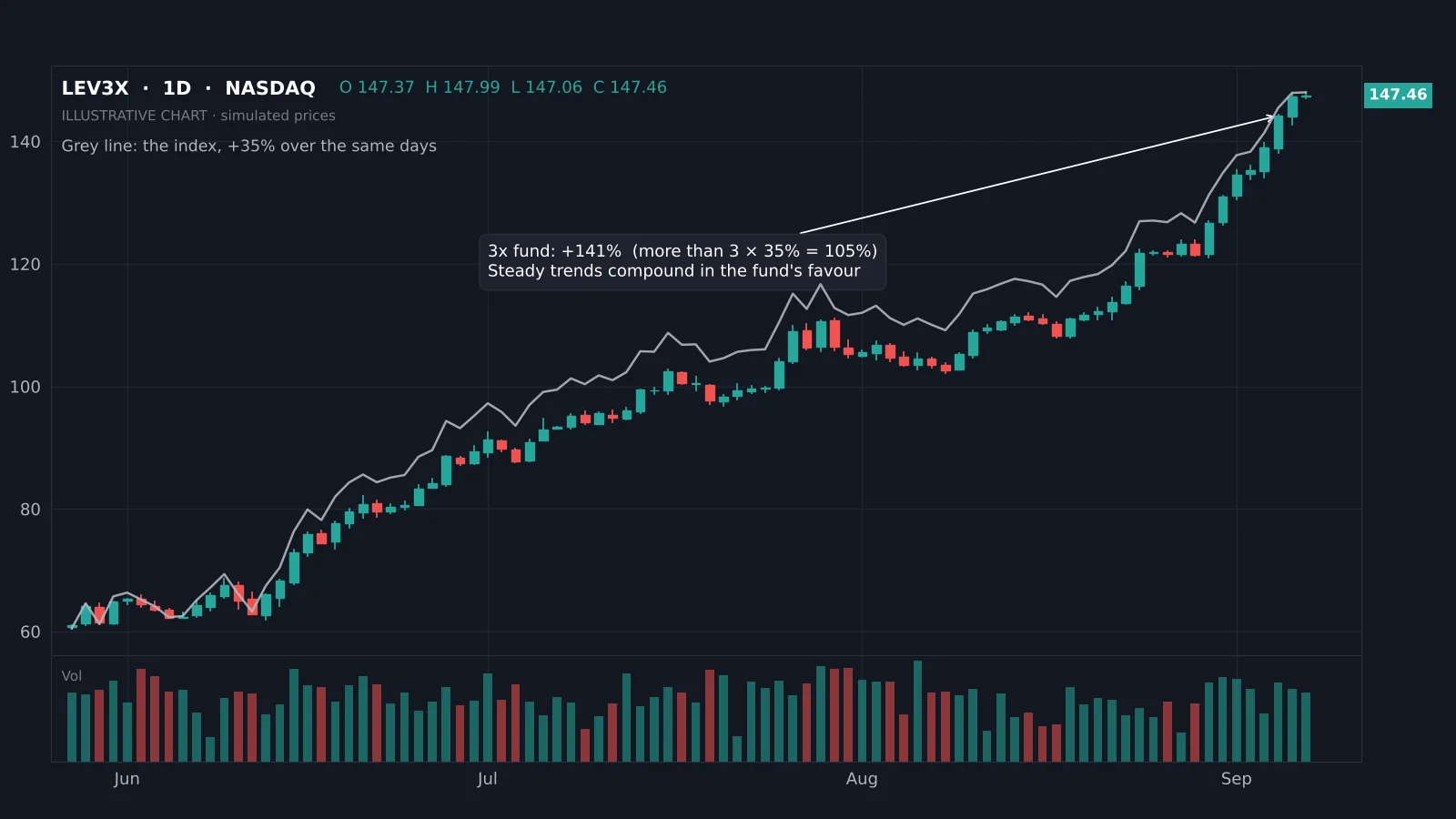
Yes. When an index trends steadily with small daily moves, the same compounding works for you. In the example the index gains 35% over about four months with low volatility, and the 3x fund gains roughly 141%, more than three times 35%. Each up day adds to a bigger base.
That is the honest trade-off: leveraged ETFs reward being right about direction and timing in a calm trend, and they punish sideways, volatile markets twice, once through the price action and again through decay. Reading which regime you are in matters more than picking the multiple. The Choppiness Index and ADX are two common ways to measure it.
How does volatility change a 3x fund's yearly return?
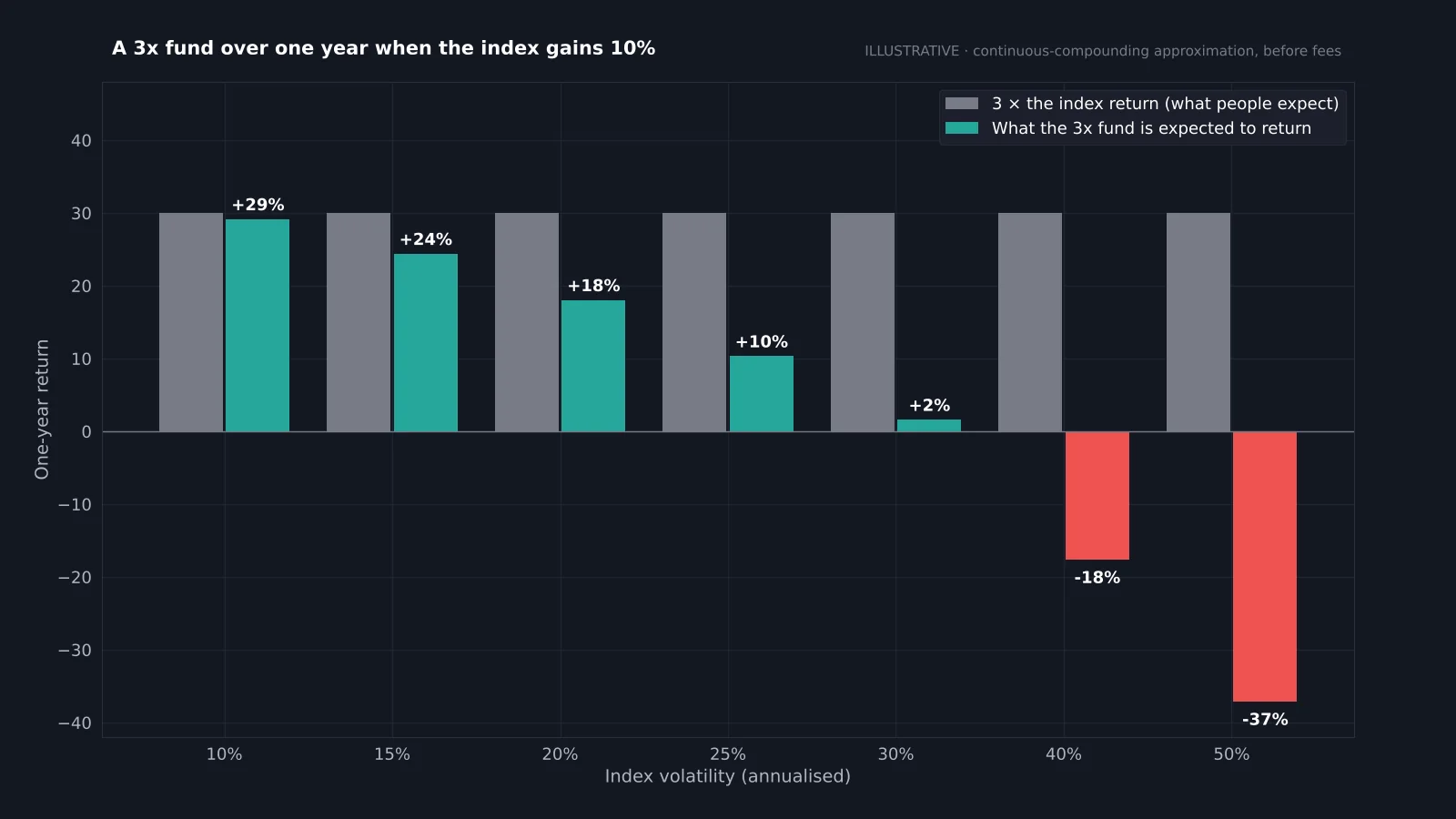
Assume the index gains 10% over a year. Many buyers expect a 3x fund to return 30%. With low index volatility (10%) it comes close at about 29%. At 25% volatility the expected return falls to about 10%, at 40% it is around −18%, and at 50% around −37%, all while the index itself is up 10%.
Before costs, the figure depends on just two things: the index's return and its volatility. For context, the S&P 500's long-run volatility is roughly 15–20% a year, the Nasdaq-100's somewhat higher, and single stocks and crypto often far higher, which is why single-stock and crypto leveraged funds decay fastest.
What do leveraged ETFs cost to hold?
- Expense ratio: typically around 0.9% to 1% a year for the large 2x and 3x funds, several times a plain index ETF.
- Financing: the borrowed exposure is paid for inside the swaps, roughly the short-term interest rate times the extra leverage. With rates around 4%, a 3x fund carries about 8% a year of financing drag on top of the fee.
- Trading costs: daily rebalancing and swap spreads show up as slight underperformance against the target, even on quiet days.
- Taxes: frequent trading of these funds usually means short-term gains in a taxable account.
Add those up and a 3x fund held for a year needs a meaningful trend just to keep pace with three times the index. Compare that with buying futures, where financing is built into the price, in our guide to futures trading for beginners.
How do inverse and leveraged inverse ETFs work?
Inverse ETFs aim for the opposite of the index's daily return: −1x, −2x or −3x. They let you profit from a fall without a margin account or short selling, and your loss is limited to what you paid. They reset daily too, so the same decay applies: an inverse fund can lose money over a month in which the index ends lower, if the path was choppy enough.
Inverse funds also have a structural headwind in markets that rise over time. Held for long periods, they tend to lose value even after sharp sell-offs, so they are used as hedges or short-term trades around specific events, not as a permanent position.
How do traders use leveraged ETFs well?
- Hold for days, not months. Most professional use is intraday to a few weeks, with a planned exit.
- Trade the regime. Use them in clear trends; step aside in high-volatility chop.
- Size by the multiple. A 3x position of $3,000 carries the daily risk of $9,000 in the index. Cut position size accordingly, as in our position sizing guide.
- Use stops on the underlying. Set exits from the index chart, where the levels are cleaner, and execute in the fund.
- Know the gap risk. A 10% index gap down would be about −30% for a 3x fund before you can react; stop orders do not protect you through a gap.
Many traders plan entries on the index itself, for example a QQQ or SPY chart, and use the leveraged fund only for execution. Our comparison of SPY vs QQQ explains which index each fund family tracks.
Reference data
| Item | Value |
|---|---|
| Target | 2x or 3x (or −1x to −3x) of the index's daily return |
| Rebalancing | Daily, near the close |
| Drag approximation | (L² − L) ÷ 2 × variance over the period |
| Typical expense ratio | about 0.9–1% a year |
| Financing inside swaps | about short-term rate × (L − 1) |
| US rule | SEC Rule 18f-4, 200% VaR limit |
| Typical holding period | Intraday to a few weeks |
Leveraged ETF decay calculator
Enter the index's return over your holding period, its annual volatility, the leverage and how many trading days you plan to hold. The calculator estimates the fund's return and how far it lands from simply multiplying the index return, before fees and financing.
Are leveraged ETFs regulated, and what are the risks?
In the US they are registered funds under the SEC's derivatives rule for funds (Rule 18f-4), and brokers must treat them as complex products. FINRA and the SEC have long warned that they are designed for one-day use. In late 2025 the SEC staff told issuers that funds above 2x leverage on a single asset do not fit the rule's 200% risk limit, which stalled filings for new 3x and 5x single-stock and crypto products.
- Decay in volatile, sideways markets.
- Gap risk magnified by the multiple.
- Tracking error from costs and rebalancing.
- Closure risk: small funds can be shut down, forcing you out at a bad time.
- Single-stock funds concentrate all of this on one company.
Should you trade leveraged ETFs?
They are a legitimate tool for short-term traders who know the market regime, size positions for the multiple and exit on a plan. They are a poor substitute for a long-term index fund, and the most common way people lose money with them is holding a 3x fund through a volatile, sideways stretch and assuming it will "come back" with the index.
Start with the index chart, decide whether it is trending or chopping, and only then pick the fund. Keep every trade in a trading journal with the holding period noted, so you can see whether decay is costing you more than you think.
Leveraged ETFs deliver 2x or 3x the index for one day. Because they reset daily, multi-day returns drift: steady trends compound in your favour, choppy markets cause volatility decay even if the index ends flat. Expected drag grows with volatility and the leverage multiple, and fees plus financing add several percent a year. Use them for short holding periods, size for the multiple, and plan exits on the underlying index.
◆ Interactive check
Can you spot the leveraged ETF trap?
Questions traders ask about leveraged ETFs
You can, but returns will drift from 2x or 3x the index, often below it in volatile markets, and fees plus financing add several percent a year. Most issuers describe them as short-term products.
If the path was volatile, the daily reset can cost more than the index gained. The fund only targets 3x for each single day.
A 3x fund would lose almost everything on a single day the index fell about 33%. Daily circuit breakers make that unlikely for broad indexes, but long declines can shrink a fund close to zero and lead to closure or a reverse split.
They cap your loss at what you paid and need no margin account, but they decay. Margin on a plain ETF has no decay but you pay interest and can lose more than you put in.
Rarely in any meaningful amount; most income is consumed by fees and financing.
3x funds move more each day and suffer roughly three times the volatility decay of a 2x fund, compared with about one times.
For short periods, yes. Held for months they tend to lose value even if the market eventually falls.
Yes. They trade like stocks, though some brokers ask you to acknowledge their risk first.
References & Related Guides
Read next
- Leverage Trading Explained
- What Is Margin Trading?
- SPY vs QQQ
- What Is Short Selling?
- Choppiness Index
- ADX Indicator
- Position Sizing
- Futures Trading for Beginners
- Best Indicator for Nasdaq
- Trading Journal