Wyckoff Method
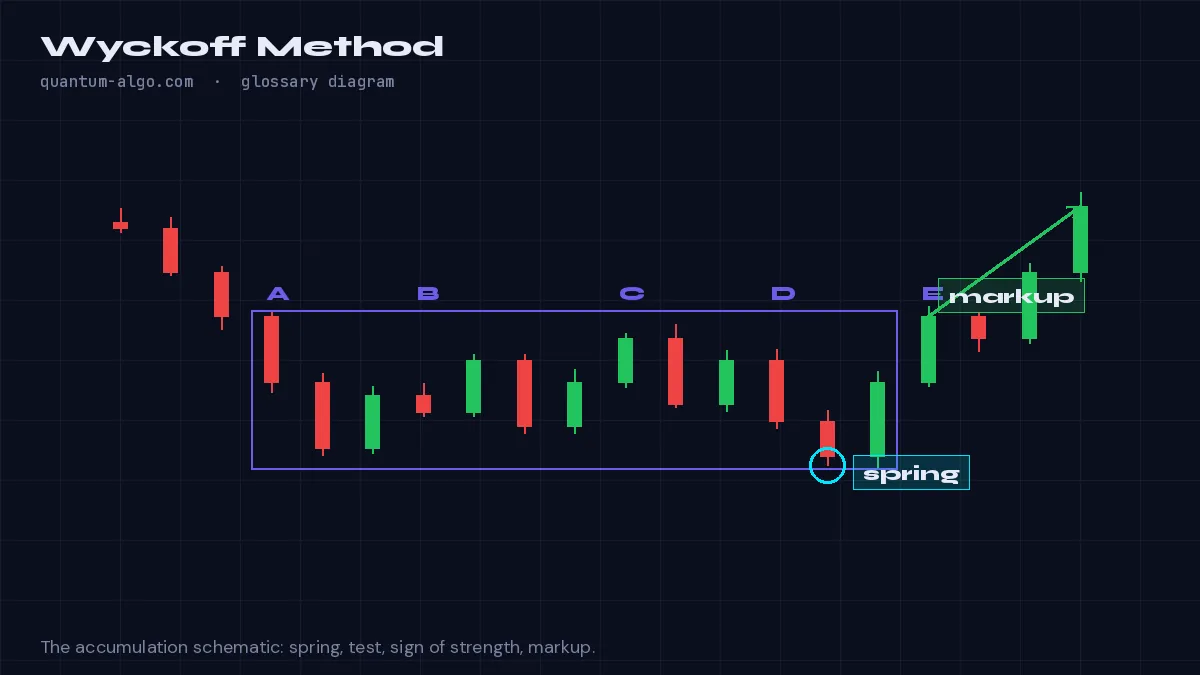
The Wyckoff Method is a market analysis framework developed by Richard Wyckoff in the early 1900s. It describes price cycles as accumulation, markup, distribution and markdown. Its spring, sign of strength and last point of support map term-for-term onto the SMC liquidity sweep, displacement candle and order block. Traders use it to judge the market's phase before taking setups.
◆Full guide: Wyckoff Method: The Complete Institutional Market Methodology Guide
What it means
The Wyckoff Method is a market analysis framework developed by Richard Wyckoff (1873–1934) that describes the cyclical behavior of all liquid markets as a four-phase sequence: Accumulation (institutions quietly buying), Markup (price rises sharply), Distribution (institutions quietly selling to retail), and Markdown (price falls sharply). The method predates modern SMC by nearly a century but reads the same chart events with different terminology.
Wyckoff identifies specific event signatures within each phase. The Spring is a deliberate sweep below accumulation support to trigger stops before the markup phase begins — identical to the modern SMC concept of a liquidity sweep below SSL. The Sign of Strength bar is a strong displacement candle that breaks structure and creates a Fair Value Gap. The Last Point of Support is a return to the order block before the markup continues. The mapping between Wyckoff and SMC is exact, term-for-term.
The Wyckoff method's enduring value is its macro-cycle context. Where SMC focuses primarily on individual setups (single OBs, single FVGs), Wyckoff teaches you to read where the entire market is in its cycle — Phase B accumulation, Phase D markup, etc. This context determines whether a particular setup is likely to extend or reverse, which raw SMC analysis often misses.
Modern SMC traders who study Wyckoff alongside ICT material develop dramatically better contextual judgment. They recognize when the market is mid-accumulation (favor longs aggressively), early distribution (start scaling out), or late markdown (prepare for re-accumulation). This macro framing is hard to replicate with pure setup-by-setup SMC analysis.
How to identify it on a chart
- Identify the phase: accumulation, markup, distribution, markdown.
- Read volume against price: effort versus result.
- Use the spring or upthrust as the trigger, the break of the range as confirmation.
Worked example
A market-bottom candidate with climactic volume, a quiet range and a spring on low volume is a Wyckoff accumulation — the same signature the Market Bottom Finder grades.
See it on the chart, read it in depth
Frequently asked questions
Is Wyckoff still relevant in modern markets?
Yes. The institutional mechanics Wyckoff observed in 1900s commodities and stocks are essentially identical to those in modern crypto, forex, and indices. The terminology has changed but the underlying market structure has not. Wyckoff's accumulation/distribution schematics map directly onto modern SMC patterns.
How does Wyckoff differ from SMC?
Wyckoff is macro-cyclical (where in the cycle are we?). SMC is setup-focused (what is this specific OB/FVG telling us?). The two are complementary: Wyckoff gives context, SMC gives entries. Top traders use both.
Should I learn Wyckoff before or after SMC?
Learn SMC first for actionable setups. Add Wyckoff later for context and macro framing. The combination is far more powerful than either alone, but the SMC entry mechanics are easier to operationalize for beginners.
Related terms
See Wyckoff Method on your TradingView chart
Zeno reads Smart Money structure across timeframes and prints the entry, stop and targets — with a public record of every posted trade. The free indicators draw the concepts this page defines.