Multi-Timeframe Analysis
Multi-timeframe analysis (MTF) is a framework that uses a higher timeframe to set directional bias and a lower timeframe to time precise entries, choosing three timeframes in roughly 4-6x steps such as daily, 4H and 15m. The rule is never to trade against the higher-timeframe bias; aligned order blocks win roughly 65-68% versus about 55% alone.
◆Full guide: Higher Timeframe Bias (HTF): The Complete Top-Down Guide
What it means
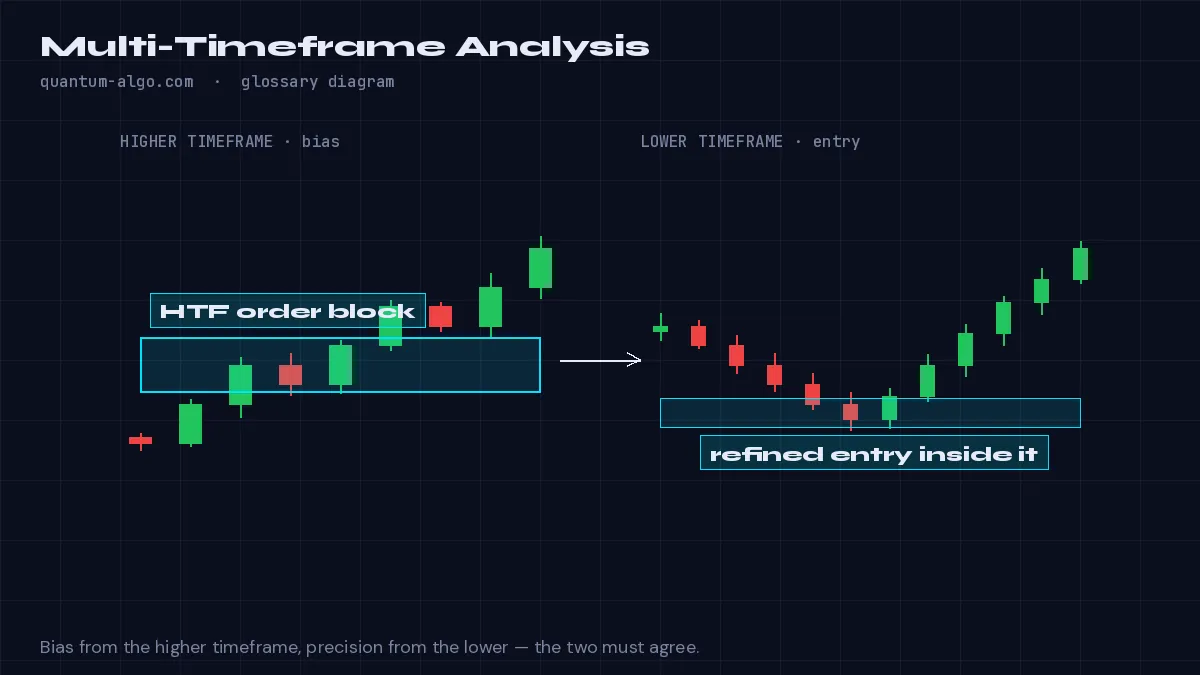
Multi-timeframe analysis (MTF) is the institutional-grade approach to using multiple chart timeframes coherently. The higher timeframe (HTF) sets the directional bias — the trend institutions are committed to. The lower timeframe (LTF) provides the entry timing — the precise candle on which to commit capital. Trades that align HTF and LTF dramatically outperform single-timeframe execution.
Standard MTF pairings: for swing traders, daily HTF + 4H or 1H LTF; for day traders, 4H or 1H HTF + 15m or 5m LTF; for scalpers, 1H or 15m HTF + 1m or 5m LTF. The principle is consistent: HTF for bias, LTF for timing, and never trade against HTF bias regardless of how clean the LTF setup looks.
The compounding effect of MTF is powerful. A clean LTF order block has roughly 55% win rate without HTF context. The same order block aligned with HTF bias has roughly 65–68% win rate. The ~10 percentage point uplift compounds across thousands of trades into a dramatically different equity curve.
Quantum Algo's Multi-Timeframe Panel automates MTF analysis by displaying the structural state (bullish/bearish/neutral) of three higher timeframes simultaneously while you trade on the entry timeframe. The panel flags when LTF setups align or contradict HTF bias, eliminating one of the most common SMC execution errors.
How to identify it on a chart
- Choose three timeframes in roughly 4–6× steps (e.g. daily, 4H, 15m).
- Take the bias and the key zones from the highest.
- Refine the zone and time the entry on the lowest.
Worked example
The daily shows a bullish order block; the 4-hour shows price entering it; the 15-minute prints a CHoCH inside it. The three agree, and the 15-minute entry has the daily behind it.
See it on the chart, read it in depth
Frequently asked questions
Which timeframes should I use for SMC trading?
Day traders: 4H bias + 15m execution. Swing traders: daily bias + 1H execution. Scalpers: 1H bias + 5m execution. The HTF should be 4–8x your LTF — close enough to be relevant, far enough to filter noise.
Can I trade against higher-timeframe bias?
Counter-trend trades against HTF bias produce roughly 40% win rate versus 65%+ for trend-aligned trades. They are not impossible to take but require extraordinary confluence and reduced position sizing. Most experienced SMC traders simply don't take them.
How many timeframes should I monitor?
Three is the sweet spot: HTF (bias), MTF (setup formation), LTF (entry timing). More than three creates analysis paralysis and conflicting signals. Quantum Algo's MTF Panel uses three by default for this reason.
Related terms
See Multi-Timeframe Analysis on your TradingView chart
Zeno reads Smart Money structure across timeframes and prints the entry, stop and targets — with a public record of every posted trade. The free indicators draw the concepts this page defines.