Session-Based Trading
Session-based trading is an execution framework that aligns trading with the Asia, London and New York sessions, where institutional flow concentrates. The London/New York overlap (08:00–11:00 EST) is the highest-volume window and produces the cleanest setups. Traders avoid the Asian range, wait for London Open, and treat the Asian high and low as liquidity targets.
◆Full guide: Forex Market Hours: When the Forex Market Opens, Closes and Actually Moves
What it means
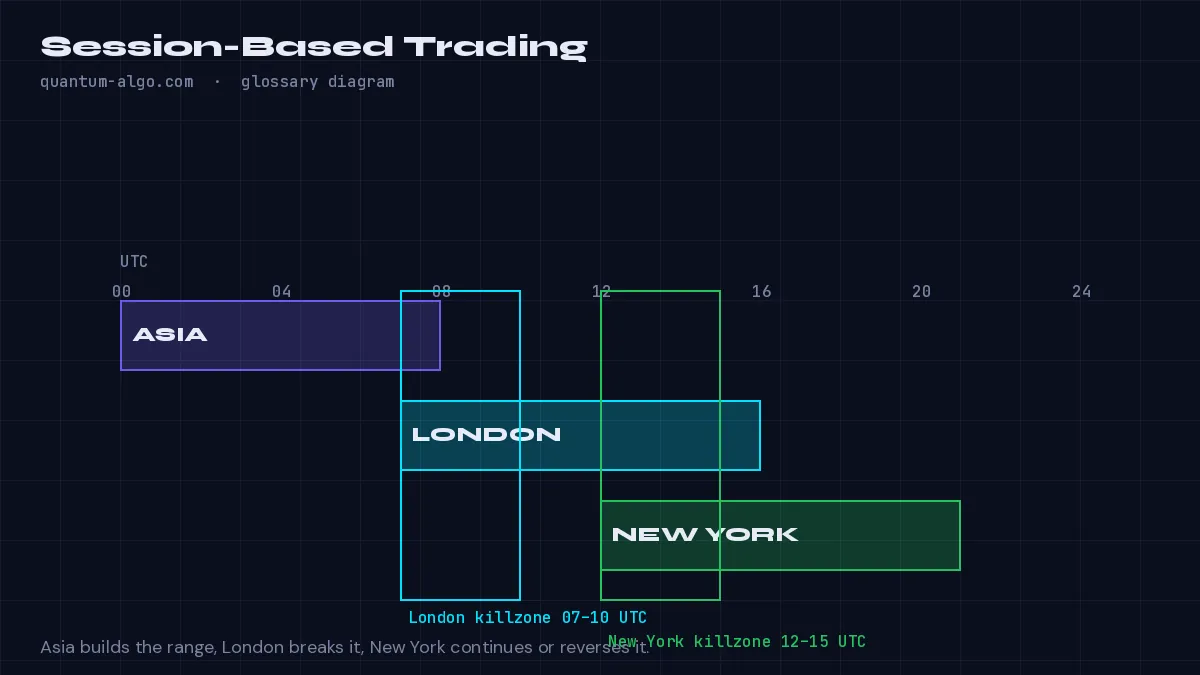
Session-based trading is the SMC execution framework that aligns trading activity with the three major global market sessions. The Asian session (typically Tokyo + Sydney, 18:00–02:00 EST) is characterized by tight ranges and lower institutional flow. The London session (02:00–11:00 EST) opens European institutional desks and produces the first major directional flow of the day. The New York session (08:00–16:00 EST) overlaps with London and includes the New York equity market open at 09:30 EST.
The London/New York overlap (08:00–11:00 EST) is the highest-volume window of the global trading day for most major forex pairs and gold. This is where the bulk of daily price movement occurs and where SMC setups produce the cleanest results. The ICT 'killzone' framework formalizes specific high-probability windows within these sessions.
The Asian session is the institutional 'positioning' window for the rest of the day. It typically prints a tight range that becomes the reference for liquidity targets during London and New York. The Asian-session high and Asian-session low are major liquidity pools that institutional flow often sweeps during the early London Open. This is the basis of the Judas Swing pattern.
Practical session-based execution: avoid taking trades during Asian range hours unless you have specific HTF confluence. Wait for London Open (and the typical 60–90 minute Judas Swing window) before committing capital. The cleanest setups print during the London/New York overlap. After 12:00 EST, opportunity quality declines as European desks close and only US flow remains active.
How to identify it on a chart
- Mark the Asian range, London open and New York open on the chart.
- Expect the Asian range to be swept early in London.
- Take entries in the killzones; avoid the dead hours between sessions.
Worked example
The Asian range on EURUSD is 30 pips; London sweeps its low at 07:40 UTC and reverses. The New York session then continues the London direction after a pullback at 13:00.
See it on the chart, read it in depth
Frequently asked questions
Which session is best for SMC trading?
London/New York overlap (08:00–11:00 EST) for forex, gold, and indices. London Open (02:00–05:00 EST) for European-focused setups. New York Open (09:30 EST) for indices specifically. Avoid Asian session for SMC unless higher-timeframe context demands it.
Does session-based trading apply to crypto?
Less strictly than forex, but yes. Bitcoin and Ethereum show clear flow concentration around equity-market hours, especially New York Open. Altcoins are more random because retail-heavy flow dominates them. Crypto traders benefit from session awareness but should not over-restrict trading hours.
Can I trade during the Asian session?
It is possible but lower probability. Asian session prints tight ranges with low institutional flow. Setups print but tend to revert without follow-through. Most SMC traders avoid Asian-session entries unless they are explicitly trading the AsiaPac currencies (AUDUSD, NZDUSD, USDJPY) where session liquidity is meaningful.
Related terms
See Session-Based Trading on your TradingView chart
Zeno reads Smart Money structure across timeframes and prints the entry, stop and targets — with a public record of every posted trade. The free indicators draw the concepts this page defines.