Is Jane Street a Prop Trading Firm? How It Works, How It Makes Money, and How It Differs From Retail Prop Firms

Yes. Jane Street is a proprietary trading firm: it trades only its own capital, has no outside clients' money to manage, and earns its revenue as one of the world's largest market makers and liquidity providers in ETFs, bonds, options and stocks. It is not a retail "prop firm" that sells evaluations or funded accounts. The only way to trade for Jane Street is to be hired as an employee.
The words "prop firm" now mean two very different businesses. One is the institutional trading house that risks its own balance sheet, like Jane Street, Optiver or Susquehanna. The other is the online challenge company that charges traders a fee for a shot at a funded account. I'll show you where Jane Street fits, how it actually makes money, how people get in, and which parts of its playbook a retail trader can borrow.
Is Jane Street a prop trading firm?
Yes, in the original meaning of the term. Proprietary trading means a firm trades its own money for its own profit rather than executing orders or managing funds for clients. Jane Street has no hedge fund investors, no retail brokerage customers and no assets under management. Every position it holds sits on its own balance sheet, and every gain or loss belongs to the firm and its partners.
Jane Street describes itself as a quantitative trading firm and global liquidity provider, and calls itself one of the world's largest market makers. Those labels all describe the same thing: it stands ready to buy and sell, quotes prices on both sides of the market, and makes its money from the spread and from pricing instruments more accurately than everyone else. If you came here from the world of retail prop firms, the business model is completely different, and I'll get to that below.
What does Jane Street actually do?
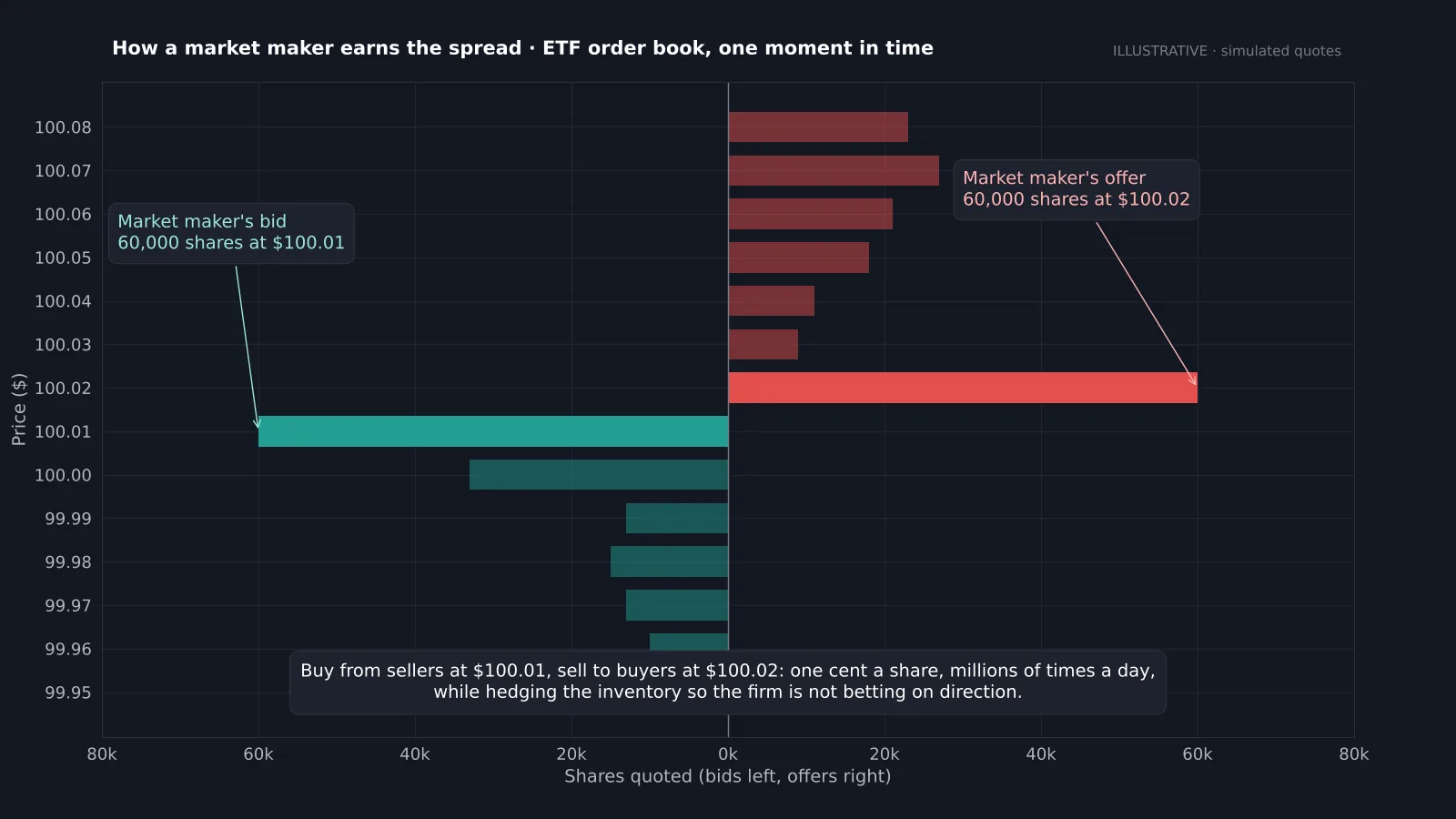
At its core, Jane Street is a market maker. It posts a bid (a price it will buy at) and an offer (a price it will sell at) in thousands of instruments at once. When a pension fund wants to sell a block of a bond ETF, or a broker routes a retail options order, there is a good chance Jane Street is on the other side.
The firm says it can trade continuously on more than 200 electronic exchanges and venues, and that it is a major player in equities, bonds and options. It is best known for ETFs: it quotes funds that hold hundreds of stocks or bonds and keeps the ETF price in line with the value of what the fund owns. It also trades futures, currencies and commodities, and deals directly with institutions that want to move large size without moving the market.
Markets are mostly electronic now, so most of this runs through software the firm builds itself. Jane Street is famous among programmers for writing most of its systems in OCaml, a functional language few other companies use at that scale.
How does Jane Street make money?
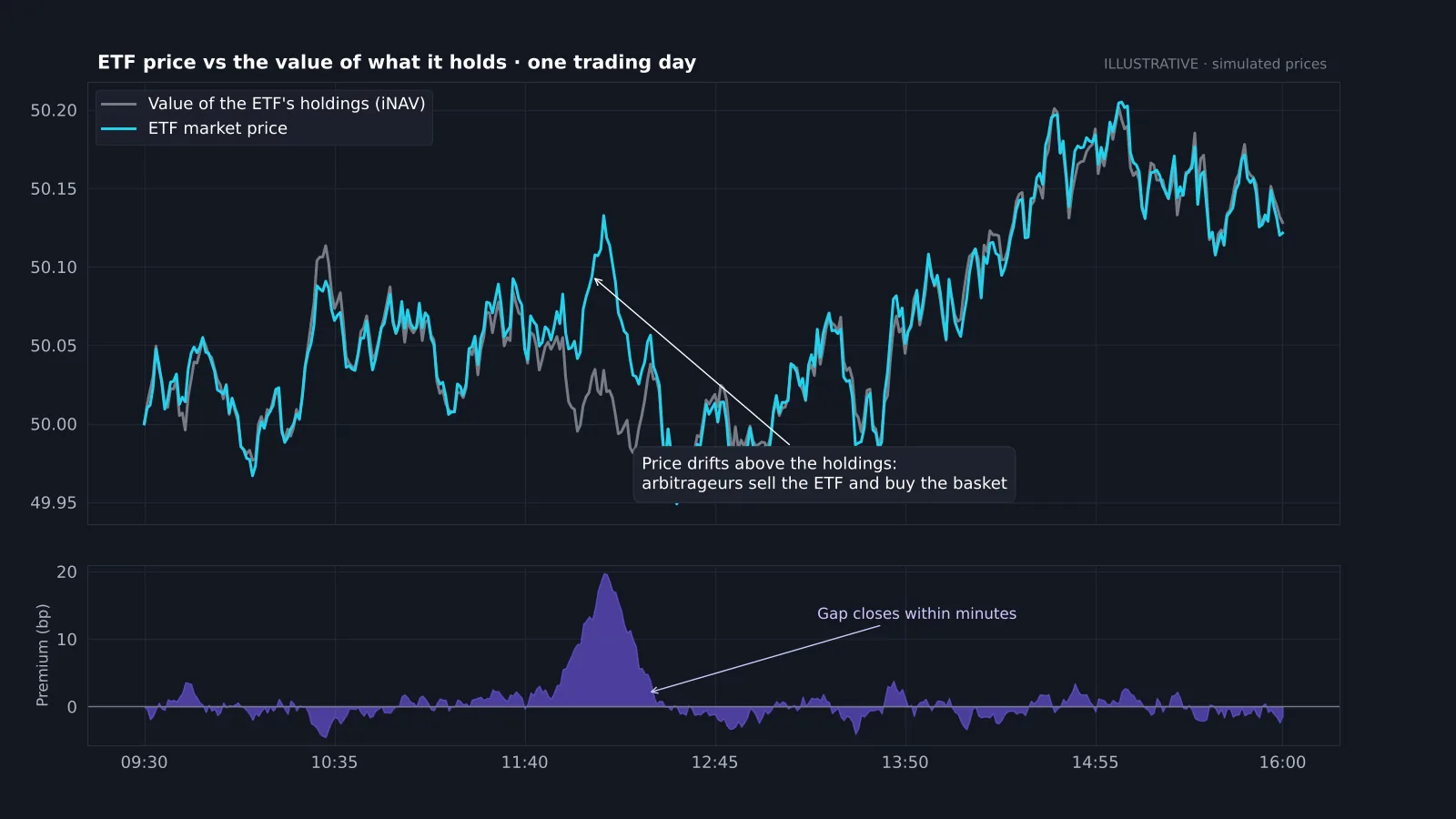
Jane Street makes money in three overlapping ways, all with its own capital:
| Source | How it works | Example |
|---|---|---|
| Bid-ask spread | Buy at the bid, sell at the offer, keep the difference many times a day. | Buy ETF shares at $100.01, sell at $100.02. |
| ETF arbitrage | When an ETF trades above or below the value of its holdings, buy the cheap side and sell the rich side. | ETF at a premium: sell the ETF, buy the basket, create new shares. |
| Relative value | Price related instruments against each other and trade the mispricing. | An option against its underlying, a bond against a bond future. |
None of these depends on predicting whether markets go up or down. A market maker wants to buy and sell all day, keep a sliver of each trade, and hedge whatever inventory builds up so a big move does not hurt. That is why firms like this can be profitable in falling markets as well as rising ones. The hard part is the pricing: quote too tight and informed traders pick you off, quote too wide and nobody trades with you.
Jane Street vs a retail prop firm: what is the difference?
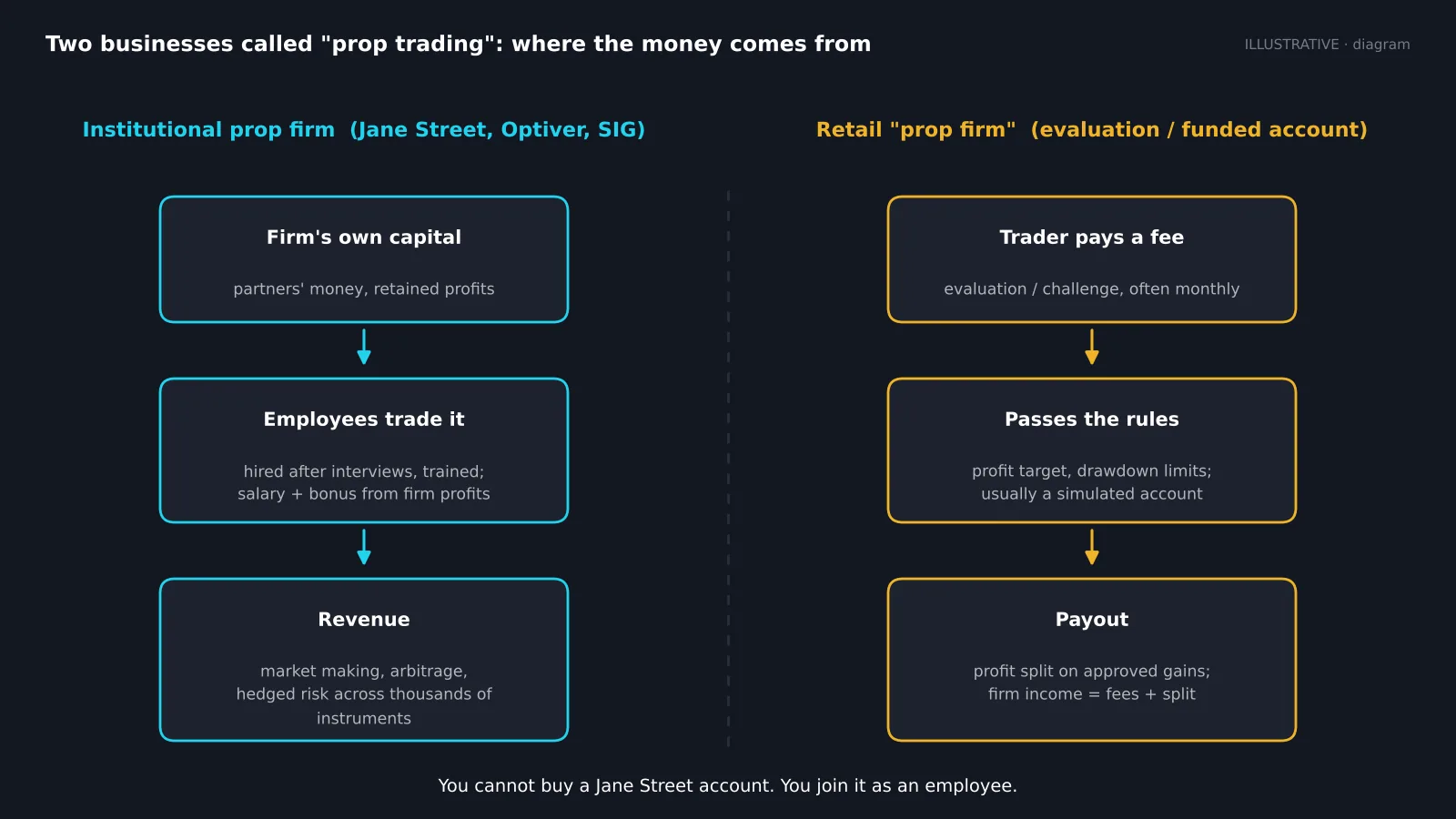
Both are called prop firms, but the money flows in opposite directions. At Jane Street the firm puts up the capital and pays you a salary and bonus to trade it. At a retail prop firm you pay a fee to take an evaluation, trade a usually simulated account under strict rules, and receive a share of the profits if you pass and the firm approves the payout.
| Jane Street (institutional) | Retail prop firm | |
|---|---|---|
| Whose money? | The firm's own capital | Usually simulated; firm pays from fees and its own funds |
| How you join | Applications, interviews, training | Buy an evaluation online |
| Upfront cost to you | None | Evaluation fee, often monthly |
| How you get paid | Salary + discretionary bonus | Profit split on approved payouts |
| Strategy | The firm's systems and models | Your own, within the rules |
| Typical background | Maths, CS, physics, economics graduates | Anyone |
Neither model is a scam by definition, but they solve different problems. Jane Street needs a few hundred exceptional graduates a year. A retail prop firm needs thousands of paying traders and a rulebook that keeps payouts below fee income. If you want the retail route, our list of prop firms for stock trading and the prop firm comparison cover the firms worth looking at.
Who owns Jane Street and how is it run?
Jane Street is privately owned by its partners. It was started at the turn of the millennium by a small group of traders, some of whom had worked at Susquehanna, and it dates its founding to 2000. It has never taken outside investors, so it does not publish a full annual report the way a listed bank does.
The firm is known for a flat structure. It has no CEO in the usual sense and runs through committees and senior partners, and it is known for pooling profits so that people are rewarded for the firm doing well rather than only for their own desk. That culture matters for the trading itself: with everyone paid from the same pot, teams share models and risk instead of hiding them.
How big is Jane Street?
Big enough to sit alongside banks in global market share. The firm has trading floors in New York, London, Hong Kong, Singapore and Amsterdam, and several thousand employees. Industry data has put it among the largest traders of US-listed ETFs, and it was reported to handle a large share of bond ETF volume.
Because it is private, revenue figures come from bond documents and press reports rather than official filings. Bloomberg and other outlets have reported net trading revenue in the tens of billions of dollars a year, larger than the trading arms of several major banks. Treat any single number as an estimate; the scale is the point.
Can you trade for Jane Street?
Only as an employee. There is no evaluation to buy and no way to bring your own strategy and keep a split. Jane Street hires for three main roles:
- Quantitative trader: makes pricing and risk decisions, works with the firm's models, and adjusts quotes and hedges.
- Quantitative researcher: builds the statistical models and signals the trading uses.
- Software engineer: builds the trading systems, data tools and infrastructure.
Most hires come from university recruiting and internships. The interviews are known for probability puzzles, mental arithmetic, betting and market-making games, and coding. You do not need a finance degree or trading experience; the firm teaches the markets. What it looks for is fast, careful reasoning under uncertainty. A retail trading record helps far less than people expect.
Which firms are like Jane Street?
Jane Street belongs to a small group of global electronic market makers and proprietary trading houses. They compete for the same order flow and the same graduates:
| Firm | Known for |
|---|---|
| Optiver | Options and ETF market making, Amsterdam roots |
| IMC | Options and equities market making |
| Susquehanna (SIG) | Options market making, decision-science culture |
| Hudson River Trading | Fully automated, algorithm-first trading |
| Jump Trading | High-frequency trading across futures and crypto |
| DRW | Futures, rates and crypto trading |
| Citadel Securities | Retail order flow and equities market making |
All of them trade their own capital and hire through interviews. None of them sells retail funded accounts. If a website offers you a "Jane Street style" funded challenge, it has nothing to do with the firm.
Has Jane Street been in regulatory trouble?
Like every large trading firm, it has had disputes. The most prominent was in India, where the market regulator SEBI issued an interim order over its index options trading, required a large sum to be placed in escrow, and later allowed it to resume trading after the deposit. Jane Street denied wrongdoing and contested the findings. It has also been named in US lawsuits connected to crypto collapses, which it also disputes.
These cases are worth knowing because they show what market makers are watched for: whether trading in one market moves prices in another to the firm's advantage. For a retail trader they change nothing practical, since you cannot open an account with Jane Street either way.
Reference data
| Item | Value |
|---|---|
| Type of firm | Proprietary trading firm, market maker, liquidity provider |
| Founded | Dates its founding to 2000 |
| Ownership | Private partnership, no outside investors |
| Trading floors | New York, London, Hong Kong, Singapore, Amsterdam |
| Venues traded | More than 200 electronic exchanges and venues |
| Main markets | ETFs, bonds, options, equities, futures, currencies |
| Retail funded accounts | None |
| Main roles hired | Quant trader, quant researcher, software engineer |
What can retail traders learn from how Jane Street trades?
You cannot copy a market maker's speed, but you can stop trading against it blindly. Three lessons carry over directly:
- The spread is a real cost. Every market order pays it. Use limit orders where you can; our guide to order types shows when each one makes sense.
- Liquidity is thin at the edges. Large orders walk the book. Check depth with Level 2 before you size up, and expect slippage in fast markets.
- Edge is small and repeated. Market makers win by making a slightly positive bet thousands of times with tight risk. That is the same logic behind fixed-risk position sizing.
If you want to see where large players are likely to act, the institutional order flow lesson shows how liquidity pools and sweeps appear on a chart.
Which prop trading path fits you?
Pick what you want and where you are starting from. The finder points you to the route that actually matches, with the main catch.
The bottom line on Jane Street
Jane Street is a prop trading firm in the institutional sense and one of the most successful ever built. It is not a place to buy a challenge, and it does not fund outside traders. If you are a strong maths or computer science student who likes fast probability problems, apply; the firms in this group are among the best-paid jobs in finance. If you want to trade your own ideas with someone else's capital, a retail prop firm is the only route, and you should read its rules as carefully as Jane Street prices a trade.
Whichever path you take, the habits are the same: know your costs, size small, and only trade setups you can measure. Our free Quantum Algo indicators are a good place to start marking structure and liquidity on your own charts.
Jane Street is an institutional proprietary trading firm and market maker that trades only its own capital. It earns from spreads, ETF arbitrage and relative value, not from fees paid by traders. It does not sell evaluations or funded accounts; the only way in is to be hired as a trader, researcher or engineer. Retail prop firms are a separate business where you pay a fee and receive a profit split.
◆ Interactive check
Do you know how Jane Street works?
Questions people ask about Jane Street
Yes, an institutional one. It trades only its own capital as a market maker and liquidity provider. It is not a retail prop firm that sells evaluations or funded accounts.
No. A hedge fund manages money for outside investors. Jane Street has no outside investors and trades only the partners' capital.
No. Jane Street does not fund outside traders. The only way to trade its capital is to be hired as an employee.
Mainly from market making: earning the bid-ask spread, keeping ETF prices in line with their holdings through arbitrage, and trading related instruments against each other.
Yes. It calls itself one of the world's largest market makers and is especially active in ETFs, bonds and options.
Its partners. It is a private firm that has never taken outside investors.
Citadel is a hedge fund that manages outside money; Citadel Securities is a separate market maker. Jane Street is a single proprietary firm with no outside investors.
No. Many hires studied maths, computer science or physics. The firm trains new hires on markets and focuses its interviews on reasoning and probability.
References & Related Guides
Read next
- What Is a Prop Firm?
- Prop Firm Comparison
- Prop Firms for Stock Trading
- Options Prop Firms
- What Is Quantitative Trading?
- How to Read Level 2
- What Is Slippage?
- Order Types Explained
- Institutional Order Flow
- Alpha Futures Review