QFL Strategy: The Complete Base & Bounce Guide
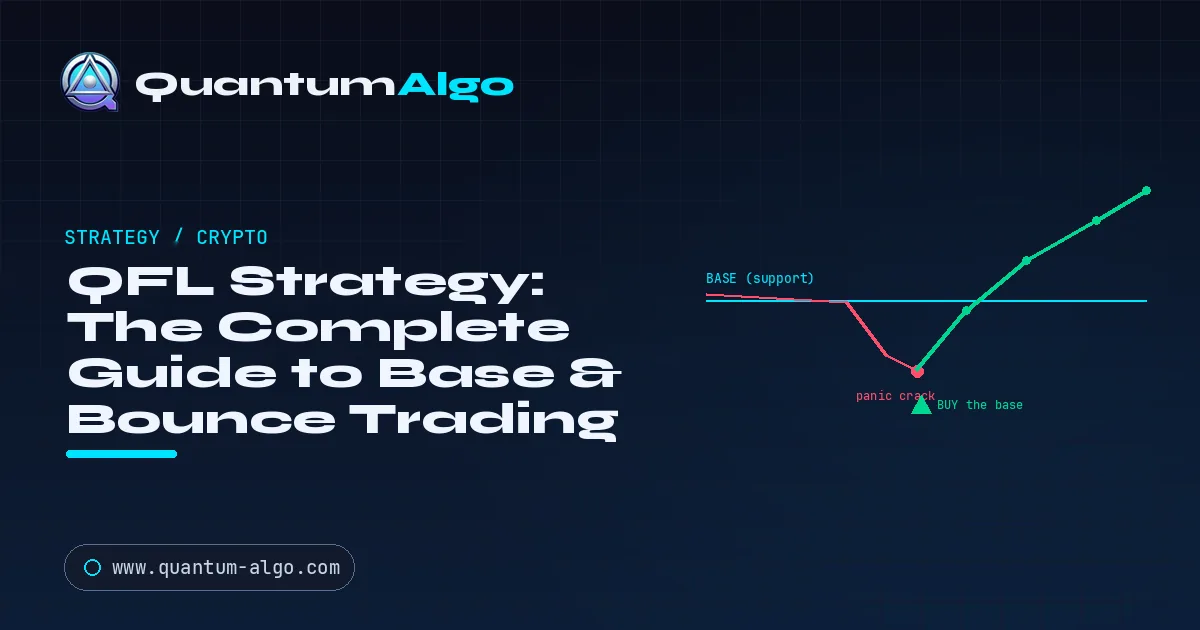
The QFL (Quickfingers Luc) strategy is a mean-reversion method that waits for price to build a clear base of repeated support, then buys the panic crack below that base, expecting a snap-back toward it. The edge is behavioral: stops and forced selling below an obvious level overshoot fair value. Base quality decides setup quality, so grade the base first.
QFL — short for Quickfingers Luc, the trader who popularised it — is a mean-reversion strategy built around one simple observation: markets that have established a clear consolidation "base" tend to snap back sharply after price cracks below that base and triggers a wave of panic selling. Rather than buying breakouts, QFL buys the fear: the moment weak hands are flushed out below a known support, the strategy steps in for the bounce.
This guide explains the full QFL logic — what a base is, why the crack below it works, how to identify high-quality bases, how to enter and manage the trade, and the risks that catch careless traders. It is written to give you a genuine working understanding of the method, not just a definition, whether you trade crypto, forex, or stocks.

Automate your trades. Let Quantum Algo trade for you.
Every signal executed on your own account — 24/7, hands-off.
What kind of strategy is QFL?
QFL is fundamentally a mean-reversion strategy with a behavioural core. The "base" is a zone where price has repeatedly found support and consolidated — a level the whole market can see. When price finally breaks below that base, it often does so on a spike of panic: stop-losses trigger, weak longs capitulate, and a cascade of forced selling pushes price further than fundamentals justify. QFL treats that overshoot as the opportunity, buying into the panic on the expectation of a snap-back toward the base.
What makes QFL distinctive is that it deliberately does the opposite of breakout trading. A breakout trader sells or avoids a break below support; a QFL trader sees that same break as a liquidity flush that sets up a high-probability bounce. The edge comes from the predictable behaviour of crowds around obvious levels — the stronger and more obvious the base, the more emotional the reaction when it cracks.
Anatomy of a QFL setup
The base is established support. The crack is the panic flush below it. The snap-back is the trade.
Why does price snap back after the crack below a base?
The strategy's edge rests on crowd behaviour around visible levels. A well-established base is not a secret — everyone can see it, which is exactly why it works. Traders place stops just below it, breakout sellers wait to short a break of it, and nervous longs plan to exit if it fails. When price finally dips below, all of that pent-up selling fires at once, creating a sharp, emotional flush that overshoots fair value.
That overshoot is temporary because it is driven by forced and panic selling, not by a genuine repricing. Once the weak hands are cleared out, selling pressure evaporates and price tends to recoil back toward the base. QFL positions for that recoil. In effect, the strategy is harvesting the predictable overreaction of the crowd to an obvious level breaking — a behavioural inefficiency rather than a technical one.
How do you identify a high-quality QFL base?
Not every support level is a QFL base. The quality of the base determines the quality of the setup, so learning to grade bases is the core skill. The strongest bases share a few characteristics.
Grading a base: strong vs weak
A strong base is obvious, repeatedly tested, and visible on higher timeframes. A weak one is a single graze.
Clear and obvious
The best bases are visible to everyone — a level price has bounced from multiple times. The more obvious the base, the more stops and emotion sit beneath it, and the sharper the flush.
Well-tested
A base touched several times over a meaningful period carries more weight than a single bounce. Repeated defence shows real buying interest that is likely to reappear.
Meaningful consolidation
Price should have genuinely paused and built structure at the level, not merely grazed it. A proper base represents accepted value, which is what price snaps back toward.
Higher-timeframe relevance
Bases that are visible on higher timeframes attract more participants and produce more reliable reactions than minor intraday levels.
Entering and managing a QFL trade
Identifying the setup is half the job; executing it with defined risk is the other half. Because QFL involves buying into active selling, disciplined management is essential.
The QFL trade sequence
Wait for the base, wait for the crack, enter into the flush with a defined stop, and target the snap-back.
Entry happens into the flush below the base — either at a fixed percentage below, scaling in, or on the first sign of stabilisation, depending on your variant. The stop sits below the flush low: if price keeps falling and does not snap back, the base has genuinely failed and you must be out. The target is the snap-back toward the base or a defined reward-to-risk multiple. Because you are catching a falling market, position sizing and a hard stop are non-negotiable — the whole method depends on the bounce materialising, and when it does not, small controlled losses keep you in the game.
How do you manage the risks of QFL?
QFL is powerful but not magic, and its central risk is obvious once stated: sometimes a break below the base is not a panic flush but a genuine breakdown, and price keeps falling. Buying into that is catching a falling knife. The entire discipline of the strategy is built around surviving those cases.
Flush versus real breakdown
The same crack can snap back (the trade) or keep falling (the stop). The hard stop is what separates the two.
The defences are a hard stop below the flush, conservative position sizing so no single failed base can seriously damage your account, and base selection that favours strong, obvious levels over weak ones. It also helps to avoid QFL longs when the broader trend is aggressively bearish, since strong downtrends produce more real breakdowns and fewer clean bounces. Treated as a probabilistic edge with strict risk control — rather than a guarantee — QFL is a robust mean-reversion approach. Treated as a reason to average down without stops, it is an account-killer.
How do the QFL variants differ?
Over time traders have developed several variations on the core QFL idea, differing mainly in how aggressively they enter and how they define the flush. Understanding the variants helps you pick the one that matches your risk tolerance.
| Variant | Entry approach | Risk profile | Best for |
|---|---|---|---|
| Single-entry QFL | One entry at a set % below the base | Simple, defined | Beginners to the method |
| Scaled / laddered QFL | Multiple entries as price flushes deeper | Better average, more exposure | Experienced, well-capitalised |
| Confirmation QFL | Enter on first sign of stabilisation | Lower risk, later entry | Trend-cautious traders |
| Multi-timeframe QFL | Only trade bases aligned with HTF | Fewer, higher-quality trades | Selective, patient traders |
The common thread across all variants is a defined stop and conservative sizing. The differences are about entry timing and how much you are willing to scale into a flush — but none of them abandon the hard stop below the flush that keeps the strategy survivable.
QFL versus breakout trading
QFL is best understood by contrasting it with its opposite: breakout trading. The two strategies interpret the exact same event — price breaking a level — in completely different ways, and knowing when each applies sharpens your judgment.
Breakout logic
A breakout trader treats a break below support as the start of a new down-move and sells or avoids it. This works in strong trends where levels genuinely give way and momentum continues.
QFL logic
A QFL trader treats a break below an obvious base as a panic flush and buys the expected snap-back. This works in ranging or mean-reverting conditions where obvious levels attract crowded, emotional selling.
Reading the context
The deciding factor is regime and base quality. Strong downtrends favour the breakout read; range-bound markets with strong, obvious bases favour the QFL read. Misreading the regime is the main way each strategy fails.
Which markets and traders suit QFL?
QFL works best in markets that respect levels and produce emotional flushes — which is why it became popular in crypto, where retail-driven panic is common and support levels are widely watched. It also applies to forex and stocks anywhere obvious support attracts crowded stops. It suits patient, mean-reversion-minded traders comfortable buying into fear with strict risk control, and it fits poorly with traders who need constant action or cannot tolerate the discomfort of entering against short-term momentum.
As with any single method, QFL is strongest when combined with broader context: higher-timeframe trend, liquidity, and market structure all improve base selection and filter out the low-quality flushes that become genuine breakdowns. Used as one tool within a complete framework, it is a durable way to harvest the crowd's predictable overreaction to obvious levels breaking.
• Objective base grading — Liquidity, order blocks and structure to judge which bases are worth trading
• Flush vs breakdown clarity — Context to tell a panic flush from a genuine breakdown before you buy
• Accountable performance — A verified public track record behind every signal
◆ Spot the bases and flushes objectively
Quantum Algo's Smart Money Concepts tools map the liquidity, order blocks and market structure around key levels — helping you grade bases and identify genuine flushes versus real breakdowns, all backed by a verified public track record.
See the indicator → Verify the track recordFrequently Asked Questions
QFL, named after the trader Quickfingers Luc who popularised it, is a mean-reversion strategy that buys the panic crack below an established support 'base.' The idea is that when price breaks below an obvious base, it triggers a wave of forced and emotional selling that overshoots fair value — and that overshoot tends to snap back toward the base. QFL positions for that bounce, deliberately doing the opposite of breakout trading.
QFL stands for Quickfingers Luc, the online alias of the trader who developed and popularised the strategy, particularly in crypto communities. The name is now used as shorthand for the base-and-bounce method itself: identifying a clear support base, waiting for a panic crack below it, and buying the expected snap-back.
A base is a zone where price has repeatedly found support and consolidated — a level the whole market can see. The strongest bases are clear and obvious, well-tested over multiple touches, represent genuine consolidation rather than a single graze, and are visible on higher timeframes. Base quality determines setup quality, so grading bases strictly is the core QFL skill.
It works because of predictable crowd behaviour around visible levels. Everyone can see an established base, so stops sit beneath it, breakout sellers wait to short it, and nervous longs plan to exit if it fails. When price dips below, all that selling fires at once, creating a sharp emotional flush that overshoots fair value. Because that overshoot is driven by panic rather than genuine repricing, price tends to recoil back toward the base — which is what QFL buys.
No, though it became popular in crypto because retail-driven panic is common there and support levels are widely watched. The underlying behaviour — crowds overreacting to obvious levels breaking — appears in forex and stocks too, anywhere obvious support attracts crowded stops. The strategy applies to any market that respects levels and produces emotional flushes, not just crypto.
Entry happens into the flush below the base, using one of several approaches: a single entry at a set percentage below the base, scaling in as price flushes deeper, or entering on the first sign of stabilisation. Whichever variant you use, the stop sits below the flush low and the target is the snap-back toward the base or a defined reward-to-risk multiple. A hard stop and conservative sizing are non-negotiable because you are buying into active selling.
The central risk is that a break below the base is not a panic flush but a genuine breakdown, and price keeps falling — meaning you have bought into a falling knife. The defences are a hard stop below the flush, conservative position sizing so no single failed base seriously damages your account, favouring strong obvious bases, and avoiding QFL longs when the broader trend is aggressively bearish. Treated as a probabilistic edge with strict risk control, it is robust; treated as a reason to average down without stops, it is an account-killer.
They interpret the same event oppositely. A breakout trader treats a break below support as the start of a new down-move and sells or avoids it — which works in strong trends. A QFL trader treats a break below an obvious base as a panic flush and buys the expected snap-back — which works in ranging, mean-reverting conditions. The deciding factor is regime and base quality; misreading the regime is the main way each strategy fails.
Only within a pre-planned, defined-risk scaling variant with a hard stop — never as an open-ended attempt to rescue a losing trade. When price blows through your stop without snapping back, the base has failed and this is a real breakdown; taking the small planned loss is what keeps QFL viable. Removing the stop or averaging down indefinitely is how traders turn one bad base into a blown account.
Common variants differ mainly in entry timing and aggression. Single-entry QFL takes one entry at a set percentage below the base. Scaled or laddered QFL adds entries as price flushes deeper for a better average but more exposure. Confirmation QFL waits for the first sign of stabilisation, lowering risk at the cost of a later entry. Multi-timeframe QFL only trades bases aligned with the higher-timeframe picture for fewer, higher-quality trades. All keep the hard stop below the flush.
It works poorly in aggressive downtrends, because strong bearish momentum produces more genuine breakdowns and fewer clean bounces — exactly the conditions where buying a crack below support fails. QFL is a mean-reversion strategy best suited to ranging or range-bound markets with strong, obvious bases. Filtering trades by higher-timeframe trend, and standing aside when the broader market is aggressively bearish, materially improves results.
Quantum Algo's Smart Money Concepts tools map the liquidity, order blocks, and market structure around key levels, which helps you grade bases objectively and distinguish a genuine panic flush from a real breakdown. Since QFL depends heavily on base quality and reading whether a crack is emotional or fundamental, having institutional-grade structure and liquidity context — backed by a verified public track record — supports better base selection and risk decisions.
References & Related Guides
More in this topic
- Supply and Demand Trading Guide — Zones, Flips & Strategies
- Liquidity in Trading: Complete Guide — Order Blocks, Raids & Kill Zones
- Liquidity Sweep Trading: Stop Hunts Explained
- Smart Money Concepts (SMC): Ultimate Trading Guide
- Order Blocks Trading: Complete Guide (Identify, Grade & Trade OBs)
- Mean Reversion Trading Guide
- Crypto Trading for Beginners: Complete Guide
- Range Trading Strategy: Complete Guide | Quantum Algo
- Swing Trading Strategies Guide
- Risk Management in Trading — The Complete Survival Guide
- Best Buy/Sell Indicator: How to Choose One That Actually Works
- What Is the Golden Pocket in Trading? (Fib 0.618)
- Best TradingView Indicators
- What Is Supply and Demand in Trading?
Core reading
- Smart Money Concepts (SMC): Ultimate Trading Guide
- Risk Management in Trading — The Complete Survival Guide
- Best TradingView Indicators
- All Premium Guides
- Public Track Record
- Quantum Algo on TradingView