What Is the Best Indicator for FTSE 100 (UK100)?
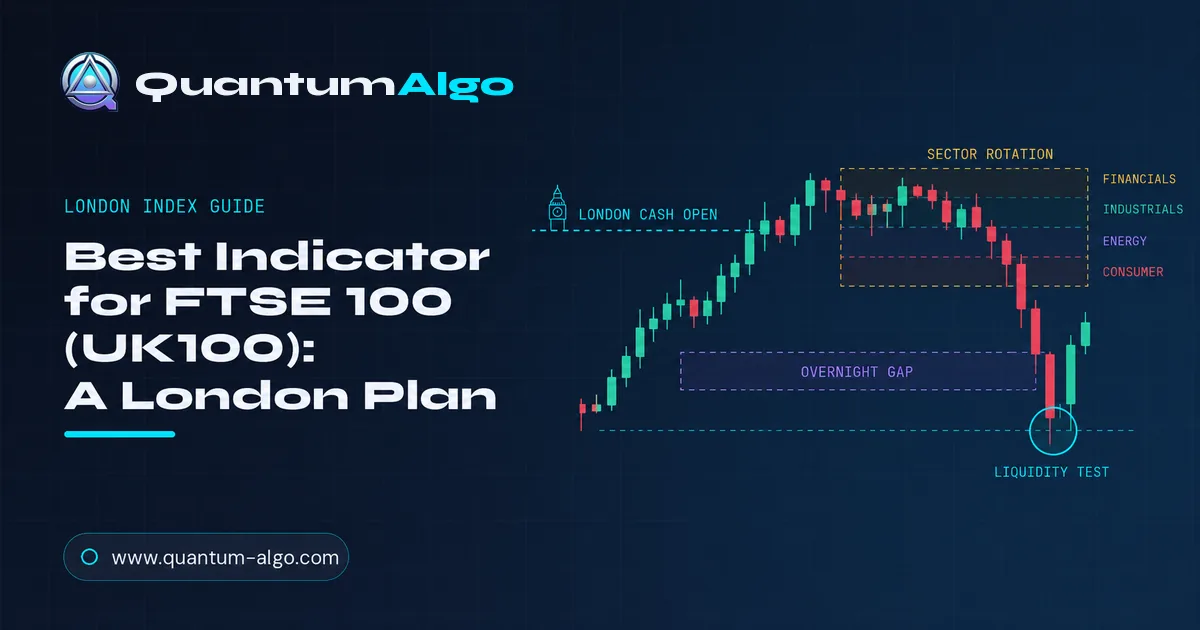
At 08:00 London, the screen can show a gap above yesterday’s close before a single cash FTSE auction has proved that buyers want higher prices. If banks and energy shares are driving the first print while defensives lag, UK100 is giving you a sector-rotation question, not a clean breakout. That is why the best indicator for FTSE 100 trading starts with the London scene and waits for acceptance or a sweep.
The best indicator for FTSE 100 trading is a session-aware structure tool paired with VWAP and ATR. Mark the overnight range, wait for the London cash open, check sector rotation and require acceptance, displacement or a reclaim before entry. Quantum Algo's free public indicators mark order blocks and FVGs; Zeno adds confirmed Buy/Sell signals with SL/TP and built-in risk management.
The FTSE 100 is a London cash-open and sector-rotation problem before it is a signal problem: the indicator earns its place by showing when overnight futures become a real auction. I treat the first London move as a question, not as permission to chase. The clean setup is usually the answer that comes after the question.
Indicators that prove themselves in public.
One engine, four precision tools — the Gold (XAU) Scalper, the institutional Gravity Zone, the Zeno momentum Oscillator, and Zeno Stocks for equities.
The FTSE UK Index Series ground rules are the permanent benchmark reference; the Bank of England Bank Rate page is the macro context I check before treating a gap as a clean trend day.
Use this guide for UK100 CFDs, FTSE futures and the TradingView symbol supplied by your broker. The London Stock Exchange trading-hours page is the reference for the official cash schedule, while ICE’s FTSE 100 futures page is useful for contract-specific details. The chart still decides whether the opening price is accepted or rejected.
| Layer | Read | Failure mode |
|---|---|---|
| Overnight range | Where Asia and early Europe left resting liquidity. | Assuming the edge must break before London. |
| Cash open | Whether the market accepts the futures price. | Trading the first wick as a trend. |
| Sector rotation | Whether banks, energy and defensives agree. | Calling one strong sector broad confirmation. |
| VWAP / ATR | Location and realistic movement. | Using either as a standalone trigger. |
| SMC signal | Structure event with a defined invalidation. | Ignoring the session that created it. |
What is the best indicator for FTSE 100 (UK100)?
I would choose a session-aware Smart Money Concepts indicator with a volatility check. The SMC layer shows where price swept a prior high or low, displaced, or returned to an order block or FVG. The session layer tells me whether that event happened before or after the London cash auction. ATR prevents a quiet-Asian stop from being used on a London expansion.
“Best” therefore means the tool helps me answer four questions in the right order: where is liquidity, when is the active auction, what confirms the direction, and how much cash is at risk? The DAX session-first guide makes a similar time-based argument for a different European index.
Why does the London cash open matter on the FTSE?
The FTSE trades before London opens through futures and CFD feeds, so a chart can already look directional at 07:00 or 08:00 London time. That does not mean the cash auction agrees. The opening print can sweep the overnight extreme, fill part of a gap, or validate the direction that futures established.
My rule is to mark the overnight high, low and prior close, then wait for the first meaningful post-open expansion. If price pokes through an overnight level and closes back inside, I treat it as a candidate sweep. If it holds outside and retests from the other side, I treat it as acceptance. This is a cleaner read than labeling every early move “bullish” or “bearish.”
How does sector rotation change a UK100 signal?
The FTSE is not a pure technology index. Financials, energy, mining and defensives can contribute different pressures. That matters because a headline move can be carried by one pocket of the index while another pocket is fading. I do not need to trade every constituent, but I do want to know whether the index move is broad enough to justify a continuation entry.
Use sector rotation as a veto, not a trigger. If price sweeps the overnight high, reclaims VWAP and the major sectors are not fighting the move, the setup has cleaner context. If energy is strong but banks and defensives are rolling over, I demand a closer target or wait for a clearer structure break. The futures indicator guide helps with the volume side of this decision.
What does an overnight FTSE gap tell you?
A gap is a location, not a forecast. A gap above the prior close can be accepted, partially filled and continued, or rejected back through the opening level. FTSE Russell’s UK index material gives useful context on how the family of indexes is constructed, but it does not tell you what today’s auction will do.
I divide gaps into three practical states: open-and-hold, open-and-fill, and open-and-fail. Open-and-hold setups usually need a retest rather than a chase. Open-and-fill setups can rotate toward the prior close. Open-and-fail setups often create the best reversal location because traders who entered with the gap direction are now trapped.
How do you build a London-first FTSE trading plan?
On 1H, decide whether price is trending or rotating into a higher-timeframe level. On 15m, mark the overnight range, prior close and VWAP. At the London open, wait for either a sweep/reclaim or a displacement/hold. On 5m, refine the entry only if the 15m condition remains intact.
Classic tools have narrow jobs. VWAP describes the average-price reference; the ATR guide is the better reference for stop distance. Neither replaces an invalidation level. If you cannot point to the price that proves the idea wrong, you do not have a complete trade.
The Academy liquidity lesson is useful practice: mark obvious highs and lows before the active session, then review whether the first break was a sweep or acceptance. I prefer that review over adding another oscillator.
What does a UK100 gap-following setup look like?
Imagine a 15-minute UK100 chart with a bearish 4H bias. The overnight range is 38 points wide. At the London open, price pushes 12 points above the overnight high, then closes back below it while VWAP remains overhead. A later bearish displacement candle breaks the local low. The entry is on the retracement, not on the spike.
The stop sits above the sweep and the structure that invalidates the short thesis. The target sits near a prior low, not at an arbitrary round number. If your CFD feed values one point at £1, the planned risk at 30 points is £30 per unit. If the contract uses another multiplier or your account is denominated in euros, translate the risk before entry.
The worked example also explains why two traders can take “the same” FTSE signal and receive different results. One entered the first spike with a 70-point stop; the other waited for reclaim and risked 30 points. The pattern name is less important than the auction sequence.
Which chart should frame a UK100 cash-open trade?
Use 4H and 1H for bias, 15m for the London structure and 5m for entry refinement. Avoid moving to 1m while the cash-open event is still forming. The smaller chart can make spread and fast repricing look like a new structure break.
For comparison, the DAX guide focuses on Frankfurt-to-London handoff; FTSE requires more attention to the London cash opening print and sector rotation.
How many points should a UK100 stop be?
Use this overnight-gap planner before the 08:00 London cash open. It measures the distance from the prior close, normalises it by ATR(14), and gives the guide’s rule: small gaps can rotate, medium gaps need acceptance, and oversized gaps deserve a wait rather than an automatic fade.
Use the position-sizing lesson to make the calculation a habit. When London volatility expands, the responsible response is usually smaller size, not a larger risk budget.
The London session also changes the quality of a signal through timing. A setup that appears at 07:30 may be an overnight positioning event; the same reclaim after the cash open has a different participant mix. I record the time beside every screenshot so the review does not flatten those two situations into one category.
Keep the chart labels practical: UK100, FTSE100 and the futures symbol can use different decimals, contract values and session shading. The indicator is only as good as the symbol mapping underneath it. Verify the broker’s point value before converting a 30-point stop into a cash number.
If the first London move is unusually wide, I wait for a second structure event rather than forcing a decision. A late entry with a beautiful label is still late. The best indicator should make waiting easier because the invalidation and target remain visible.
That is why I prefer a market-specific rule to a universal setting. The local auction, the instrument specification and the session context all change the meaning of a chart event. A serious review records those details before it records the result, then checks whether the same decision would still be reasonable on the next session. That is the difference between an indicator review and a screenshot collection. It gives the next decision a measurable standard.
When the evidence is mixed, the cleanest decision is often to wait. A missed entry costs less than an explanation built from hindsight. Patience is part of the system. The next clean session will still offer information. Review it calmly and keep the rule visible before each new London trade.
Will QuantumBot follow a UK100 gap plan?
Automation solves execution, not market understanding. QuantumBot is Quantum Algo’s automated execution service: it trades the signals for the user where a supported connection is available. The service is $199/mo; cancel anytime. Keep symbol selection, contract verification and risk limits separate from the execution layer. If you prefer signal-assisted execution, compare the Zeno AI Agent with the current plans.
How do you audit a UK100 indicator?
Review the FTSE in London time and keep the overnight map visible. Start the replay before the cash open, mark the prior close and the overnight edges, and write down whether the open is above, inside or below the previous day’s range. Only then evaluate the indicator. A signal that arrives before the auction may be context; a signal after acceptance may be execution.
Track the type of open, not only the direction. Was it open-and-hold, open-and-fill or open-and-fail? Over a meaningful sample, that classification tells you more about the tool than a single win-rate screenshot. It also makes the FAQ answerable: the best FTSE indicator is the one that helps you distinguish a repriced market from a trapped overnight position.
Sector context should be recorded as a sentence, not a dashboard obsession. Note whether banks, energy and defensives agreed, rotated, or contradicted the index. If you cannot access a reliable sector feed, use the index structure and lower your confidence rather than inventing precision. A missing data point is better than a fabricated confirmation.
For testing, keep the stop rule fixed while the market changes. Do not move the stop closer because London produced a wider candle. Change size, target distance or skip the trade. The Academy backtesting lesson is useful for separating the rule from the result.
That is the FTSE habit I would keep: read the clock, classify the open, check the sectors, then let structure decide. The order matters because a beautiful reclaim during a dead session is not the same trade as a reclaim after real London participation arrives.
That review keeps the product claim precise. The free public indicators mark the SMC structures; Zeno adds the confirmed signal, SL/TP and risk-management layer. Neither one turns an early London wick into certainty, and the public ledger remains evidence to verify rather than a forecast for your broker feed.
Save the pre-trade view with the overnight range, cash-open state and planned risk visible. A later screenshot of a winning FTSE move is much less useful than the decision you made before the auction resolved.
The final test is repeatability: can another trader read the same range, identify the same invalidation and calculate the same cash risk without needing your hindsight? If yes, the indicator has earned a place in the process. If not, simplify the chart before adding another tool.
That is the standard I would use for a buyer-intent page: the recommendation must survive a chart replay, a contract check and a risk calculation. A polished label is not enough. The decision should still make sense after the excitement of the opening candle is gone. That is the difference between a tool and a process you can audit later, before any new trade.
The FTSE 100 is a London cash-open and sector-rotation problem before it is a signal problem: the indicator earns its place by showing when overnight futures become a real auction. Mark the local range, wait for the active auction, require structure confirmation, use the market-specific context filter, place the stop beyond invalidation and size from cash risk. If you automate, automate a verified plan rather than a naked arrow.
◆ Interactive check
Can you pass the London-open gap check?
Questions traders ask about FTSE 100
There is no single magic oscillator. The strongest approach is a session-aware structure workflow that maps liquidity, confirms displacement or reclaim, uses VWAP or breadth as context, and sizes the stop from current volatility. Quantum Algo’s free public indicators mark order blocks and FVGs; Zeno adds confirmed Buy/Sell signals with SL/TP and built-in risk management.
VWAP is useful as an intraday location reference, not as a complete entry system. It can show whether price is accepting above or below an average, but it cannot tell you whether liquidity was swept, whether breadth agrees, or where the idea becomes invalid.
The most useful window is the local cash-market open and the first active overlap that follows it. Check the official exchange schedule, your broker chart timezone and daylight-saving changes; do not copy a fixed clock time from another feed.
Use 4H and 1H for bias, 15 minutes for the session structure, and 5 minutes only to refine a qualified setup. A 1-minute chart can help with execution, but it should not rewrite the higher-timeframe invalidation or the cash-risk calculation.
The free public Quantum Algo indicators mark Smart Money Concepts structures such as order blocks and fair value gaps. Zeno is the paid signal layer: it provides confirmed Buy/Sell signals with stop-loss, take-profit and built-in risk management; it does not draw those structures.
Quantum Algo is built for TradingView markets including indices. Test the exact symbol, exchange feed, point value and session representation supplied by your broker before committing capital.
The stop belongs beyond the price level that invalidates the idea, not at a fixed number copied from another trader. Use the session structure and current volatility to set the distance, then reduce position size when the stop is wider.
QuantumBot is the automated execution service that trades the signals for the user where a supported connection is available. It executes the signal plan; it does not replace symbol verification, contract selection, position sizing or the responsibility to check the connection.
Quantum Algo publishes a public ledger showing a 75% win rate across 160 closed signals, with 120 wins and 40 losses. That is a record to verify, not a promise for this index or for any individual account.
The logic can transfer, but the contract cannot be assumed to match. CFDs and futures can have different point values, spreads, trading hours and rollover behavior. Translate the chart stop into the exact cash value for the instrument you trade.
References & Related Guides
Read next
- Best Indicator for Nasdaq: Complete Guide
- Best Indicator for DAX (GER40): A Trading Plan
- VWAP Indicator: Complete Trading Guide
- ATR (Average True Range): Complete Guide
- Liquidity Sweep Trading Guide
- Smart Money Concepts Guide
Authoritative sources
- London Stock Exchange: trading hours
- ICE: FTSE 100 Index Futures
- FTSE Russell: UK index methodology
- FTSE Russell: UK Index Series ground rules
- Bank of England: Bank Rate
Verify the proof
For a focused comparison, read the breadth confirmation for FTSE 100 before applying the setup.