What Is CISD (Change in State of Delivery)?
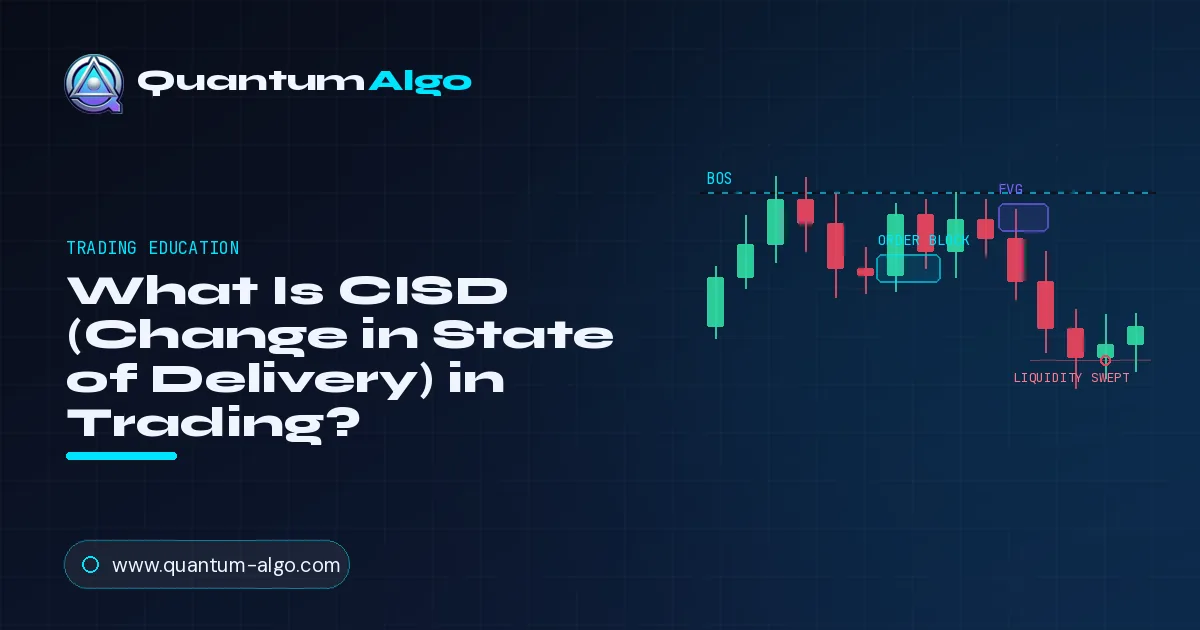
CISD stands for Change in State of Delivery, an ICT concept marking the exact moment the market stops delivering price in one direction and starts delivering it in the other. It is confirmed when a candle closes back through the opening prices of the preceding run of candles. It is a precise, early reversal signal that often precedes an MSS.
The short answer
CISD stands for Change in State of Delivery, an ICT concept. It marks the moment the market stops delivering price one way and starts delivering it the other — confirmed when price closes back through the opens of the prior candle run. A CISD is a precise, candle-based early reversal signal.
CISD stands for Change in State of Delivery. It is an ICT concept that marks the exact moment the market flips direction.
First, the key word: delivery. In ICT, delivery simply means the direction the market is actively pushing price. If price is making down candles, the market is ‘delivering’ to the downside. Sellers are in control.
A CISD is when that delivery flips. It is confirmed when a candle closes back through the opening prices of the previous run of candles. So after a run of sellers pushing down, an up candle that closes above their opens signals the market is about to deliver up instead. It is a precise, candle-based early reversal signal. The rest of this answer shows how it forms, how it compares to MSS, and how to trade it — then links you to the full ICT guide.
How does a CISD form on the chart?
A CISD is defined by exact candles, which is what makes it so precise. Use the interactive tool below to watch delivery flip from down to up.
The sequence has three parts. First, the market is delivering in one direction — say a clean run of bearish candles pushing price down. Note the opening prices of those down candles.
Second, price reverses and a strong candle closes back above those opens. That close is the CISD. It is the signal that sellers have lost control and buyers are taking over.
Third, the market begins delivering the other way — price trends up. The level where the CISD happened becomes a reference for entries. Because the signal is tied to specific opens and closes, there is no guesswork about whether it triggered. It either closed through the level or it did not.

Automate your trades. Let Quantum Algo trade for you.
Every signal executed on your own account — 24/7, hands-off.
How does CISD differ from MSS and BOS?
CISD, MSS and BOS are all reversal or continuation signals, so it helps to see how they relate.
| Signal | Defined by | Signals |
|---|---|---|
| CISD | Close through prior candle opens | Delivery flip (early reversal) |
| MSS | Break of a swing point vs trend | Structure shift (reversal) |
| BOS | Break of a swing point with trend | Continuation |
The key difference is what defines the signal. An MSS is defined by a broken swing point — price takes out a prior high or low. A CISD is defined by candle delivery — price closing back through a run of opens.
Because a CISD does not need a full swing point to break, it often triggers earlier than an MSS. Many traders use them together: the CISD gives the first, precise hint that delivery has flipped, and the MSS then confirms the structural reversal. Think of the CISD as the fine-grained version and the MSS as the bigger-picture version of the same reversal story.
How do you trade a change in state of delivery?
Trading a CISD is about precision and patience. Here is the process for a bearish-to-bullish flip. Invert it for the opposite.
- Spot the delivery run. Identify a clean run of candles pushing price one way — here, a bearish run into a low. Mark the opens of those candles.
- Wait for the close-through. Watch for a strong candle to close back above those opens. That close is your CISD confirmation.
- Prefer confluence. A CISD is strongest right after a liquidity sweep or at a key level, where a reversal is already likely.
- Enter on the retest. After the CISD, wait for price to pull back to the CISD level, then enter in the new direction.
- Stop below the low. Place your stop beyond the extreme that formed before the flip. A new low invalidates the change in delivery.
The strength of the CISD is its precision and earliness. It is defined by exact candles, so entries are clean, and it often fires before a full structure break — getting you in early with tight risk.
The weakness is the same as any early signal: it can be a false flip. A single close-through does not guarantee a reversal. This is why confluence is essential. A CISD on its own is a hint; a CISD right after a liquidity sweep, at a strong zone, aligned with the higher timeframe, is a genuine edge. Used that way, it is one of the more precise reversal tools in the ICT toolkit.
◆ Test Your Knowledge
How do you spot a CISD with Quantum Algo?
A CISD is defined by exact candle opens and closes, which makes it perfect to automate. Quantum Algo’s Smart Money Concepts tools track delivery and structure on TradingView, so you can spot a change in the state of delivery the moment it prints, rather than scanning every candle by hand.
Related guides
◇ Frequently Asked Questions
CISD stands for Change in State of Delivery, an ICT concept. It marks the moment the market stops delivering price in one direction and starts delivering it in the other, confirmed when price closes back through the opening prices of the prior run of candles. It is an early reversal signal.
It means the market has switched the direction it is actively pushing price. Delivery is the direction of control: down candles mean bearish delivery, up candles mean bullish delivery. A change in state of delivery is the point where that control flips from one side to the other.
A CISD is confirmed when a candle closes back through the opening prices of the previous run of candles. After a bearish run, an up candle closing above those opens confirms a bullish CISD. Because it is tied to exact opens and closes, the signal is precise and objective.
A CISD is defined by candle delivery, price closing through a run of candle opens, while an MSS is defined by a broken swing point against the trend. Because a CISD does not need a full swing break, it often triggers earlier than an MSS, though the two describe the same reversal story.
Yes. Change in State of Delivery comes from ICT (Inner Circle Trader) methodology, which frames price movement in terms of delivery, the direction the market is pushing price. CISD is a refined, candle-based way to spot the moment that delivery direction changes.
Identify a clean run of candles in one direction and mark their opens. Wait for a strong candle to close back through those opens, which confirms the CISD. Prefer setups right after a liquidity sweep or at a key level, enter on the retest of the CISD level, and stop beyond the prior extreme.
As an early signal, a CISD carries some risk of being a false flip, since a single close-through does not guarantee a reversal. Reliability improves sharply with confluence, such as a CISD right after a liquidity sweep, at a strong zone, and aligned with the higher-timeframe direction.
In ICT, delivery refers to the direction in which the market is actively moving, or delivering, price. When price makes lower candles, the market is delivering to the downside; when it makes higher candles, it is delivering upward. A change in delivery signals a shift in control.
No. A CISD is an early warning that delivery has flipped, not a guarantee. Price can still resume its prior direction. That is why traders combine the CISD with confluence like liquidity sweeps and key levels, and always manage risk with a clear stop beyond the recent extreme.
Yes, they work well together. The CISD often fires first, giving an early, precise hint that delivery has flipped, and the MSS then confirms the broader structural reversal. Using the fine-grained CISD alongside the bigger-picture MSS gives both early entry and structural confirmation.
References & Related Guides
More in this topic
- Best TradingView Indicators — Complete Guide
- Divergence Trading: Complete Guide
- Elliott Wave Theory — Complete Trading Guide
- Fisher Transform Indicator: Complete Guide
- Harmonic Patterns: Complete Trading Guide
- Heikin Ashi — Complete Smoothed Candlestick Guide
- Inside Bar Trading: Complete Guide
- Leverage Trading: The Complete Guide
- Machine Learning Trading Indicators (Lorentzian): Complete Guide
- Pin Bar Trading: Complete Guide
- Pivot Points — Complete Intraday Support & Resistance Guide
- Position Trading: Complete Guide
Core reading
- BOS & CHoCH: Complete Market Structure Guide
- Order Blocks Trading: Complete Guide
- Risk Management in Trading — Complete Guide
- Candlestick Patterns Guide — Engulfing, Pinbar & More
- All Premium Guides
- Quantum Algo on TradingView
- Public Track Record