Best Trading Books: 14 Classics That Still Matter, What Each One Teaches and the Order to Read Them
The trading books most often recommended by professional traders are Reminiscences of a Stock Operator (Edwin Lefèvre), Market Wizards (Jack Schwager), Trading in the Zone (Mark Douglas) and Technical Analysis of the Financial Markets (John Murphy). Beginners should start with one book on how markets work, then one on charts, then one on psychology and risk, and only then move to books on building and testing systems, such as Trade Your Way to Financial Freedom (Van Tharp) and Evidence-Based Technical Analysis (David Aronson). Fourteen classics, sorted by level and topic, are below.
There are thousands of trading books and most repeat each other. The ones below have lasted for decades because each teaches something the others do not: how a great speculator thinks, how professional traders actually make money, how to read a chart, how to control your own behaviour, or how to prove an idea works before risking money on it. I have grouped them into a reading order, added what each is best for and its limits, and included a picker to find your next one.
What are the best trading books of all time?
These fourteen appear again and again on professional reading lists. The year is the first edition; most have updated editions.
| Book | Author | First published | Best for |
|---|---|---|---|
| Reminiscences of a Stock Operator | Edwin Lefèvre | 1923 | How a speculator thinks |
| The Intelligent Investor | Benjamin Graham | 1949 | Investing vs speculating |
| A Random Walk Down Wall Street | Burton G. Malkiel | 1973 | Why most active traders underperform |
| Options as a Strategic Investment | Lawrence G. McMillan | 1980 | Options strategies in depth |
| How to Make Money in Stocks | William J. O'Neil | 1988 | Growth stocks and CAN SLIM |
| Market Wizards | Jack D. Schwager | 1989 | Interviews with top traders |
| The Disciplined Trader | Mark Douglas | 1990 | The psychology of losing |
| Japanese Candlestick Charting Techniques | Steve Nison | 1991 | Candlestick patterns |
| Trade Your Way to Financial Freedom | Van K. Tharp | 1998 | Position sizing and expectancy |
| Technical Analysis of the Financial Markets | John J. Murphy | 1999 | The complete chart reference |
| Trading in the Zone | Mark Douglas | 2000 | Thinking in probabilities |
| Fooled by Randomness | Nassim Nicholas Taleb | 2001 | Luck vs skill |
| Evidence-Based Technical Analysis | David Aronson | 2006 | Testing ideas statistically |
| Algorithmic Trading | Ernest P. Chan | 2013 | Building and backtesting systems |
If you only read three, read Market Wizards for how real traders think, Trading in the Zone for discipline, and Murphy for the vocabulary of charts.
In what order should you read trading books?
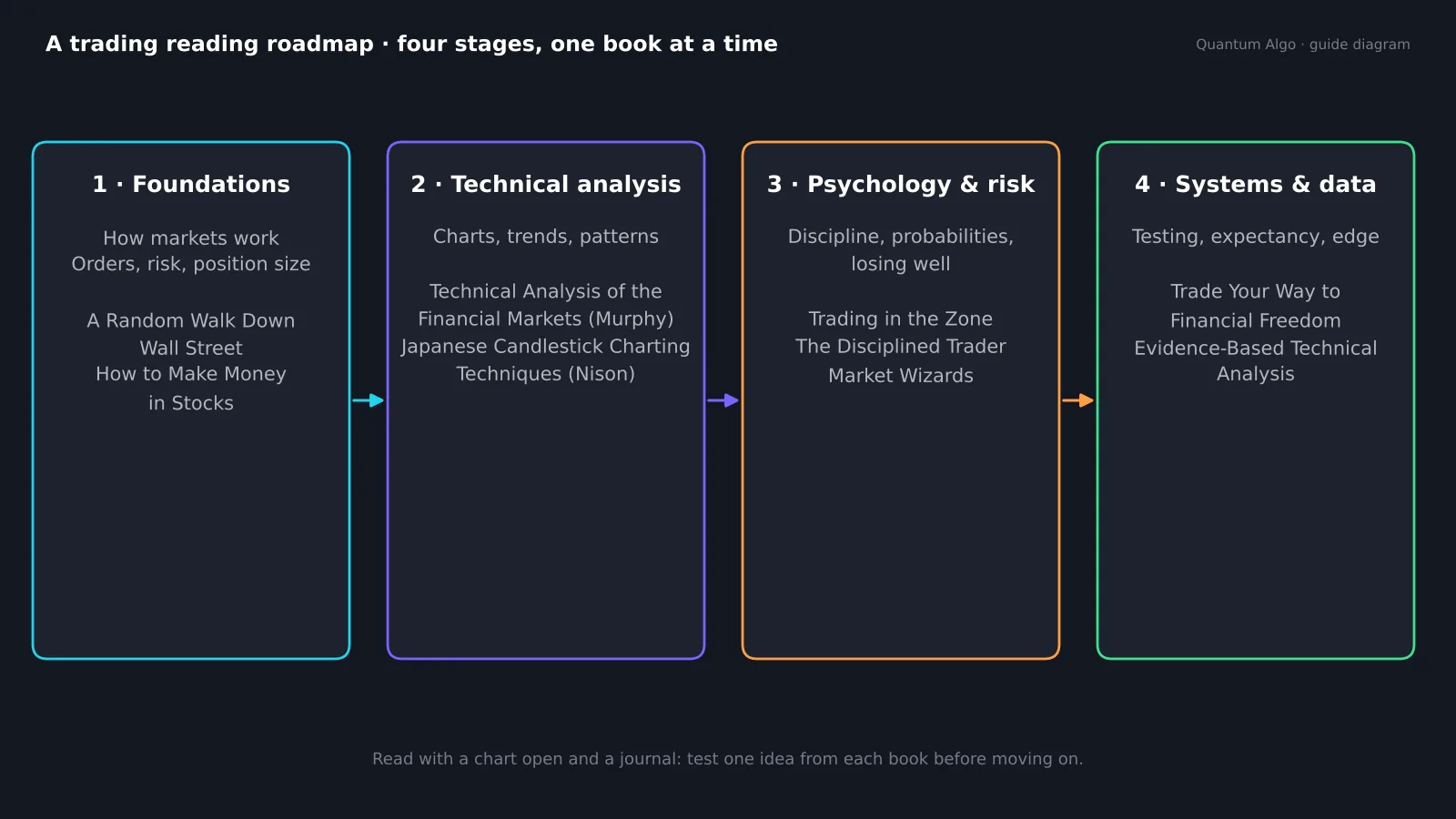
Reading the advanced books first is the most common mistake. A book on statistical testing means little before you know what a trend or a stop is, and a book on psychology lands harder after you have taken a few real losses. Work through four stages, and test one idea from each book on a chart before moving to the next:
- Foundations — how markets and orders work, why most active traders underperform.
- Technical analysis — trends, support and resistance, patterns, indicators.
- Psychology and risk — position size, losing streaks, discipline.
- Systems and data — expectancy, backtesting, avoiding overfitting.
What are the best trading books for beginners?
Start with A Random Walk Down Wall Street: it is not a trading manual, but it explains why beating the market is hard, which is the right starting point. Follow it with How to Make Money in Stocks for a concrete, rules-based approach to buying strong stocks, and Market Wizards, which shows that successful traders use very different methods but share the same habits around risk.
Pair the reading with our how to start trading guide and a demo account; see paper trading.
What are the best books on technical analysis?
Technical Analysis of the Financial Markets by John J. Murphy is the standard reference, covering trends, chart patterns, moving averages, oscillators and intermarket analysis in one volume. Keep it as a reference rather than reading it cover to cover. Japanese Candlestick Charting Techniques by Steve Nison introduced candlestick charts to Western traders and is still the clearest explanation of the main patterns.
Our free technical analysis guide and candlestick patterns guide cover the same ground with live chart examples.
What are the best books on trading psychology?
Trading in the Zone is the most recommended trading book of the last 25 years for one reason: it explains why a trader with a positive edge can still lose by treating each trade as if it must win. Mark Douglas's idea of thinking in probabilities, where any single trade is just one result from a large sample, is the foundation of consistent execution. The Disciplined Trader, his earlier book, is heavier but goes deeper into why losses hurt.
Fooled by Randomness by Nassim Nicholas Taleb is the useful counterweight: it shows how easily luck is mistaken for skill. See also our trading psychology guide.
Which trading book fits your level?
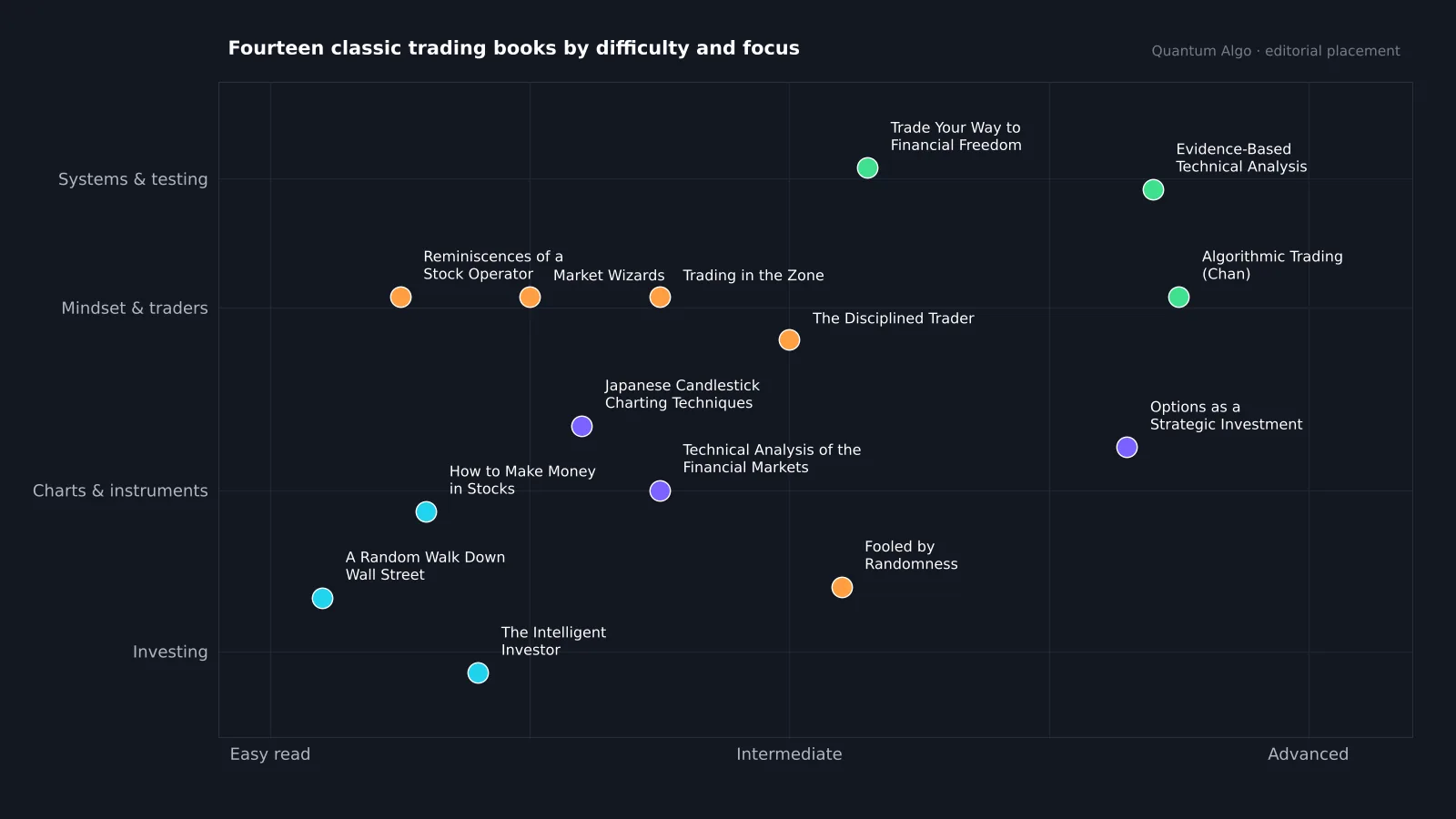
The map places each book by how demanding it is to read and by what it focuses on. Books on the left can be read in a weekend; books on the right reward slow reading with a spreadsheet open. Mindset books cluster in the middle because they are easy to read but take years to apply.
What are the best books on trading systems and backtesting?
Trade Your Way to Financial Freedom by Van K. Tharp is where many traders first meet expectancy, R-multiples and position sizing as the real drivers of results. Evidence-Based Technical Analysis by David Aronson is the most rigorous: it shows how to test a trading rule statistically and how data-mining bias makes most backtests look better than reality. Algorithmic Trading by Ernest P. Chan is a practical introduction to coding and testing mean-reversion and momentum strategies.
These pair well with our backtesting guide and free algorithmic trading course.
Are there good books on day trading?
Fewer than you might expect. Most day trading books are thin on evidence and heavy on screenshots chosen after the fact. The books above teach the skills that matter for any timeframe: reading structure, sizing positions and staying consistent. For the intraday specifics, rules on margin and the realities of the job, regulators' investor pages such as FINRA's guide to frequent intraday trading are more reliable than most paperbacks.
Read our is day trading worth it guide before committing money to the style.
Are trading books still worth reading?
Yes, for a specific reason: the best books are organised arguments written by people with long careers, which videos and social posts rarely are. Market Wizards records decades of experience from traders with verified results, and Evidence-Based Technical Analysis explains testing mistakes that most online strategies still make. Neither can be summarised in a 60-second clip.
Use books for principles and frameworks, and current platforms for tools and data. Our Academy and guides are designed to bridge the two with live chart examples.
Reference data
| Item | Value |
|---|---|
| Oldest book on the list | Reminiscences of a Stock Operator, 1923 |
| Most recent | Algorithmic Trading (Ernest P. Chan), 2013 |
| Market Wizards series | Market Wizards (1989), The New Market Wizards (1992), later volumes |
| Two books by Mark Douglas | The Disciplined Trader (1990), Trading in the Zone (2000) |
| Standard technical reference | Murphy, Technical Analysis of the Financial Markets (1999) |
| Reading stages | Foundations · charts · psychology · systems |
Trading book picker
Choose your level and what you want to improve. The picker suggests three books from the list, in the order to read them.
How do you get the most out of a trading book?
- One idea at a time. Write down the single rule you want to test from each chapter.
- Test it on charts before trading it: mark 30–50 past examples and record what happened.
- Keep a journal of the trades that use the idea; our trading journal guide shows what to record.
- Be wary of hindsight. Chart examples in books are chosen because they worked.
- Reread the classics after a year of trading; Market Wizards and Trading in the Zone read very differently once you have real losses.
Which trading book should you read first?
If you are new, read Market Wizards first: it is enjoyable, it shows that there is no single method, and it makes the case for risk control better than any textbook. Then read Murphy for the chart vocabulary and Trading in the Zone for execution. Move to Tharp and Aronson when you are ready to build and test your own system.
The most recommended trading books are Reminiscences of a Stock Operator, Market Wizards, Trading in the Zone and Technical Analysis of the Financial Markets. Read in four stages: foundations, technical analysis, psychology and risk, then systems and testing. Test one idea from each book on past charts before trading it, and keep a journal. Books on testing, such as Evidence-Based Technical Analysis, are the best protection against strategies that only work in hindsight.
◆ Interactive check
How well do you know the trading classics?
Questions traders ask about trading books
Market Wizards by Jack D. Schwager is the most widely recommended, followed closely by Trading in the Zone and Reminiscences of a Stock Operator.
Start with A Random Walk Down Wall Street for context, then Market Wizards and How to Make Money in Stocks.
Trading in the Zone by Mark Douglas, followed by his earlier book The Disciplined Trader.
Technical Analysis of the Financial Markets by John J. Murphy, with Steve Nison's Japanese Candlestick Charting Techniques for candlesticks.
No. Books give you ideas and vocabulary; skill comes from testing those ideas on charts and with small real positions.
Yes. The markets have changed, but its lessons on speculation, crowd behaviour and cutting losses have not.
Trade Your Way to Financial Freedom by Van K. Tharp explains position sizing, expectancy and R-multiples.
Ernest P. Chan's Algorithmic Trading and David Aronson's Evidence-Based Technical Analysis are good starting points.
References & Related Guides
Read next
- How to Start Trading
- Trading Psychology
- Technical Analysis
- Candlestick Patterns
- Backtesting a Trading Strategy
- Free Algorithmic Trading Course
- Position Sizing
- Risk Management in Trading
- Trading Journal
- Is Day Trading Worth It?