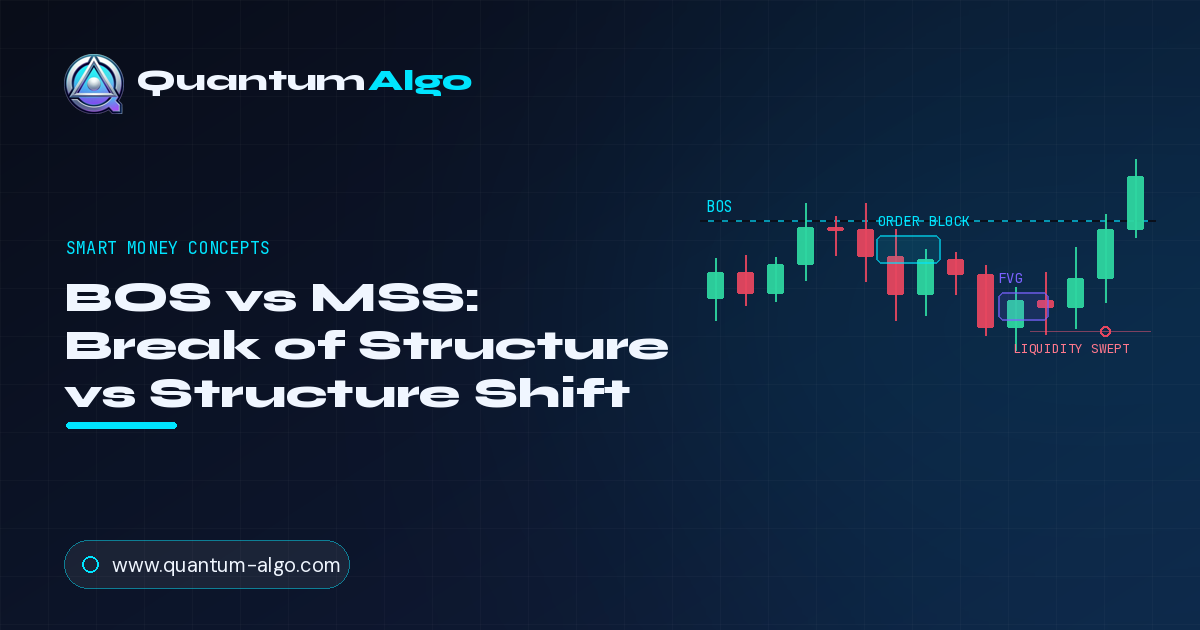
What is a Break of Structure (BOS)?
A Break of Structure is the confirmation that an existing trend is continuing. In an uptrend, every time price closes above the most recent swing high, you have a bullish BOS. In a downtrend, every close below the most recent swing low is a bearish BOS.
BOS is the simplest and most important market structure event. It tells you the trend is still in control — the buyers (in an uptrend) or sellers (in a downtrend) are still in command, and the path of least resistance has not changed.
BOS does not give you an entry signal by itself. It gives you directional bias. If you saw a bullish BOS on the 4H chart, you now know to look for long setups on lower timeframes, not shorts.
What is a Market Structure Shift (MSS)?
A Market Structure Shift is the first signal that the trend has ended. In an uptrend, an MSS occurs when price breaks the most recent swing low instead of pushing higher. In a downtrend, an MSS occurs when price breaks the most recent swing high.
MSS is also called CHoCH (Change of Character) in many SMC frameworks — the two terms are equivalent. CHoCH is more common in ICT-derived material; MSS is more common in pure SMC content.
An MSS does not, by itself, mean the trend is reversed. It means the character of price action has changed — the prior trend is no longer in clean control. The reversal is confirmed only when the next opposing swing point is also broken (which would be a BOS in the new direction).
BOS vs MSS — The Mechanical Difference
Both events are 'price breaks a previous swing point.' What differs is which swing point and in which direction relative to the prevailing trend.
- BOS in uptrend: Price breaks above the previous swing high → trend continues up.
- MSS in uptrend: Price breaks below the previous swing low → trend may be reversing down.
- BOS in downtrend: Price breaks below the previous swing low → trend continues down.
- MSS in downtrend: Price breaks above the previous swing high → trend may be reversing up.
The same chart event (price breaking a swing low) is a BOS in a downtrend but an MSS in an uptrend. Context determines the label.
Why Traders Mix Them Up
Three common errors. First, traders assume any structure break is bullish/bearish in absolute terms — but BOS confirms an existing direction; MSS contradicts it. Second, indicators that label every break as 'BOS' regardless of direction lead traders to misread reversals as continuations. Third, the line between MSS and BOS-in-the-new-trend is fuzzy on choppy charts where structure flips multiple times in a short window.
The correction: always identify the prevailing trend first. Higher highs and higher lows = uptrend. Lower highs and lower lows = downtrend. Only then can you label the next break as either confirming (BOS) or contradicting (MSS) that trend.
Most quality SMC indicators distinguish them automatically — they track the trend state internally and color-code the structure breaks accordingly. If your indicator labels every break the same way, it's not really doing the work.
How to Trade BOS and MSS
BOS is a continuation signal. The trade is to wait for a pullback to a fresh order block or FVG inside the new leg, then enter in the direction of the BOS. Stop goes below the order block (for longs) or above it (for shorts). Target is the next significant liquidity pool.
MSS is a reversal signal. The trade is more aggressive and higher-risk because you're betting against the prior trend. The standard approach is to wait for the MSS, then for a pullback into the order block that caused the MSS, then enter in the new direction. Stop goes outside that order block. Target is the prior swing point.
MSS setups have a lower win rate but higher reward-to-risk because you're catching the reversal early. BOS continuation setups have a higher win rate but more modest reward-to-risk. Both belong in a complete SMC playbook.
Displacement is the tell
The cleanest way to separate a genuine market structure shift from an ordinary break of structure is the strength of the move. A real MSS — the first break against the prevailing trend — is driven by displacement: a sharp, decisive candle that often leaves a fair value gap behind it. A weak wick through a level with no momentum is usually a liquidity grab, not a structural event. Demand displacement before you treat any break as a true shift.
How to trade them in sequence
Think of MSS and BOS as a sequence, not rivals. The MSS marks the first counter-trend break that warns the trend may be over; subsequent breaks in the new direction become BOS that confirm the new trend. The disciplined play is to wait for the MSS at a higher-timeframe point of interest, then enter on the pullback to the order block it created, using the following BOS as confirmation that you are on the right side.
Frequently Asked Questions
Is MSS the same as CHoCH?
Yes. Market Structure Shift (MSS) and Change of Character (CHoCH) describe the same event — the first break against the prevailing trend. MSS is the SMC term; CHoCH is the ICT term. They are interchangeable.
Can a BOS turn into an MSS?
No — they are mutually exclusive labels for the same chart event, depending on trend context. A break of structure either confirms the existing trend (BOS) or contradicts it (MSS). It can't be both at once.
Which is more important — BOS or MSS?
Both are essential. BOS tells you the trend is still active and gives you a directional bias for trend-following entries. MSS tells you the trend may be ending and gives you a heads-up for reversal entries. Trading only one without the other leaves you blind to half the market.
How many candles confirm a valid BOS or MSS?
Most SMC traders use a body close beyond the swing point on the relevant timeframe — a wick break alone is not enough. Some demand a full close-and-hold (the next candle also closes beyond) to filter false breakouts.
What is the difference between BOS and MSS?
A break of structure (BOS) continues the existing trend, while a market structure shift (MSS) is the first break against it — the earliest signal of a potential reversal. BOS confirms the trend; MSS warns it may be ending.
How do you confirm a real MSS?
Look for displacement. A genuine shift breaks structure with a sharp, decisive move that often leaves a fair value gap; a weak wick through a level with no momentum is usually a liquidity grab, not a true shift.
Related Reading
- → Smart Money Concepts Explained
- → ICT Trading Strategy Guide
- → Liquidity Sweeps & Stop Hunts
- → Smart Money Concepts Complete Guide
Trade these concepts with Quantum Algo
Quantum Algo identifies order blocks, FVGs, BOS/MSS, mitigation status, and PD zones automatically — every concept in this article, plotted live on your chart with confirmed-on-close signals.