What is a Supply or Demand Zone?
A supply zone is a price area where selling pressure overwhelmed buying pressure, causing a sharp move down. A demand zone is the inverse — buying overwhelmed selling, causing a sharp move up. Both are drawn as horizontal rectangles on the chart.
The drawing convention varies by trader: some use the consolidation base before the move, some use the most recent opposite-colored candle, some use the wick-to-body range. There is no universal rule.
Supply/demand trading predates Smart Money Concepts. It descends from Sam Seiden's institutional supply/demand methodology and earlier wholesale/retail price theories. The core idea — that price returns to areas of unfilled orders — has been retail trading folklore for decades.
What is an Order Block?
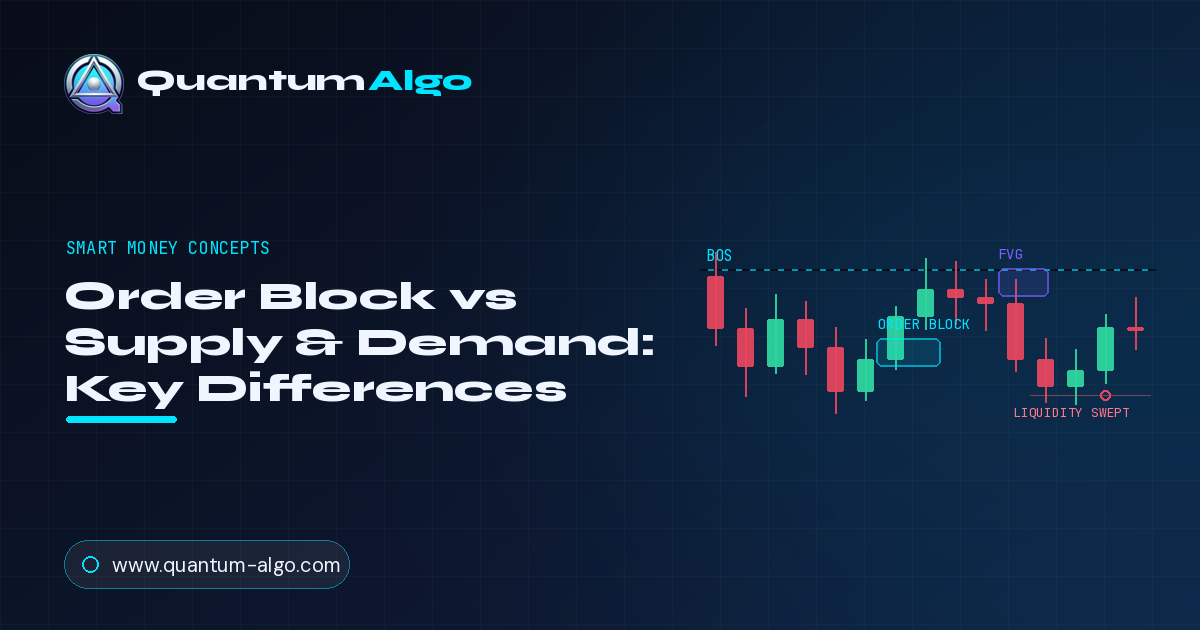
An order block is the last opposite-colored candle before a strong displacement that causes a Break of Structure. For a bullish order block, find the last bearish candle before a strong bullish move that breaks the prior swing high. For a bearish order block, find the last bullish candle before a strong bearish move that breaks the prior swing low.
The defining requirements are precise: (1) opposite color from the displacement, (2) immediately precedes the displacement leg, (3) the displacement must break market structure. If any of these three is missing, it's not a valid order block by SMC rules.
Order blocks are interpreted as institutional accumulation or distribution zones — the last candle where institutions absorbed liquidity before pushing price aggressively. The strict formation rule is what makes them tradable: every order block has the same structural meaning.
The Real Difference
Two differences matter in practice. First, formation rules: supply/demand zones are subjective; order blocks have objective criteria. Two traders looking at the same chart will draw different supply/demand zones but should agree on order blocks.
Second, structural context: order blocks require a Break of Structure to validate them. Supply/demand zones don't — they're valid wherever price reversed. This means order blocks are filtered by trend, while supply/demand zones include both with-trend and counter-trend areas.
The result: order blocks are scarcer (5-15 valid zones on a typical 4H chart), more aligned with institutional flow, and easier to systemize. Supply/demand zones are abundant (often 30+ on the same chart), more inclusive of every reversal, and rely heavily on subjective filtering.
Which Performs Better?
Honest answer: order blocks have better statistical properties on backtests because the formation rule filters out noise. Supply/demand zones have a longer track record and more flexibility but require more discretionary filtering to work consistently.
If you're a discretionary trader with years of experience reading charts, supply/demand zones offer more setups and you have the judgment to filter them. If you're newer or trying to systemize your edge, order blocks give you objective rules to follow.
Many SMC traders use both: they identify supply/demand zones as the 'broad area of interest' and look for order blocks within those zones as the precision entry. This combines the broad context of supply/demand with the precise entry of an order block.
The Trading Mechanics
Both setups trade the same way: wait for price to return to the zone, watch for rejection (wick, engulfing candle, lower-timeframe MSS), enter in the direction of the original move, stop loss outside the zone, target the next opposing zone or liquidity pool.
Where the frameworks diverge in practice is on invalidation. A supply/demand zone is generally considered invalidated after price closes through it. An order block has a more nuanced rule — many SMC traders consider an order block 'mitigated' (and thus less valid) after price has tapped into it once, even if it didn't close through. The strictest interpretation says an order block is fresh only on its first test.
This invalidation rule is one of the reasons order blocks tend to outperform supply/demand zones: by definition, you're only trading the highest-probability tap, not all subsequent tests.
The precision difference in practice
Supply and demand zones and order blocks point at the same idea — areas where institutions transacted — but at different resolutions. A supply/demand zone is a broad area; an order block is the specific candle (typically the last opposing candle before a displacement move) that pinpoints where within that zone the real activity occurred. The order block gives you a tighter entry and a smaller stop, which is why SMC traders favour it for execution.
When to use each
Use the broad supply/demand zone for context and bias — it tells you the region price is likely to react in. Then drop to the order block for the precise entry once price arrives. They are complementary: the zone frames the opportunity, the order block executes it. Trying to enter off a wide zone alone usually means a needlessly large stop and a worse reward-to-risk.
Frequently Asked Questions
Are order blocks just renamed supply and demand zones?
Not quite. Order blocks have stricter formation rules — they must be the last opposite-colored candle before a structure-breaking displacement. Supply/demand zones are any reversal area without that constraint. Every order block is a demand or supply zone, but not every supply/demand zone is an order block.
Can I use both order blocks and supply/demand together?
Yes, and many SMC traders do. Use supply/demand zones for big-picture context and order blocks for precision entries. The two systems complement each other when used in the right roles.
How long does an order block stay valid?
Strict SMC says an order block is valid only on its first test (the 'mitigation' rule). More permissive interpretations allow multiple tests until price closes fully through the zone. Backtesting suggests first-touch entries have a meaningfully higher win rate.
Do I need an indicator to find order blocks?
No, but it helps. Manually identifying order blocks requires confirming the displacement, the structure break, and the opposite-color rule on every potential zone. An indicator does this automatically and avoids subjective drawing — which is the whole point of having strict formation rules.
What is the difference between an order block and a supply and demand zone?
They mark the same idea at different precision. A supply and demand zone is a broad area where institutions transacted; an order block is the specific candle — usually the last opposing candle before a displacement move — that pinpoints where within that zone the activity occurred.
Is an order block better than a supply and demand zone?
For execution, yes — the order block's precision gives a tighter entry and smaller stop. Use the broad supply and demand zone for context and bias, then the order block for the precise entry once price arrives.
How do you identify an order block?
Find the last down-candle before a strong bullish move (a bullish order block) or the last up-candle before a strong bearish move (a bearish order block). The displacement away from it confirms institutional intent.
Related Reading
- → Order Block Trading Complete Guide
- → Supply Demand Zones vs Order Blocks
- → Order Blocks Playbook
- → Smart Money Concepts Complete Guide
Trade these concepts with Quantum Algo
Quantum Algo identifies order blocks, FVGs, BOS/MSS, mitigation status, and PD zones automatically — every concept in this article, plotted live on your chart with confirmed-on-close signals.